Wednesday, November 27, 2019

Morgan S. Freeman: A Man of Courage and Honor - Part 2

Very interesting closeup view of Martin B-26C Marauder.
==Source== http://www.maxwell.af.mil/au/afhra/photo_galleries/merhar/Photos/01097628_035.jpg

Staff Sgt. Morgan S. Freeman in his WWII uniform c. 1943
Morgan Earl Freeman Collection: 2019.061.001
Ten days after the mission, The Shreveport Times printed the news that Freeman was missing in action. Then, on June 4, 1943, The Shreveport Times announced that two Bossier City soldiers were officially listed as prisoners of war by the War Department. The report listed Staff Sgt. Freeman as a POW of the German government and that he was “slightly wounded.”

By mid-July Freeman's, “parents received 18 cards and three letters from shortwave radio listeners in 8 states. These messages have all told of SERGEANT FREEMAN speaking from Europe and telling that he was safe, well and receiving good treatment. He told that he would soon be assigned to a German prison camp and would be allowed to correspond with his relatives,” according to The Shreveport Times, July 16, 1943.

That same month, Freeman sent a card to his parents, which did not make it to them until December. According to the Dec. 19, 1943 issue of The Shreveport Times, Freemans card stated, “that he had been out of bed a week at that date and asked that his family keep in touch with the Red Cross. He said that he was getting along well and was taking exercises. It is presumed that he meant he was taking exercise after being a hospital patient from May to July.”

Five months went by without any word on Freeman’s condition. Was he still in the POW camp, and how was he doing? Finally, his parents received a telegram from Staff Sgt. Frank Batterson stating, “Just arrived back in this country from prisoner of war camp where your son is held by Germans. His health is good and he sends his love to all.” Right after the telegram came, the Freeman’s received a letter from their son reassuring them “he was fine and had received their letters, packages and pictures.”

The Shreveport Times later revealed that in Freeman’s letter to his parents, dated May 24, 1944, he told them that Staff Sgt. Frank Scorsune of Bossier City had just arrived at the camp a few days earlier and caught Freeman up on the latest news of friends and family back home in Bossier City.

On April 26, 1945, The Shreveport Times announced, “Three Bossier City boys, MILTON J. DEVILLE, MORGAN FREEMAN AND FRANK SCORSUNE, were held prisoner in a German camp, Stalag 17B, which was among those listed yesterday by the war department as liberated by Allied armies.” This news was confirmed a month later when Freeman’s parents were informed directly by Freeman in a letter that “he had been freed from Stalag 17-B, German prison camp, and that he would be home ‘just as soon as I can make it.’ He wrote that he was in good health.”

Although the letters and the reports to the newspapers painted a nice picture of POW camp, the reality is that prisoners often did not receive the best treatment, and food was scarce. When Freeman enlisted in the U.S. Air Corps, he weighed 148 lbs., but after two years in the German POW camp, Stalag Luft 17B, he weighed only 80 lbs.

Freeman received an honorable discharge from his military service on Oct. 18, 1945, and returned home to Bossier City. George Dement introduced Freeman to Georgia McMillan, who he married in 1947. In 1948 their first and only child, Morgan Earl Freeman, was born.

Thanks to Freeman’s son, Morgan, we know that Freeman did not remember the crash,
and as a result of it, he suffered a leg injury losing some of his hamstring on one leg, and he
sustained burns. We also learned that he did not talk about his time overseas with just anyone;
most of what Morgan learned about his father’s time in the war was told to him by his mother.
Despite his injuries, Freeman never walked with a limp, and he worked as a self-employed
contractor installing flooring and countertops, a trade he learned from his father-in-law.

To learn more about Bossier Parish during wartime or to research Bossier Parish veterans
in your family, visit the Bossier Parish Libraries History Center at 2206 Beckett St., Bossier
City.

By: Amy Robertson

Wednesday, November 20, 2019

Morgan S. Freeman: A Man of Courage and Honor - Part 1

Morgan Samuel Freeman was born on Jun. 11, 1915, in Ruston, La. to James and Elizabeth Freeman. He had two brothers and four sisters. In the early 1920s, the Freeman’s moved to Bossier City, where Freeman lived the rest of his life, which ended suddenly on “a beautiful, sunny January day,” according to Freeman’s son Morgan Earl Freeman. He died on Jan. 6, 1972, of a brain aneurysm while at the VA medical center when he was picking up a prescription.

Bossier High School 1932 graduating class.
Morgan S. Freeman is on the second row on the right.
Gaye Englad Colelction: 2018.034.005
Freeman graduated from Bossier High School in 1932, where fellow students voted him as the "wittiest boy" of his senior class. He was a member of the Bossier City Athletic Club, where he learned to box, training under Babe Kennedy. By the time he started college at LSU in Baton Rouge, his boxing skills were already well known in north Louisiana.

As a freshman at LSU, he earned the title as the champion of the featherweight fighters of the LSU freshman team and was declared “the best prospect” that Captain Brink, coach of the team, had ever had to that point. He completed three years at LSU, where he continued his boxing career and for at least the next few years afterward. After college, he worked in the oilfield in Rodessa, LA.

Staff Sgt. Morgan S. Freeman in his WWII uniform c. 1943
Morgan Earl Freeman Collection: 2019.061.001
On Jan. 22, 1942, Freeman enlisted in the U.S. Air Corps. After gunnery school, Freeman was offered a position as an instructor, but he declined this opportunity. Instead, he served on the 452nd Bomb Squadron, and in March of 1943, he was sent overseas to Rougham, Bury St. Edmunds, England, where he was an engineer/gunner for the 322nd Bomb Group commanded by Lt. Col. Robert M. Stillman.

Freeman was on the B-26 Marauder 41-17982 that was shot down on a low-level mission on May 17, 1943. The goal of the mission was to raid a Velsen power station in IJmuiden, Holland. The Marauder plane was hit by German flak and crashed into dunes west of Rozenburg, Holland killing three of the six crewmembers. The surviving crew members were Lt. Col. Robert Stillman, pilot; Sgt. Clyde D. Willis, radio operator/gunner tech.; and Staff Sgt. Morgan S. Freeman, engineer/gunner were pulled from the wreckage by Germans and placed in a prisoner of war camp.

In light of it being aviation history month, I feel it necessary to explain in greater detail what happened on May 17, 1943, as it served as a pivotal point in the history of the B-26 Marauder.
The B-26 Marauder that Freeman was on that day was only one of the 11 Marauders that went on this mission. All but one of these 11 Marauders were shot down by flak on that mission. The only plane not shot down that day experienced mechanical problems and turned back to base. There was a total of sixty airmen shot down in enemy territory, 22 survived as prisoners of war.

As a result of this ill-fated mission, tactics of how the military implemented the B-26 changed. The 322nd Bomb Group was stood down, and the B-26 Marauder program was put on
hold temporarily. Flying the B-26 at low-level was deemed suicidal and was only used at
medium levels from then on.

Be sure to pick up the Bossier Press-Tribune next week to read the second part of
Freeman’s ordeal. Remember, if you are researching veterans in your family tree that are from
Bossier Parish, be sure to visit the Bossier Parish Libraries History Center at 2206 Becket St.,
Bossier City.

By: Amy Robertson

Wednesday, November 13, 2019

America's Heroes

America, the great nation where within our borders live many different ethnic groups. Our nation permits individuals of all ethnicities the right to pursue the American dream: life, liberty and the pursuit of happiness. These rights are often taken for granted, but if not for price that was paid by many men and women who fought to protect or inalienable rights we as a nation would not be a strong as we are today. Standing united our nation gives thanks for those men and women who fought so selfishly to ensure our citizens free rights. Today we stand together to give Thanks to our Veterans for their unwavering courage and honor for our great nation.

President Woodrow Wilson proclaimed November 11, 1919 as the first commemoration of Armistice Day. Speaking the following words he honored the men and women who fight and fought for our freedoms: To us in America the refection’s of Armistice Day will be filled with solemn pride in the heroism of those who died in the country’s service and with gratitude for the Victory, both because of the thing which it had freed us and because of the opportunity it had given American to show her sympathy with peace and justice in the councils of the nations…”

In 1954, President Dwight D. Eisenhower officially changed the name Armistice Day to Veterans Day. The Uniform Holiday Bill of 1971 passed by Congress moved the celebration of Veterans Day to the fourth Monday in October, but do to the historical significance of Veterans Day President Gerald Ford returned Veterans Day to November 11, in 1975. It is on this date every year that America offers it Respect and Gratitude to those how have served our country,both past and present.

With World War II in full force it was essential that men and women of the United States take a stand to protect our great nation. One individual answering the call was Charlie W. Dieball. Volunteering for service Charlie Dieball enlisted in the United States Marine Corps on January 5, 1940. After completing basic training Pvt. Dieball was issued orders to participate in action against the enemy within the Asian-Pacific Theater. In July 1940, Pvt. Dieball began engaging the enemy in action. For over the coming year Pvt. Dieball continued in battle showing great courage, honor and faithfulness to the United States. In December of 1941 Pvt. Dieball participated in the Bataan, P.I., a battle that led to great loss for all who participated. May 6, 1942, Pvt. Dieball became a Prisoner of War. Arriving at the Hoten/Mukden Prisoner Of War Camp November 11, 1942, Pvt. Dieball remained imprisoned until August 20, 1945.

On August 16th, 1945 the Hoten/Mukden POW Camp was liberated by an American six-man American OSS (Office of Strategic Services) team that parachuted into Mukden to liberate the camp. Soviet troops entered Mukden a few days later and helped the evacuation of POW's.

At the time of his release Pvt. Dieball had in his possession two small note pads, and a pencil worn to the numb, one he had used to log the daily life in camp. His entries depict life inside the camp and the atrocities the men were forced to endure. With the second notepad Pvt. Dieball recorded the names and addresses of the men he came into contact with. On some occasions there are recorded entries of death dates of fellow prisoners. These entries bring to life the conditions of which these brave men endured and their will to live. Pvt. Dieball’s detailed history of the work, clothing, and lack of food provided are a vivid reminder of the price men payed for freedom.

Prior to his discharge Pvt. Dieball was promoted to the rank of Corporal and honorably discharged from the United States Marine Corps on the 15th January, 1946. The atrocities that Cpl. Dieball and thousand’s other endured in our fight for freedom bare reason that our great nation proudly celebrate Veterans Day.

The United States has stood proudly against its’ enemies with each passing century. New battles have risen but our nation’s brave military men and women continue to answer the call. The unwavering love of country, honor, selfishness, and commitment these individuals demonstrate stands tall in our nation today. America is secure in knowing that “we are secure” for our men and women in the military continue to stand for our freedoms. It is for these reasons that honoring our Veterans past and present is an honor and a privilege. Please join the Bossier Parish Libraries History Center in saying THANK YOU to our military personnel for continuing to stand between the United States and those who oppose us.

By: Ann Toellner

Wednesday, November 6, 2019

Bossier High Alumnus Becomes Country Star

Trade ad for David Houston's single "Livin' in a House Full of Love," Nov. 13, 1965.
Epic Records [Public Domain]; https://commons.wikimedia.org/wiki/File:David_Houston_(1965).png
David Houston was an American country music artist, television performer, and actor who rose to fame in the 1960s. He was born on Dec. 9, 1935, in Bossier City to Ora Eugene “Gene” and Beatrice Lee Houston as Charles David Houston, and he was a descendant of Sam Houston, the first president of the Republic of Texas and Confederate General Robert E. Lee. His godfather was 1920s pop singer Gene Austin.

On a side note, Gene Austin’s daughter, actress Charlotte Austin, visited the Houston’s here in Bossier City during the summer of 1953 when she served as an honorary judge for the Miss Physical Culture contest at the Municipal Auditorium.

Before graduating from Bossier High School in 1953, Houston was already performing locally at benefits and programs. In Nov. of 1952, Houston performed at a talent show during the 13th annual Kiwanis Club benefit raising money to send underprivileged children to the Kiwanis summer camp on Caddo Lake.

After the performance, The Times published an article by Pericles Alexander, who wrote, “With no show complete without a fold artist, ‘Hits and Bits’ presented David Houston, who yodeled and sang two classics, ‘The Mailman Blues’ and ‘Anytime.’ This chap sings as though he’s headed for ‘Louisiana Hayride’ fame and that ain’t bad in these Ark-La-Tex.” Little did he know that, while still a teenager, Houston would become a regular on the Louisiana Hayride.

David Houston performing at the KWKH Louisiana Hayride c. 1957.
Houston rose to fame in 1963 when his first hit “Mountain of Love” was released and rose to the number two spot of the Billboard’s Hot Country Singles Chart. The song he is most famous for is “Almost Persuaded,” which was released in 1966 and quickly became the number one song on the Billboard’s Hot Country Singles chart and an international hit.

“Almost Persuaded” remained in the number one spot of the Billboards for nine straight weeks. Over the next forty years, no other song reached the top of the charts and stayed at the top for as long as “Almost Persuaded” did until Taylor Swift’s 2012 hit “We Are Never Ever Getting Back Together,” which spent ten weeks in the number one spot.

Houston won two Grammys in 1967 for Best Country & Western Recording and Best Country & Western Performance, Male for “Almost Persuaded.” He was the first country artist to receive two Grammys in one year for the same song. From that time until 1973, Houston had a string of top-five singles, including six more number one hits, one of which was a duet with Tammy Wynette. He also performed duets with Barbara Mandrell on several of her early hits. His last Top 10 country hit came in 1974 with “Can You Feel It,” though he continued making records until 1989. Throughout his career, Houston released 27 albums and about 60 singles.

In 1971 Houston became a member of the Grand Ole Opry in Nashville, TN. His last appearance on the show was on Nov. 6, 1993. On Thanksgiving Day, he suffered a brain aneurysm and remained in a coma at the Bossier Medical Center where he died on Nov. 30, 1993. At the time of his death, Houston was under contract with the federal government to tour South Korea, entertaining U.S. troops.

Houston is buried in Bossier City in the Rose-Neath Cemetery, next to his wife Katherine
Jane Guillotte of Shreveport. A country singer and songwriter with the stage name of Kathie
Raye. His side of the headstone reads “Almost Persuaded,” and her side reads “Was Persuaded,”
with “The Greatest duet partners in life” on the rear of the headstone.

Visit the Bossier Parish Libraries History Center at 2206 Beckett Street, Bossier City, to
learn more about David Houston or other famous people from Bossier Parish.

By: Amy Robertson

Friday, November 1, 2019

This Month in Bossier Parish History


November: Through the Years

Nov 2019: High School Basketball season begins!
*Please enjoy the photos of basketball teams from around our parish.
C.1900’s: Alden Bridge Women's Team.  Girls are dressed in middy blouses
 and skirts, and carry pennants with "Alden Bridge" on them. The young man is the coach.
2000.070.005 Mary Coyle Collection
1932: Elm Grove High School Basketball Team
1st row L to R: James Durham, ?, ?, ?, Curtis Hutchins
2nd row L to R: Tandy Key, James Br___, Mr. Jacks (principal), Claude D___, Clarence D___.
1999.104.007 Rev. Glen Nelson Collection


Nov. 11  Veterans Day
Veterans Day, formerly known as  Armistice Day, was originally set as a U.S. legal holiday to honor the end of World War I, which officially took place on November 11, 1918. ... With the approval of this legislation on June 1, 1954, Nov. 11 became a day to honor American veterans of all wars.
Jun. 2, 1954: The Times
1916: William Hollis Bradford, trumpeter, Troop R. 6th Cavalry
2002.035.206McKim Collection
1918: Postcard of Allie Mattison "Bud" Merritt 1892-1964 in World War I uniform. Son of Lawson Taylor Merritt and Narcissa Roach. Message reads "Hello! Mary Belle, How are you. If crows are bothering watermelons just put this on the string."
2002.004.033  Johnette Parham Collection


Nov. 17, 1955: The announcement was made for the dedication of a new elementary school.  R.V. Kerr was dedicated in honor of Robert Vance Kerr on Nov. 10, 1955.  He retired in 1956 after serving 35 years as the Bossier Parish School's superintendent. 
R.V. (Robert Vance) Kerr: was a member of the Bossier Parish School Board as the superintendent for 35 years, retiring in 1956.  
He also served in the military during WWI and WWII.
Picture: R.V. Kerr dedication in the 1956 Bossier High School yearbook

Nov 17, 1955: Bossier Banner


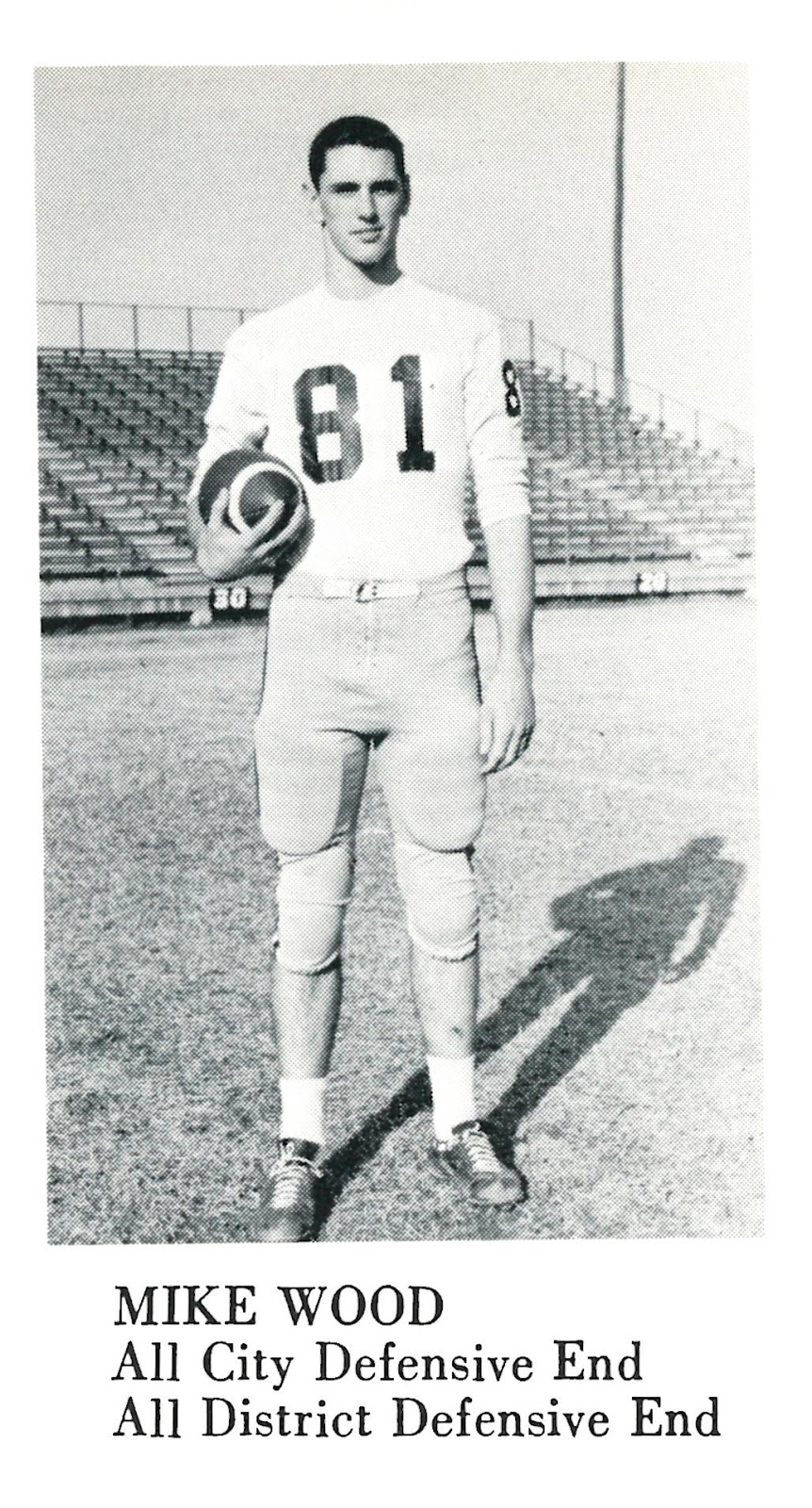
Nov. 28, 1968: In memory of Michael D. Wood (Mike)