Wednesday, May 26, 2021

First Asian American Enlists as Cadet at Barksdale

At the beginning of World War II, there were only 55 enlisted pilots in the U.S. Army Air Corps. At the end of 1941, the Army lowered cadet education requirements allowing enlisted men to apply to flight training. Instead of needing a college degree, those with a high school diploma were allowed to enlist for flight training. Between 1941 and 1942, over 2,580 enlisted men became pilots.
Staff Sergeant Samuel "Jake" Mardock


During that time, Samuel "Jake" Mardock, Jr. proudly became the first Chinese to be accepted as a flying cadet at Barksdale. The following announcement appeared in "The Shreveport Journal" on Thursday, Jan. 29, 1942, with the heading, "Chinese Enlists As Flying Cadet: Sam Mardock, Jr., of Tyler Accepted for Army At Barksdale Field."

"Sam Mardock, Jr., 26-year-old Chinese, of Tyler, Texas, Wednesday became the first of his race to be accepted at Barksdale Field as a flying cadet.

"'Now maybe I'll get a crack at those Japanese,' Sam said when informed that he had met cadet requirements and been accepted.

"Julian, 24-year-old brother of Sam, was accepted recently at a Texas air base for army cadet training, 'and when they lowered cadet educational requirements I didn't lose any time getting at Barksdale to try and make it myself,' Sam said.

"Barksdale's first Chinese cadet is the son of Mr. and Mrs. Samuel Mardock of Tyler, both of whom were born in China, where they have many relatives.

"' But we don't hear from them much anymore, because of the war the Japanese are making,' Sam said.

"He took civilian flight training in 1938, and has more than 200 hours of flying to his credit. He attended Tyler Junior college. His brother, Julian, is a graduate of the University of Texas."

Sam and his brother Julian were among the first Chinese-Americans to train and become official American Aviation Corp Pilots for the United States Army. After receiving "winged commando" training, Staff Sergeant Sam Mardock was stationed at Luke Airfield, AZ. During his time in service, he piloted small planes and gliders and was an aerial gunner.

The Mardock family was the first Chinese family to settle in Tyler, TX, in the late 1800s. Samuel Mardock, Sr. immigrated to the United States at 13 or 14-years-old working as a farmhand where he learned to speak, write, and read English. Then, he found work on the railroad, which eventually brought him to Texas. He settled in Tyler as a pioneer, started a restaurant, and eventually was able to bring his wife over from China.

According to asianpacificheritage.gov, there are more than 300,000 living Asian American, Native Hawaiian, and Pacific Islander American veterans. The Mardock brothers are no longer living but are remembered for their service to their country during WWII.

What do you want to know about Bossier Parish's history? Or, perhaps you have important information or artifacts about Bossier Parish History that you would like to share. Donations are a large part of our collection and are vital in helping us preserve Bossier Parish's history. Whether researching or interested in adding to our collection, visit, call or email the Bossier Parish Library History Center. We are at 2206 Beckett Street, Bossier City, 318-746-7717, history-center@bossierlibrary.org.

By: Amy Robertson

Wednesday, May 19, 2021

WWI and Local American Red Cross Societies

Book, "The Red Cross" by Clara Barton, 1898.
Mae Helverson Collection: 2015.010.001
This Friday marks the 140th anniversary of the American Red Cross, which was founded by Clara Barton and "a circle of her acquaintances." When World War I broke out in the summer of 1914, it experienced phenomenal growth as "the number of local chapters jumped from 107 in 1914 to 3,864 in 1918 and membership grew from 17,000 to over 20 million adult and 11 million Junior Red Cross members." Bossier Parish being the patriotic and charitable community that it is, established three Red Cross Societies during the spring of 1917.

It all began when a movement was started in April that year by the Shreveport Lion's Club during a luncheon at the Hotel Youree to establish a chapter of the National Red Cross in Shreveport. Immediately following this organization, Red Cross Societies began organizing throughout Bossier Parish. These societies served as auxiliaries to the Shreveport chapter. The first two societies were formed in Benton and Plain Dealing that May, then in Bossier City in July.

That June, the American Red Cross announced its first War Fund drive to raise 100 million dollars and reached this goal in one week. But that did not slow down the efforts of the local Red Cross Societies from increasing memberships and asking for donations. Including Drs. D. J. McAnn of Atkins and S. E. Prince of Curtis, who traveled together through the parish collecting subscriptions for the benefit of wounded soldiers and sailors, provided through the American Red Cross Society.

American Red Cross Poster, c 1918.
By Artist Wladyslaw 
T. Benda

Retrieved from Library of Congress,
<www.loc.gov/item/2002708897/>.

When fall came and the threat of winter just around the corner, an urgent request was made to the Red Cross headquarters by Maj. Grayson Murphy, head of the American Red Cross in France. The request was for the immediate shipment of one million five hundred thousand each of warm knitted woolen sweaters, mufflers, wristlets, and socks. The Shreveport chapter was tasked with supplying five thousand of each article listed. To meet this quota, they needed the cooperation of every woman in the six parishes under its jurisdiction. Naturally, the women of Bossier bought wool and got busy knitting.

The Caddo-Bossier Red Cross chapter published a statement at the end of 1918, giving an account of its total receipts and disbursements from the time of organization, in spring of 1917, through the end of Oct. 1918. The various receipts totaled to $115,186.73 and the disbursements totaled $80,323.47, that’s equivalent to $1,408,996 today. They also reported 13,410 knitted garments, 29,778 hospital garments, 14,544 refugee garments, and 155,783 surgical dressings made by local women and distributed to the soldiers and sailors.

For 104 years, the local chapter of the American Red Cross has been in operation. They "alleviated human suffering in the face of emergencies by mobilizing the power of volunteers and the generosity of donors. Its members offer aid and resources to others to prevent, prepare for and respond to emergencies through immediate assistance, education, outreach and training. Today, in addition to domestic disaster relief, the American Red Cross offers educational programs that promote health and safety, support and comfort for military members and their families, and provide international relief and development programs."

By: Amy Robertson

Wednesday, May 12, 2021

Cottage Grove Holds First Columbian Club Affair

Heinze, Hermann, A. Zeese & Co, and World'S Columbian Exposition. Souvenir map of the World's Columbian
Exposition at Jackson Park and Midway Plaisance, Chicago, Ill, U.S. A. Chicago: A. Zeese & Co., Engravers, 1892.
Map. Retrieved from the Library of Congress, <www.loc.gov/item/2010587004/>. 

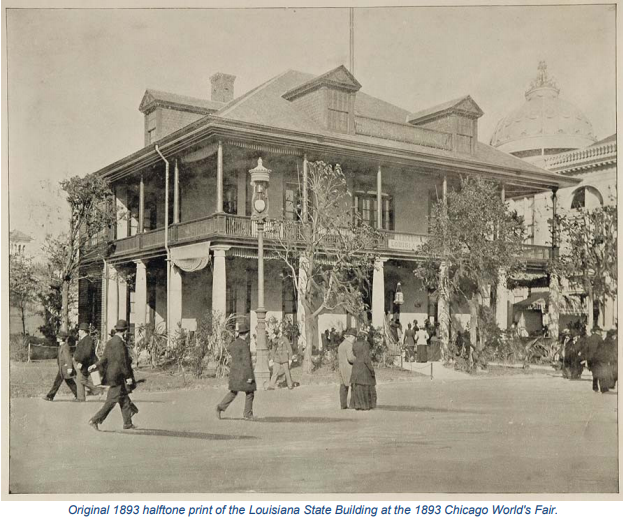
Aug. 10, 1893, was Louisiana Day at the World's Fair: Columbian Exposition in Chicago, IL. This world's fair celebrated the 400th anniversary of Christopher Columbus' arrival in the New World in 1492. Dedication ceremonies for the fair were held on Oct. 21, 1892, but the fairgrounds were not open to the public until May of 1893 and ran for six months closing in Oct.

The planning began nearly ten years before the dedication ceremony. Many prominent civic, professional, and commercial leaders from across the nation participated in the fair's financing, coordination, and management. The total cost of the fair was approximately $46,000,000, which is the equivalent of nearly 1.4 billion dollars today. There were forty-six countries, 34 U.S states, and 4 U.S. territories with buildings at the exposition.

To have a state building or headquarters meant having a proper representation of their resources at the world's fair. Early estimates suggest that the appropriation needed was at least $75,000. But, the Louisiana legislature only appropriated $36,000, and $12,000 of that was earmarked for the two commissioners, which ruffled quite a few feathers. Since $24,000 was not enough money to provide proper representation, Columbian Clubs began to form throughout the state.

In an article appearing in the "Weekly Shreveport Times" on Mar. 5, 1893, the writer stated that "Louisiana was too poor – floods and legislative inaction throwing the burden of making a display upon the women of the state." An article in "The Bossier Banner" on Aug. 11, 1892, supports this statement; it reads as follows:

"It is to our credit as a parish that the ladies, always active and enthusiastic in any good cause, are evincing interest in organizing for the purpose of raising funds for our State exhibit at the World's Fair. That we have at present two Columbian Clubs, one at Cottage Grove, and one at Benton, both organized with good membership, surely speaks well for the ladies of said places and vicinity, reflecting great credit on their public spirit."

Martha "Mattie" Gilmer Swann c. 1905
Ann Fitzpatrick Graham Collection: 2003.007.016D
The writer goes on to list the names of the officers for both clubs, all women. And then admonished, "Surely all will help this cause, and before snother [sic] month rolls by we hope to have not two Columbian Clubs in Bossier parish, but a dozen, if need be, that every community of ladies may do what they can to help make a 'record' for our parish in the State work."

Earlier that year, Dr. W. M. Abney, President of the Police Jury, with the unanimous approval of the jurors, appointed Martha “Mattie” Swann as the parochial delegate from Bossier Parish to the World's Fair. She was instrumental in the organizing of these local clubs. Shortly after the article ran announcing the two Bossier Parish clubs, she visited Plain Dealing, where a third Columbian Club was organized in this parish. Again, the officers of the club were made up entirely of women from that community.

These clubs held elaborate affairs to raise money for the Louisiana State Exhibit building at the World's Columbian Exposition. The Columbian Club at Cottage Grove held the first of these affairs at Swannhaven plantation, home of Mattie Swann. Guest enjoyed supper and entertainments complete with recitations, tableaux, soliloquies, instrumental duets, horseshoe quartets, and other musical numbers. The night was concluded with an address from Mrs. Julia Rule, Pansy of the Times, "to arouse enthusiasm in our State Columbian work."

Swannhaven Plantation, Cottage Gove, Louisiana, c. late 1800s
Ann Fitzpatrick Graham Collection: 2003.007.007

Next, the Benton Columbian Club prepared a feast that was given at the Union Hotel supper-room. The write-up in the “Shreveport Times,” provides the following description. “The contributions to this supper were most generous, and some responded who were not members of the club; long tables groaned ‘neath the weight of delicious salads, cakes, beautiful jellies and appetizing pickles – all ‘home products’ – as were the barbecued meats, daintily trussed turkeys and chickens galore!”

Both events were filled with dancing and merriment, and the ladies' efforts were rewarded by the “...large and appreciative crowds, whose patriotism and pride in our fair State’s representation at the coming magnificent exposition...”
Louisiana Day, Aug. 10, 1893, World's Columbian Exposition, Chicago, IL
Source: Digital Research Library of Illinois History

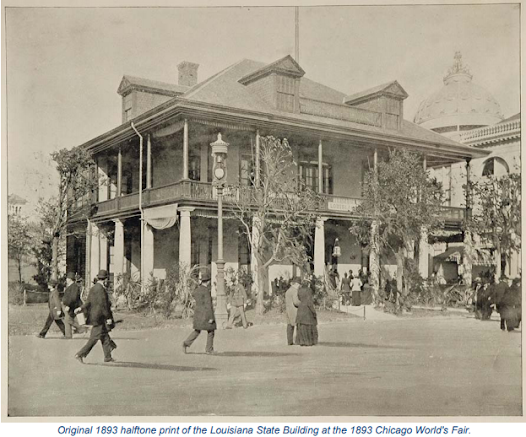
The Louisiana state building was an exhibit of authentic southern architectural style and was divided into eight rooms. One devoted to the Acadian exhibits, from the quaint old French colony in the lovely Bayou Teche country. Another room was devoted to the relics of the French and Spanish days of Louisiana. Richly carved antique furniture of a former Governor, which was usually kept at the museum of the Capitol building at Baton Rouge, filled one of the rooms.

There were eleven beautifully carved panels designed and executed by women of the State. And many other interesting articles, including a veranda of Louisiana woods, where each visitor was given a seedling of a cypress tree, resulting in the spread of cypress trees to areas where they were not native, of which many can be found in West Virginia.

When it comes to agriculture, there was also a double-decked Chinese pagoda, artistically finished off in rough rice, where samples of rice were given to the ladies that visited. In a massive pillared veranda made of sugar cane were displays of syrups, molasses, and sugars, including the old sugar-loaf cakes. There was an exhibit of ramie hemp and other fiber plants, corn, and tobacco.

Of course, it wouldn't be a true representation of Louisiana without its food and music. So naturally, a Creole kitchen served all the southern delicacies for which the state is noted, and a Creole concert company entertained the many visitors.

The World’s Columbian Exposition was the most significant world's fair in U.S. history and one of the most important in the history of world expositions. The Ferris wheel made its debut at the fair, as did the brownie, among other things. The architecture shaped the country's style for the next 25 years and the exhibits were more impressive than anything seen before. It introduced the concept of the midway, a lively entertainment zone, a feature that soon became a staple of virtually all future expositions.

By: Amy Robertson

Wednesday, May 5, 2021

Plain Dealing Bank Goes Belly-up

Plain Dealing Bank. Corner of Palmetto Ave. and Lynch St.
Plain Dealing Library Collection 1997.031.102

On May 3, 1904, the Plain Dealing Bank was chartered with a capital stock of $25,000 divided into 500 shares of $50. The first Board of Directors were H.H. Montgomery, President; P.G. Pye, First Vice President, and Cashier; W.B. Boggs, Second Vice President; S.H. Cochran, Dr. T.N. Keoun, N.W. Sentell, W.J. Johnston, and J.P. Keeth. Four months after the charter was filed, the bank opened its doors for business.

Although P.G. Pye was listed in the charter as the cashier, W.M. Stephenson was the first cashier when it came time to open for business. After his resignation in early 1905, Jonah Perry was elected to succeed him. Perry had been serving as the Cotton Belt Railroad agent before becoming the cashier. He temporarily employed the assistant cashier W.J. Pugh from the Bank of DeRidder to assist him in getting started with the job.

Being a cashier of a small-town bank back in those days often meant you were a one-person show. For the next sixteen years, Perry not only served its members at the cashier window processing deposits and withdrawals, but he also processed loans, maintained the bank's books, charged overdraft fees, and collected monies due, among other things. During that time, he earned the people's trust, and he even served as the Mayor of Plain Dealing from 1914-1916.

But in April of 1921, he fled to Arkansas. "Upon making his departure Sunday night, Perry left a note intimating that he was short in his accounts and announcing that the bank would have to suspend operations, but he gave no information as to where he was going." "It is stated that Perry had told his wife when he left home Sunday, that he was going to Little Rock, and instructed her to inform Sheriff Adair that he would return voluntarily when notified that his presence was desired. Sheriff Adair wired Perry at Little Rock Wednesday, requesting him to return, and a few hours later the sheriff received a message from the fugitive that he was on his way, and asked Sheriff Adair to meet him in Shreveport."

The following statement by his attorney, Thomas W. Robertson, appeared in The Shreveport Journal, "Mr. Perry denies that he got any of the money – not even a nickel. The losses were occasioned [sic] by injudiciously allowing overdrafts and the accumulation of uncollectable notes, coupled with a loose system of keeping track of profits and losses. This condition of affairs was brought about largely by the fact that he had no assistance, and the work, for several years has been entirely too arduous for him, rendering it impossible for him to perform correctly all of the various duties devolving upon him."

"According to his attorney, Perry, at the time of the crash, was worth, in notes, bonds, stocks, land and property of various kinds, in the neighborhood of $20,000, and that he surrendered it all in an effort to protect, as far as he was able, those who had lost through the bank's failure." A final audit of the books revealed that the bank had been insolvent for four or five years and the shortage was $121,000. Even with Perry surrendering his property and monies and the bank's liquidation, the members only received a small portion of their money back after waiting nearly a year.

Perry was convicted and sentenced by Judge Roberts of Minden to serve 9-10 years in the state prison. His attorney filed a motion for a new trial but was denied. He then appealed the case to the Supreme Court, which sustained the district court's verdict. Perry maintained his innocence in the embezzlement charge and that he never personally made use of the money. He was granted an early release from jail and was discharged on May 9, 1926. He died on Christmas eve that same year.

Shortly after the Plain Dealing Bank closed, the State Bank of Plain Dealing was organized, with a capital stock of $15,000 and Dr. Shea Edward Prince as president. It purchased the building and fixtures of the defunct institution and opened for business on Sep. 1, 1921.

An independent agency of the federal government, the Federal Deposit Insurance Corporation (FDIC), was created in 1933 in response to the thousands of bank failures that occurred in the 1920s and early 1930s. The National Credit Union Administration, which regulates and insures credit unions, was formed in 1935.

By: Amy Robertson

Saturday, May 1, 2021

This Month In Bossier Parish History

 May: Though the Years


May 5, 1921; Weekly news from 100 years ago.

  •       Ben Keeth was an appreciated caller at the Bossier Banner office.


1906: J.P. Keeth General Merchandise Store. 
South Cotton Belt Street. 
"Cheap General Merchandise Store $1.00 cash for 75c "  
"Located in area of Otasco about 1906 Plain Dealing, La."
To right of Keeth store is the J.A. Mitchell Hardware store.
Left to right J.T. Manry, ? , Benton Boggs, J.T. Dudney, 
boy in front of stool is A.B. Turnley, 
boy with leg crossed is J.B. Turnely, 
unknown, Phill Haskins, A. Dudney.
1997.062.105 Turnley Collection

  •  The switchboard at the local telephone exchange is now in charge of Mrs. Myrtis


C.1900’s:  Plain Dealing telephone operator for Plain  Dealing Telephone Company.  
Her name is Annie Bell.
1997.062.165 Turnley Collection

  • Mr. Will Manry hurt his arm while cranking the motor of a six-cylinder automobile. 

 C.1920’s: Members of the Manry, Banks & Wheeler Families donated by Mary Wheeler Corley.
2003.026.011L  Corley Collection


May 18, 1984: Justin Wilson (1914-2001),  was a Southern American chef and humorist known for his brand of Cajun-inspired cuisine, humor and storytelling helps kick off the summer program.  While at the Bossier City/Central Branch, he read his book “Justin Wilson’s Cajun Fables” to the children and autographed books.   program at the library may 18 1984
Justin Wilson Program, Bossier Parish Libraries Central Branch, 1984
He was known for the catchphrase, "I gar-on-tee!" (I guarantee). 

May 18, 1984: Justin Wilson Program, Bossier Parish Libraries Central Branch
2020.001.0206

The Times
19 May 1984 


May 22, 1953:  Bossier City was the 10th largest city in the sate of Louisiana. 


The Shreveport Journal
22 May 1953


Aerial view of Bossier City, showing Red River, Texas Street bridge, railroad bridge, Barksdale Blvd in "old downtown" Bossier City, and Bossier High School. 
000.006.008


May 29, 1884: Bossier Parish Medical Society was organized
The Bossier Banner
29 May 1884

Dr. Elisha J. Hall of Bossier Parish.
2005.007.002Hall Collection


1920-1930’s: Mr. Cecil Kelly,  grandfather of Patrick Boggs, in his pharmacy at Stamps, Ark.  Mr. Kelly moved to Plain Dealing in 1931 and went into business with Dr. Bell.
1997.109.001 Boggs Collection


C.1900’s: Dr. Paul Lawrence is shown standing with his family in front of his south Haughton home. From left to right are T. Humphrey Lawrence, Mary Lawrence (sister to Paul), Dr. Paul Lawrence, Eva Lawrence, Myrtis Lawrence, Mary Haughton Lawrence (wife of Paul), Sudye Lawrence (youngest of nine children), and Lucille Lawrence.
1999.089.003 Cardin Collection


1915: Dr. Sidney Gardner when he practiced medicine.  Dr. Sidney Gardner was killed June 1917.
2000.071.089A     Watson Collection