During the first world war, an organization by the name of Louisiana Colonization, Construction, Oil and Gas company purchased the Rainbow Plantation in the summer of 1915. Robert R. Emery was the vice president of the organization, and he secured the $40,000 purchase of the 1,000-acre property from the current owners at that time, George P. Murray and John E. Murray. The Rainbow Plantation, which was located four miles below Shreveport in South Bossier, was purchased for colonization purposes.
According to an article published in The Shreveport Journal on July 6, 1915, “The Louisiana Colonization, Construction, Oil and Gas company stock is largely owned by Italians, and the company proposes to put Italian farmers, truck gardeners and fruit growers on the land it has purchased. It is capitalized at $200,000. The officers and directors of the company are as follows: Joseph R. Tucker of Shreveport, president; Joseph Di Carlo of New Orleans, first vice president; Robert R. Emery of Shreveport, second vice president; D. Zagone, Shreveport, treasurer; A. Tingali, secretary. The directors are: J. W. Peyton, Joseph Sunseri, Frank De Fatta, Phillip Tucker, Joseph P. Glorioso, John Cordaro, Sam Ginnoni, and V. L. Campisi of Shreveport, and Joseph H. Tingali of Detroit. Messrs. Barnett & Keeney are the attorneys.
“The plantation will be divided into 20-acre tracts, each fenced and provided with a house and barn. The buyers will be supplied with horses and wagons, implements, and seed and feed for the first year.
“These tracts will be sold to Italian farmers only, and they will be given every convenience for comfortable and sanitary living. Graveled roads will be built, deep well water piped to the houses which also will be provided with gas for fuel and, eventually, with electricity.
“A school house and a church will be built this summer. The company is now erecting a building for store purposes. An experimental farm of sixty acres has been reserved and will be one of the first tracts to be put into cultivation. On it will be started everything that can be successfully grown in this climate for the instruction of farmers who come from other sections of the country, and, as its name implies, experiments will be made with profitable products unknown now to this section.
“Arrangements have been made to place twelve families on the land just as soon as possession can be had, which probably will be early in November. Permission has been secured, however, to proceed with the erection of the necessary houses at once.
“One of the farmers who will settle on the land has bought sixty acres, and will plant an up-to-date vineyard with the best varieties of Mediterranean grapes, the so-called California types. He will instal [sic] a heating plant and piping system with which to warm the ground and the air about the vines when necessary to defeat frost.
“Every building in the colony will be painted white, and the owners have already dubbed it ‘The White City.’”
In another article published in The Shreveport Times, July 7, 1915, it was reported that, “It is the belief of the company’s officers that, following the close of the war in Europe, Italian immigration to this country will be enormous, and they intend to take advantage of this circumstance to select the best of the immigrants for their colonies. They expect to buy a great deal more land in this section and treat it in the manner they are handling Rainbow Plantation.”
The reason the Italian Americans wanted to colonize during that time is most likely because they were often shunned by the dominant white culture in Louisiana, including Bossier Parish. By forming their colony, they would have a stronger sense of community, allowing them to support one another and create opportunities to improve their socio-economic status.
To learn more about the history of Rainbow Plantation and local communities in Bossier Parish, visit the Bossier Parish Libraries History Center at 2206 Beckett Street, Bossier City.
By: Amy Robertson
"Preserving the history and memories of Bossier Parish, Louisiana"
Wednesday, January 29, 2020
Wednesday, January 22, 2020
First Bossier Church's Fire of 1984
A little over a year ago, First Bossier Church on Airline Drive suffered significant damages due to fire, which they have recently begun the process of rebuilding. In the very long history of this church, which started in 1903, this is not the first fire that it has experienced.
On Feb. 22, 1984, a flame coming out of a roof louver was spotted by a Bossier City police officer around 11 pm. Thanks to a quick response, firefighters extinguished the fire in 45 minutes. The following article, written by Keenan Gingles that appeared in The Shreveport Times on Friday, Feb. 24, 1984, gives details of the event.
“Damages in a fire that destroyed part of First Baptist Church of Bossier City’s sanctuary will total more than $1 million, a church official said Thursday.
“Jim Barnwell, minister of media for the 5,000-member church, said a survey pf the damage by insurance company representatives and firefighters yesterday showed extensive damage in an area behind the choir loft. Barnwell said it could take three to four months to repair the damage.
“Firefighters battles the blaze for about 45 minutes after a Bossier City policeman apparently spotted flames coming out of a roof louver about 11 p.m., Fire Chief J.T. Wallace said.
“Fire Prevention Bureau personnel and insurance inspectors were still sifting through charred areas yesterday to determine the cause, but firefighters said they are pretty sure the blaze started from an electrical malfunction in a heating system for the church baptistry.
“Revival services had been held on Wednesday night and nothing seemed abnormal, Barnwell said. Fourteen persons were baptized and the building superintendent left the building bout 10 p.m., about an hour before the alarm was turned in.
“The fire apparently smoldered for a time, then erupted into flames, climbing up the three-story high walls and ceiling, melting the baptistry and burning a large, jagged hole in the roof, Wallace said.
“Fire walls built into the 18-year-old structure kept the fire from spreading to adjacent wings and buildings, firefighters said.
“Firefighters managed to rescue about $80,000 worth of television cameras and equipment, but a grand piano and an organ were total losses. Barnwell said the heat warped and ruined the musical instruments.
“Firefighters said it took little water to tap out the blaze, but some water damage occurred and there was also smoke damage from the heavy gray-black smoke that filled the sanctuary.
“Self-contained breathing equipment was used by firefighters who entered the building and used small hose lines to extinguish the fire.
“Barnwell said the church will be using the Airline High School and other church buildings for worship services.”
To learn more about the history of Bossier Parish churches or fires, visit the Bossier Parish Libraries History Center at 2206 Beckett St., Bossier City.
By: Amy Robertson
On Feb. 22, 1984, a flame coming out of a roof louver was spotted by a Bossier City police officer around 11 pm. Thanks to a quick response, firefighters extinguished the fire in 45 minutes. The following article, written by Keenan Gingles that appeared in The Shreveport Times on Friday, Feb. 24, 1984, gives details of the event.
“Damages in a fire that destroyed part of First Baptist Church of Bossier City’s sanctuary will total more than $1 million, a church official said Thursday.
“Jim Barnwell, minister of media for the 5,000-member church, said a survey pf the damage by insurance company representatives and firefighters yesterday showed extensive damage in an area behind the choir loft. Barnwell said it could take three to four months to repair the damage.
“Firefighters battles the blaze for about 45 minutes after a Bossier City policeman apparently spotted flames coming out of a roof louver about 11 p.m., Fire Chief J.T. Wallace said.
“Fire Prevention Bureau personnel and insurance inspectors were still sifting through charred areas yesterday to determine the cause, but firefighters said they are pretty sure the blaze started from an electrical malfunction in a heating system for the church baptistry.
“Revival services had been held on Wednesday night and nothing seemed abnormal, Barnwell said. Fourteen persons were baptized and the building superintendent left the building bout 10 p.m., about an hour before the alarm was turned in.
“The fire apparently smoldered for a time, then erupted into flames, climbing up the three-story high walls and ceiling, melting the baptistry and burning a large, jagged hole in the roof, Wallace said.
“Fire walls built into the 18-year-old structure kept the fire from spreading to adjacent wings and buildings, firefighters said.
“Firefighters managed to rescue about $80,000 worth of television cameras and equipment, but a grand piano and an organ were total losses. Barnwell said the heat warped and ruined the musical instruments.
“Firefighters said it took little water to tap out the blaze, but some water damage occurred and there was also smoke damage from the heavy gray-black smoke that filled the sanctuary.
“Self-contained breathing equipment was used by firefighters who entered the building and used small hose lines to extinguish the fire.
“Barnwell said the church will be using the Airline High School and other church buildings for worship services.”
To learn more about the history of Bossier Parish churches or fires, visit the Bossier Parish Libraries History Center at 2206 Beckett St., Bossier City.
By: Amy Robertson
Wednesday, January 15, 2020
Over Thirty Years of Bootlegging in Bossier Parish
The Prohibition Act went into effect on Jan. 16, 1920 making “the manufacture, sale, or transportation of intoxicating liquors within, the importation thereof into, or the exportation thereof from the United States and all territory subject to the jurisdiction thereof for beverage purposes is hereby prohibited.” However, Bossier Parish became a “dry” parish 21 years before the 18th Amendment took effect.
Just as with any law, those that disagree with the laws of the land find ways to circumvent them. With Prohibition came the nefarious business of bootlegging, where alcohol was manufactured illegally. Prohibition also gave rise to speakeasies, also known as blind pigs and blind tigers, which were illicit establishments that served alcohol illegally.
Bootlegging started in Bossier Parish after it became a dry parish in 1899 and continued until the 18th Amendment was repealed through the 21st Amendment on Dec. 5, 1933. Those caught engaging in the illegal manufacture of alcohol were arrested during the dry period before the Prohibition Era began. However, once it became a federal crime, federal agents were dispatched throughout the country to work with local law enforcement in a war against bootleggers. Local and federal agents worked together to locate and destroy such operations.
Bootlegging raids, arrests, and deaths became a part of the daily news throughout the nation, and Bossier Parish was no exception. The following article, which appeared in The Bossier Banner on Sept. 9, 1920, is a prime example of news reports during that period.
“Monday afternoon the officers here named destroyed about 150 gallons of mash some five miles southwest of Bellevue. The location of this still was in a field, but secluded on a timbered branch. No arrests were made, as the operators were not located. However, the two men are said to be known, and are thought to have been absent at another still they operate.
“Tuesday afternoon Mose Davis, a negro whose home is near Bodcau Station, on the V.S. and P. Railroad, was arrested for operating a still, and was also jailed in Shreveport. At his place about 30 gallons of corn mash was destroyed.
“Thus ends the story for the present, but we have learned that we may well expect material for like stories almost any day. Greed is a trait that is well cultivated in many—and so is the appetite for booze.”
To learn more about Bossier Parish during the Prohibition Era, visit the Bossier Parish Libraries History Center at 2206 Beckett St., Bossier City.
By: Amy Robertson
Just as with any law, those that disagree with the laws of the land find ways to circumvent them. With Prohibition came the nefarious business of bootlegging, where alcohol was manufactured illegally. Prohibition also gave rise to speakeasies, also known as blind pigs and blind tigers, which were illicit establishments that served alcohol illegally.
Bootlegging started in Bossier Parish after it became a dry parish in 1899 and continued until the 18th Amendment was repealed through the 21st Amendment on Dec. 5, 1933. Those caught engaging in the illegal manufacture of alcohol were arrested during the dry period before the Prohibition Era began. However, once it became a federal crime, federal agents were dispatched throughout the country to work with local law enforcement in a war against bootleggers. Local and federal agents worked together to locate and destroy such operations.
Bootlegging raids, arrests, and deaths became a part of the daily news throughout the nation, and Bossier Parish was no exception. The following article, which appeared in The Bossier Banner on Sept. 9, 1920, is a prime example of news reports during that period.
“Monday afternoon the officers here named destroyed about 150 gallons of mash some five miles southwest of Bellevue. The location of this still was in a field, but secluded on a timbered branch. No arrests were made, as the operators were not located. However, the two men are said to be known, and are thought to have been absent at another still they operate.
“Tuesday afternoon Mose Davis, a negro whose home is near Bodcau Station, on the V.S. and P. Railroad, was arrested for operating a still, and was also jailed in Shreveport. At his place about 30 gallons of corn mash was destroyed.
“Thus ends the story for the present, but we have learned that we may well expect material for like stories almost any day. Greed is a trait that is well cultivated in many—and so is the appetite for booze.”
To learn more about Bossier Parish during the Prohibition Era, visit the Bossier Parish Libraries History Center at 2206 Beckett St., Bossier City.
By: Amy Robertson
Wednesday, January 8, 2020
Mary Bixler Bryce and the 19th Amendment
The fight for women’s suffrage began on a national level in July of 1848. In the 1870s, enough pressure was applied to Congress to vote on an amendment that would recognize the suffrage rights of women. This amendment is sometimes called the Susan B, Anthony Amendment. Congress finally voted to pass the amendment on June 4, 1919. On Aug. 18, 1920, the amendment was ratified by the requisite number of States. Unfortunately, Louisiana voted against approving the 19th Amendment on July 1, 1920, and did not ratify it until 50-years later, on July 11, 1970.
In Bossier Parish, the first woman to register to vote was 20-year-old Mary Bixler Bryce, a native and life-long resident of Plain Dealing. Bryce registered to vote at the parish courthouse in Benton on Friday, Sep. 17, 1920, allowing her to vote in the upcoming November election.
![]() |
| (L to R) Charles Mitchell, Caddo registrar of voters; Mrs. Mary K. Bryce, Bossier registrar of voters and Sidney Platt, DeSoto registrar of voters. Source: The Shreveport Journal, June 6, 1962. |
Not only was Bryce the first woman to register to vote in Bossier Parish, but she was also the first woman in Louisiana to be elected to serve as a Registrar of Voters. She was elected to serve as Registrar of Voters for Bossier Parish during a regular meeting of the Police Jury on Tuesday, Dec. 13, 1921. After receiving a majority of the votes, her election was then made unanimous. She was reappointed each year, serving a total of 44 years beginning in 1921 until her death in 1965 at age 66.
Bryce was so dedicated to voting that even sickness could not keep her from the polls, as is revealed in the following article in The Shreveport Times “Stroller” section on Nov. 6, 1964.
“Setting a fine example Tuesday was a determined voter in Bossier Parish. Parish Registrar of Voters MARY K. BRYCE, who has been hospitalized since last week because of illness, told her doctor that she just had to vote for her candidate. With the physician’s approval, Mrs. BRYCE was helped to an auto by her nurse and an ambulance attendant drove her to the polls at Plain Dealing. Having cast her ballot, with a fever, Mrs. BRYCE returned to the hospital.”
Be sure to join us at the Bossier Parish Libraries History Center for our 19th Amendment Centennial Equali-Tea Party on Jan. 27, 2020, from 4:00 – 7:00 p.m. There will be refreshments and tea, crafts, and a photo booth. As always, visit the History Center at 2206 Beckett St., Bossier City, for your research about women’s suffrage in Bossier Parish.
By: Amy Robertson
Labels:
Bossier Parish History,
Local History Column,
women
Wednesday, January 1, 2020
This Month In Bossier Parish History
January: Through the years
*January happenings through the month of January in Bossier Parish. Please enjoy the photos from around our community.
![]() |
David Arthur Matlock and Zeffie Kirklin Matlock,
on their wedding day, 20 January 1926.
2011.067.002 Mitchell Collection
|
![]() |
Novie Willis of Plain Dealing, taken
from the Shreveport Times, January 1980.
|
Jan. 6, 1916: Brick and mortar buildings were taking the place of wood framed establishments.
*Photos show the brick buildings of the Kidd Building and other stores along Palmetto Avenue in Plain Dealing.
![]() |
| Jan. 6, 1916: Bossier Banner |
![]() |
C.1920’s: Kidd Building
2003.026.041B Corley Collection
|
![]() |
Kidd Building in Plain Dealing. Green and
white sign on top corner "Kelly's Pharmacy
and Gifts". Mural on side of building, is that
of cotton, fields, logging truck, and buildings.
2016.035.001
|
Jan. 16, 1952: The announcement was made of the Nu-Enamel store opening on Barksdale Boulevard, Bossier City was made. The Bossier City store was a branch of the Shreveport store, a dealer for Westinghouse Appliances.
* Photos shown are of the article, advertisements, and a photo.
![]() |
| The Shreveport Journal: Jan. 16, 1952 |
![]() |
| The Shreveport Journal: Jan. 16, 1952 |
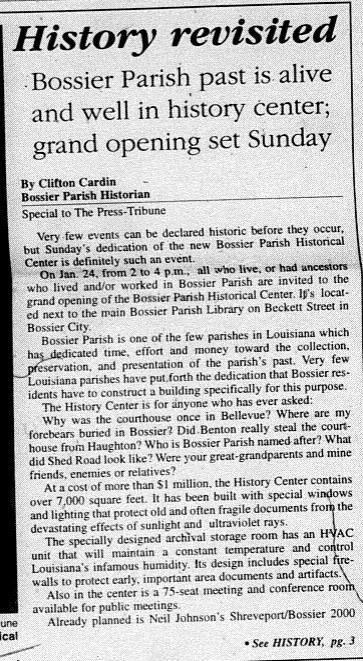
Jan. 24, 1999: The dedication and grand opening of the Bossier Pariah Libraries History Center took place.
* Please enjoy the article and photos of the Bossier Parish Libraries History Center.
![]() |
| Jan. 21, 1999: Bossier Banner |
![]() |
| Bossier Parish Libraries History Center 1999.149.001 |
![]() |
| Bossier Parish Libraries History Center Opening invitation 1999.057.005 |
![]() |
| Display at the History Center: replica of a 1850's log cabin/house. |
Temperance and Prohibition in Bossier Parish
The announcement appeared in The Shreveport Times on Sep. 27, 1899, stating, “The Second Ward of Bossier Parish Goes Dry.”
![]() |
| The Shreveport Times, Sept. 27, 1899. |
On Dec. 18, 1917, the National Prohibition Act, commonly referred to as the Volstead Act, was proposed by congress. On Jan. 16, 1919, the 18th Amendment was ratified by the requisite number of states. The Prohibition Act took effect on a federal level on Jan. 16, 1920. Louisiana, Gov. Ruffin G. Pleasant ratified the 18th Amendment on Aug. 9, 1918, prohibiting the manufacture, sale, or transportation of alcohol for beverage purposes.
The following is an article from The Bossier Banner on Dec. 25, 1919, “Business and Prohibition,” which describes a dry Christmas in Plain Dealing.
“Mr. W.A. Bounds and Mr. J.S. Rodgers each of whom has known Plain Dealing ever since the town was established some thirty-odd years ago, were remarking Tuesday that it was the first really and truly ‘dry’ Christmas in its history. Heretofore whiskey has been shipped into Plain Dealing by the express medium and bootlegging has been at times rather common.
“This Christmas there has been no whiskey, and Mr. Rodgers estimated the saving in cash at some thousands of dollars, to say nothing of the saving in broken heads and disrupted family relations.
![]() |
| Library of Congress Prints and Photographs Division Washington, D.C. 20540 USA.
National Photo Company Collection. LOT 12351-5 <item> [P&P]
|
“The Christmas trade was good – all the merchants were busy. Collections have been better on account of prohibition, it was agreed, and probably no business man in Plain Dealing would like to go back to the ‘wet’ Christmas.”
This year is the 100th anniversary of prohibition in the United States. To learn more about prohibition in Bossier Parish, visit the Bossier Parish Libraries History Center at 2206 Beckett Street, Bossier City.
By: Amy Robertson
Subscribe to:
Comments (Atom)