Showing posts with label Archaeology. Show all posts

Wednesday, October 25, 2023

Intriguing Bottles, Questionable Claims: Patent Medicines

 October is Louisiana Archaeology Month. What does the word archaeological artifact invoke for you? Some may think of mummies, in the pyramids of Egypt, or if more local, perhaps they think of “arrowheads” or pottery. Archaeological artifacts can be more recent too, part of a field called historical archaeology. Examples of historical archaeological artifacts can be coins, nails, bullets, toys like marbles. Among the most intriguing and visually appealing are glass bottles, particularly patent medicine bottles. “Patent medicine” historically describes medicines sold without a doctor’s prescription through the first half of the twentieth century when there was inadequate (or none at all!) oversight of the medicine’s ingredients or claims.


Sometimes the bottles one might find no longer have the labels on them. Archaeologists still have ways to date, and possibly identify, a bottle by looking at its shape how it was manufactured. If you’re lucky enough to have a bottle still with its label, many of which are in our collection, you can read the list of questionable ingredients and claims for the contents. But you can also look at advertisements from newspapers, including the local, historical Bossier Banner newspaper, to learn about these claims and the advertising tricks used by patent medicine manufacturers.


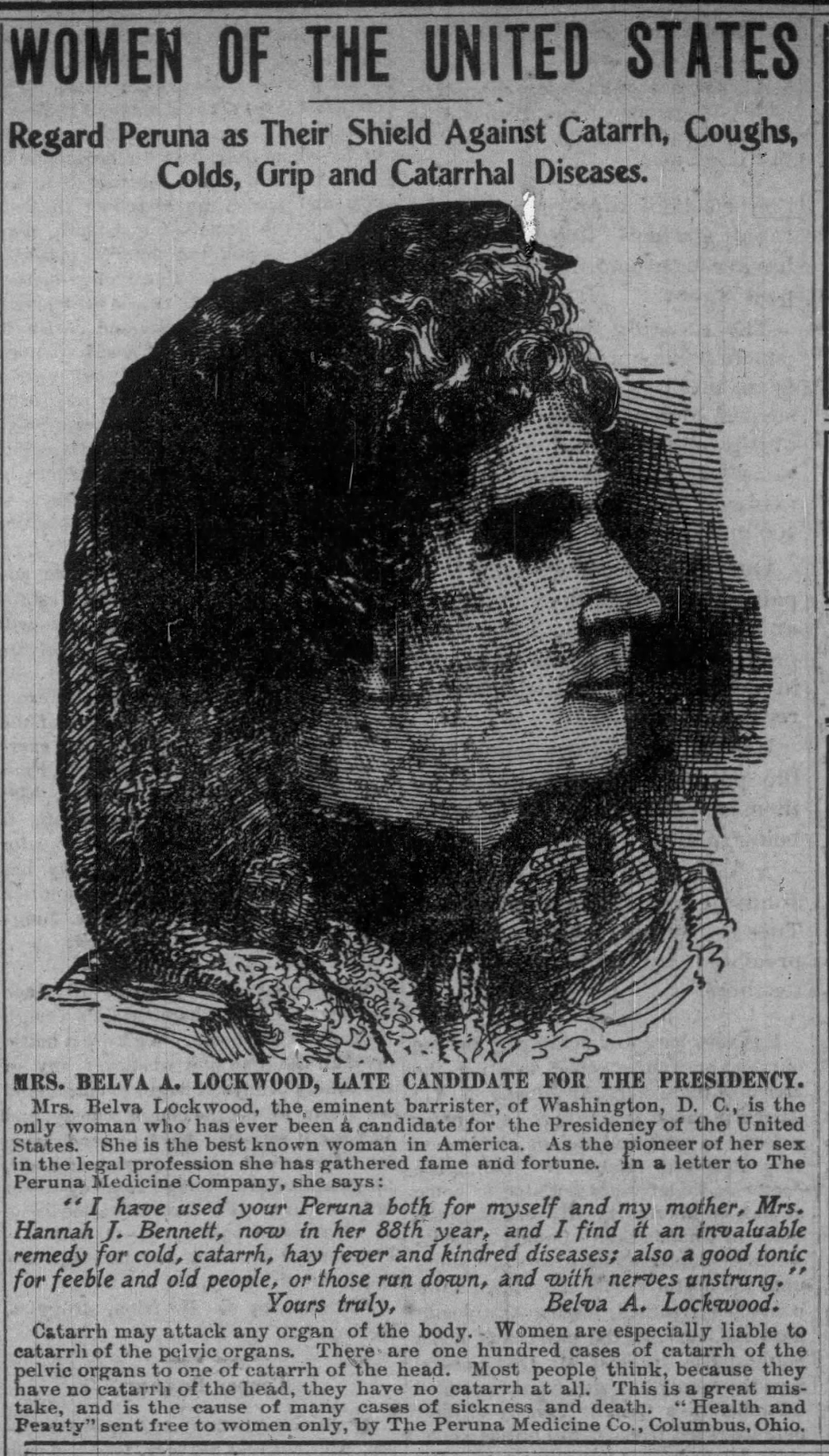
Some examples are two ads from the Banner for Pe-ru-na from 1900. Pe-ru-na was a very popular remedy, chiefly because of its high alcohol content. Why did so many medicines contain so much alcohol? Manufacturers said it was necessary to preserve herbs, but this wasn't the whole truth. Stores didn't need a liquor license to sell medication and any liquor taxes did not apply to the patent remedies. The alcohol found in patent medication provided the public with an economical way to drink. Pe-ru-na's widespread usage was also thanks to its claims to cure “catarrh.” Catarrh is when mucus accumulates in your nose, throat, or sinuses, but any kind of pain or discomfort could be pinned on catarrh by the Pe-ru-na salesmen. To hear them tell it, catarrh was the cause of stomach troubles, runny noses, earaches, and fevers. The ads boasted that no matter where the “catarrh” was in your body, Pe-ru-na could cure it.


These two ads for Pe-ru-na used "celebrity endorsements." Whether these men and women actually gave permission for the companies to use their likeness or received any compensation is unlikely. Belva Ann Lockwood was a noted attorney in Washington D.C., and was apparently the "best known woman in America" thanks to her run for president of the United States in 1884 and 1888. In one of the ads, Pe-ru-na uses her face to appeal to women across the country. In a letter supposedly from Lockwood, we learn that it is an "invaluable remedy for cold, catarrh, hay fever, and kindred diseases."
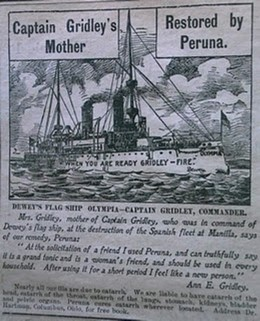


The other ad doesn't show a famous face, but rather a famous ship from the Spanish-American War. Ann Gridley touts the wonders of catarrh-curing Pe-ru-na, calling it a "grand tonic and a woman's friend." Ann was the mother of Captain Charles Gridley, the commander of the USS Olympia during the American victory at the Battle of Manila Bay. Gridley received the well-known order, "You may fire when you are ready, Gridley," from Admiral George Dewey. This ad mentions Dewey three times, implying an endorsement from the heroic admiral himself. Come to the Historical Center to see more ads or ask to look through our back issues of the Bossier Banner newspaper. Don’t forget too, that you can request our programs on Archaeology or other local history topics for your group here at the History Center or request a presentation by our staff at your classroom or other public facility. We are located at 2206 Beckett St, Bossier City, LA and are open M-Th 9-8, Fri 9-6, and Sat 9-5. Our phone number is (318) 746-7717 and our email is history-center@bossierlibrary.org


For other fun facts, photos, and videos, be sure to follow us @BPLHistoryCenter on FB, @bplhistorycenter on TikTok.

Images: Ads from 1900 in the Bosser Banner newspaper for Pe-ru-na patent medicine, which claimed to cure “catarrh

Article by: Pam Carlisle

Wednesday, August 9, 2023

The Sanders House of Plain Dealing, Both Practical and Trendy in its Time

 Wow, it’s hot out lately. Thank goodness for air conditioning. It’s hard to imagine living here in the South without it. These “dog days” of summer are a good time to revisit the southern architectural style of the dogtrot house, which featured a central open corridor from the front to back of the house.  This style of house was common throughout the Southeastern United States during the 19th and early 20th centuries.


If you were building a house a hundred or a hundred fifty years ago, the dogtrot style was practical for its ease of construction. The breezeway in between the rooms meant that without shared walls, complicated three-way hitches were not needed. At the same time, that large walkway could be a ‘room’ cooled by cross-breezes, providing a good place to rest, eat, shell peas or visit with family, neighbors and friends. 


Your farm animals and dogs would want some of that cool shade, too. They could run from one end of the house to the other, giving this design its name, “dogtrot.” (Other names for the form are breezeway house, dog-run house, or possum-trot house.) An alternate story for the name is that it comes from the respite from the heat that the breezeway provided when “the old dog is too hot to trot.”


Either way that it got its name, this house style was “cool.” The dogtrot form allowed windows to exist on all sides of a room and could isolate the kitchen area from the living side of the house, also helping to keep things cool. In fact, though air conditioning has made this style less-necessary, its features still make it desirable for the “indoor-outdoor” living style popular today. Dogtrot plans are having somewhat of a comeback in Southern architectural trends.


An amazing example of this vernacular style that “kept up” with its fancy Victorian neighbors was a unique home built at the turn of the twentieth century, the Sanders House in the north Bossier Parish town of Plain Dealing. This house was a charmingly unusual double-dogtrot, two-story, Queen Anne style house with elaborate trim. Leon Sanders, Jr. and his brother Doyle, who both served as mayors of Plain Dealing, grew up in this home. The home was built by their grandfather, along with the labor of many others, as told in Mayor Leon Sanders’ oral history here at the History Center. 


When the house was built, the town of Plain Dealing (founded in 1890) was new yet thriving, and contained many examples of Victorian architecture. The Sanders’ unique house combined two practical dogtrot hallways on both sides of the house, while the house was embellished with the elaborate woodwork and other stylistic details of the Queen Anne and Eastlake styles, especially on the second floor. The house had long front and back porches and smaller side porches, adding to its appeal and practicality. 


The house was so unique that in the early days of the Bossier Parish Library History Center, a model of the house was commissioned for display and built by artist David Fernandez. Presently the model is at the Bossier Parish Libraries Rita Sanders Keoun Memorial Plain Dealing Branch. Mrs. Keoun, a beloved local teacher who served on the Bossier Parish Libraries Board of Control in her retirement, grew up in the house with the former Mayors Sanders and her other siblings. The model was made just in time because sadly, while in the process of remodeling, the home burned in 2002. 


Come get out of the heat and visit the Bossier Parish Libraries History Center to see more photos of Bossier Parish dogtrots and peruse our local architecture books and oral histories. You may also request worksheets and activities on dogtrots for kids who are interested in old buildings. The History Center open M-Th 9-8, Fri 9-6, and Sat 9-5. Our phone number is (318) 746-7717 and our email is history-center@bossierlibrary.org

For other fun facts, photos, and videos, be sure to follow us @BPLHistoryCenter on FB, @bplhistorycenter on TikTok

Images: 
  • Photo of the C. 1898 two-story double-dogtrot Sanders house of Plain Dealing, taken in 1997
  • Front and side views of a model of the C. 1898 Sanders house of Plain Dealing. Model constructed by David Fernandez in 1997

Wednesday, September 7, 2022

Archaeology of the Caddo Indians and Louis T. Baker, Sr.

 If you’ve ever visited the History Center, then perhaps you remember our miniature scene of pre-historic life along Willow Chute Bayou. This diorama of a Caddo Indian village was constructed by the late Mr. Louis Baker, an archaeology enthusiast from Benton, Louisiana. He was one of the local residents who helped the History Center become a reality in the late 1990s. Not only did this skilled craftsman build our diorama, but he also did much of the archaeological field work right at the Caddo Indian village site of Vanceville. The diorama is based on this work - even the dirt in the diorama is authentic! 

Louis Baker was born in 1930 in North Carolina. He served in the United States Air Force during the Korean War, met his wife Dot while stationed at Barksdale Air Force Base, and they eventually settled in Benton. Louis worked in civil service until retirement when he established Baker Heating and Air. 

Louis didn’t take up his archaeology avocation until he was roughly in his 50s, but according to Jeff Girard, retired archaeologist from the Louisiana Division of Archaeology, Louis Baker’s contributions to Louisiana archaeology were immense, and his skill with a trowel was considered among the best around. He identified and plotted over a hundred archaeological sites in northwest Louisiana and worked with professional archaeologists on numerous projects in both Louisiana and Arkansas.  

As told by Jeff Girard, Louis began recording sites in Bossier Parish, where he made extensive surface collections and kept excellent records. His favorite area of investigation was along Willow Chute Bayou, a stream on the eastern side of the Red River floodplain between Benton and Bossier City. Now largely developed by residential expansion, the area was cultivated in the 1980s and 1990s. Louis maintained close relationships with the local farmers and systematically surveyed most of the existing fields, recording almost 100 sites. 

After the Regional Archaeology Program was established in 1989, Jeff Girard worked with Louis re-visiting these sites, making additional collections, conducting test excavations, and analyzing the extensive collections which are now curated at Northwestern State University. The broad and systematic nature of Louis’ endeavors enabled Louis, Jeff, and other archaeologists to interpret the area as home to a dispersed Caddo village relating to the Middle Caddo period, about 1200 to 1500.


Louis was instrumental in the beginnings of the History Center, which started in 1997 as a room in the library and later moved into its own building in 1999. In the History Center meeting room, we have a large display case that contains many of the best artifacts from Louis Baker’s collections. 


Archaeology of the Caddo Indians and Louis T. Baker, Sr.

Based on investigations that Louis and Jeff Girard conducted at the Vanceville Site in Bossier Parish, Louis designed and constructed the History Center’s diorama. It was significant to Louis that the soil that’s in the diorama is from the actual site the Caddoan people lived and walked on. According to Louis, that dark soil is what archaeologists call midden, which gets its color from the discarded debris of living, such as from years of preparing food and making tools. The Caddo lived on this site for approximately 500 years and the midden was about six to eighteen inches thick, with lots of artifacts scattered in it.  

The Caddo houses were large, as seen in the diorama.  The houses Louis and Jeff excavated locally are around 33 to 35 feet in diameter and about the same height with containing two stories. The upper story was used to for food storage for field crops like corn, beans, and squash. The grass roof had to be re-covered every fall to get ready for the cold rainy days of winter. The thatch used is a grass similar to what we call “saw grass” that still grows today in Willow Chute next to the banks of the bayou. 

Louis Baker also was an accomplished craftsman and artisan. He replicated a set of Indian tools including bows, atlatls, shell dippers, knives, celts, and ornamental items of wood and bone.  Many of the implements are compised of stone tools made by local flintknappers and hafted by Louis into finely carved and polished bois d’arc handles. The tools and ornaments are housed at the History Center and used frequently in public presentations and hands-on demonstrations. Louis’ many years of field research and the inherent difficulty of carving bois d’arc (the hardest dried wood in North America) make these replicas even more impressive. 

History Center staff will be displaying and demonstrating this set of replicas at the 7th Annual Archaeology Day at the Louisiana State Exhibit Museum on Saturday, September 17 from 10 a.m. to 2 p.m.  Archaeologists and educators will fill the museum and grounds with demonstrations and activities for the whole family to enjoy. For those interested in learning more about archaeology, the Louisiana Archaeology Society, of which Louis Baker was a member, will have representatives to discuss joining the Northwest Louisiana Chapter. This event is free and open to the public. For more information about the Louisiana State Exhibit Museum, visit www.laexhibitmuseum.org. 

Come see the Caddo Indian diorama or Louis Baker’s artifact collection at the History Center or request a program where we use the replica tools and decorative items either here at the History Center or in your classroom or other public facility. We are located at 2206 Beckett St, Bossier City, LA and are open M-Th 9-8, Fri 9-6, and Sat 9-5. Our phone number is (318) 746-7717 and our email is history-center@bossierlibrary.org

For other fun facts, photos, and videos, be sure to follow us @BPLHistoryCenter on FB, @bplhistorycenter on TikTok

Photos: Louis Baker at an archaeological dig on Loggy Bayou south of Bossier Point in 1999

Article by: Pam Carlisle