Showing posts with label Bellevue. Show all posts

Wednesday, February 1, 2023

PART II A Chilling Account of the 1851 Bellevue Tornado

 In February of 1851, a tornado decimated the east-central Bossier Parish village of Bellevue. Sometimes spelled “Belle Vue,” this tiny, remote community was the seat of Bossier Parish from the parish’s beginnings in 1843 until 1888, when it moved to its present location of Benton. This is a continuation of last week’s story (1/25/23) of how the village fared in the aftermath of this unpredicted destructive, nighttime storm. An anonymous resident described their harrowing experience in a journal, which the “The Bossier Banner” reprinted on January 17, 1895:


“’My God!’ was the general cry among us, ‘the whole town is in ruins and many must be killed!’ And then breaking out like wild men, the first object we saw was the dwelling of Dick Hollingsworth, a mass of ruins crashed between the weight of a large tree that had fallen across its center; we were at the house in a moment; we saw Dick, with his arms around his wife and little ‘Doc,’ while Mrs. H. was holding her infant in her arms, the huge tree within three feet of them and the crashed and shattered masses of roof and timber all around there. There they stood, each a mute, pale stature of terror—neither of them moving and scarcely breathing! We called to him, and he looked as awakening from a dream and answered.


‘We are all safe here, but in God’s name’—and pointed to Bodenheimer’s. So complete was the wreck here that from our position we could see no sign of a house! Some small trees in the yard had been uprooted and hid the ruins from our sight. We, however, rushed forward and saw Mrs. B. running with her infant in her arms, as if pursued by some dread object, with a wild instinct, seeking for some refuge, after the danger was entirely over.”


The house was a complete wreck—the logs thrown every way—the floor sills lifted from the blocks upon which the house rested, and not one chair or other article of furniture but what was broken, but not one soul out of the seven that were in the room was injured.


By 1847, the earliest Jewish settler in the area, Jacob Bodenheimer, was living in Bellevue with his wife, Eliza Weil. The baby in her arms would have been their first child, Harriette, born in 1850. Jacob was one of the first business owners in Bellevue, including providing lodging for out-of-town visitors. Since, as mentioned in part I, court had recently been in session and there were visitors in town, it is likely that the seven inhabitants of the destroyed home included out-of-town visitors lodging with the Bodenheimer family of three. Also, at some point in 1851, Jacob’s niece and nephew, Fanny & Lazarus Bodenheimer immigrated to Bellevue on the encouragement of Jacob, who gave Lazarus his first job. It is possible that they, too, were among that group of seven that survived the violent tornado.


We made a tour around town, and found but one dwelling house that escaped from injury. Lawson & Hervey’s livery stable was blown flat down, with several horses under the wreck. The horses were prized [pried] out of the sides and roof, and no horse was lamed or injured in any way.”


“After the tornado passed, there was not a breath of wind to be felt; the rain fell in torrents, but none of us felt the rain until after we saw all safe—saw the women wildly hugging and kissing each other, and heard mutual congratulations—and night, deep, dark and impenetrable, hid the ruins of the town from our view.”


“We have had our romantic incidents, our deeds of horror, our times of sickness, gloom and death, but our history knows of no more thrilling event than that of the 20th day of February, 1851.”


It is amazing to have such a detailed narrative of surviving the destruction of a tornado that hit without warning over a hundred and seventy years ago. What we don’t have is any scientific data from that time. The ability to record, analyze, save and compare that data, of course, is what would have allowed some prediction of the event to the folks of Bellevue. Unfortunately, it would be another one hundred years before the existence of any kind of reliable tornado forecast system.


A method of “rules” to help predict tornado forecasting were developed in 1884 (Finley’s rules from a US Army Signal Sergeant) but these rules and continued investigation gained little traction when the government forbade any reports or predictions to even use the word tornado, for fear it would cause unwarranted panic. Tornado outbreaks in Missouri, Arkansas, and Tennessee on March 21,1952, killed over 150 people and led to public outcry and Congressional pressure for the issuance of tornado forecasts. As a result, the Severe Local Storms (SELS) Center was established within the Weather Bureau in June 1953.


If you have any information, stories, or photos about natural disasters in the history of Bossier, we would love to add material to the History Center’s research collection. Please come to the History Center to see our new display about the 1978 tornado in Bossier City, or read about other events in local weather history in our collection, at 2206 Beckett St, Bossier City, LA. We are open M-Th 9-8, Fri 9-6, and Sat 9-5. Our phone number is (318) 746-7717 and our email is history-center@bossierlibrary.org


For other fun facts, photos, and videos, be sure to follow us @BPLHistoryCenter on FB, @bplhistorycenter on TikTok, and check out our blog http://bpl-hc.blogspot.com/.

Wednesday, January 25, 2023

A Chilling Account of the Bellevue Tornado of 1851

 In February of 1851, a tornado decimated the east-central Bossier Parish village of Bellevue and terrified its residents and visitors. This tiny community had many visitors because Bellevue, sometimes spelled “Belle Vue,” was the seat of Bossier Parish from the parish’s beginnings in 1843 until 1888, when it moved to its present location of Benton.


This tornado and its damage was so severe that papers around the Southern U.S. reported it, by sharing a story from the “Minden Herald.” The article exclaimed that this tornado “prostrated to the ground nearly every house in the place…It twisted off trees fifteen or twenty feet from the root, and swept those tops clear away,” a scene that that those present said was, “beyond the power of language to describe. “


However, an anonymous writer did soon find words to describe their harrowing experience and inscribed them in a journal. The writer made it public in the May 1, 1858 issue of “The Bossier Times.” Fortunately, on January 17, 1895, “The Bossier Banner” reprinted this vividly detailed account under the title, “A Stray Leaf from the History of Bellevue,” giving readers a vicarious experience of living through the touchdown of a tornado.


“I have an old journal in which I have noted the events in my life, and in its connection to events in the history of others. I am poring over that old book now, while sad memories are stealing over the soul…I am reading now from the page containing the events of the 20th day of February 1851.”


“The District Court had been in session, but had adjourned the day before. A few of the convivial ones, of our own parish, and several attorneys of our neighboring towns, were detained in our now quiet village—among that few, I remember poor “Hurricane” Martin, Nat Currier [who had served as clerk and deputy clerk of various courts in Bossier and the region], Judge Peets [who also presided at Claiborne Parish] and Major Terrill. The day had been a remarkably still and warm one for February, a dull mist of rain falling perpendicularly to the earth.”


The writer is referring to the fact that Bellevue, as parish seat, was the location of Bossier’s courthouse. In the mid-nineteenth century, many lawyers, judges, and clerks would have needed to take a long, arduous trip driven by horses through essential wilderness to get to court. They typically practiced in more than one parish, and were based elsewhere, such as Shreveport or Homer, and may have needed to spend the night in Bellevue. Travelers rented rooms (and stable stalls for their horses) from residents or stayed with acquaintances.


“In the evening about 1 o’clock, Nat came into my room, took a book and reclined on a bed to read away so dull an evening, but soon fell into an uneasy sleep. In fact, it was that kind of weather that makes barometers of us all. Soon a low rumbling sound was heard, like the reverberation of distant and continued thunder. Nat awoke, in a kind of instinctive alarm. ‘That tree’s falling.’ ‘No,’ I answered ‘it is distant thunder.’ He however got up, threw a cloak on and went out in the rain, but returned in a moment, with true, wild alarm in his countenance. ‘We are going to have an awful storm, hear the trees falling.’ It was hardly spoken before in bolted Fort, Fuller and Ben, like frightened animals seeking the nearest cove[r], each expressing alarm—Then came the storm in dread earnestness.


Nat and Fuller sprang to the door which remained open, and caught the facing, and clung to it like drowning men, while their feet were lifted and their bodies fluttered out nearly horizontal with their hold. The temporary arbor at the door floated off as if on a current of water. Ben bore wildly all of his strength against one of the walls, as if to hold the house up, while Fort stood ready to leap out at the first opening that might be made by the turning house. The door and drawers of my desk and document case opened sides as impulsive things of life, and the papers took wings as birds loosened from the cage. Every window broke from its bolted fastenings, the house rocked like a skiff [small boat] on the waves, and sounded as if pelted by hail stones—while the din without was almost deafening—we could scarcely distinguish each other’s faces in the darkness of the moment…But as it came in a moment, so it was gone in a moment…”


The continuation of this story will be in the next local history column. But, spoiler alert, you don’t need to worry. Miraculously, no people or horses were injured or died in this incident, even though both had to be dug from the rubble of Bellevue.


If you have any information, stories, or photos about Bellevue, we would be happy to add copies of the material to the History Center’s research collection. Please come to the History Center to learn more about Bellevue and other ‘extinct’ Bossier communities, as well as see a new display on the deadly 1978 Bossier City tornado. The History Center is adjacent to Bossier Central Library at 2206 Beckett St, Bossier City, LA. We are open M-Th 9-8, Fri 9-6, and Sat 9-5. Our phone number is (318) 746-7717 and our email is history-center@bossierlibrary.org


For other fun facts, photos, and videos, be sure to follow us @BPLHistoryCenter on FB, @bplhistorycenter on TikTok


Wednesday, December 8, 2021

Bossier Parish Enters American Oil Boom

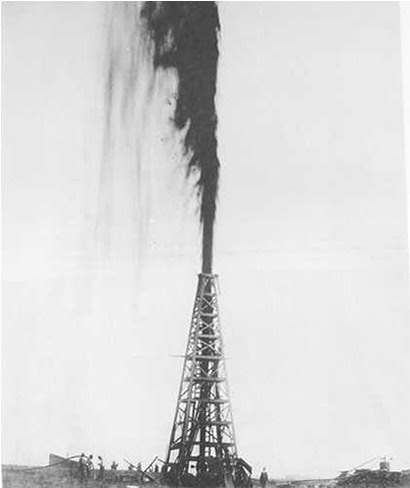
Lucas Gusher, Spindletop Hill, Texas, 1901 

Did you know that Louisiana is among the top ten producers of crude oil in the United States? The beginning of the American oil industry came when on Jan. 10, 1901, a drilling derrick at Spindletop Hill near Beaumont, Texas, produced an enormous gusher of crude oil, coating the landscape for hundreds of feet. News of the Lucas Gusher was heard around the world and ignited "oil fever." Oil prospecting became a big business. People were anxious to make similar discoveries and investors began shelling out tons of money searching for oil.

In 1909, the first oil well that struck oil in this parish was located at Oakland Plantation. Though it was deemed a success because the goal was to find oil and that they did, they felt the vein they struck was too small and decided against extracting it. The oil well was relocated and led to the discovery of natural gas in that section, a common occurrence when prospecting for oil. Nonetheless, the news of striking oil was received with joy throughout the parish and fueled the desire to find more oil here.

R.O. Roy, 1938
Owner of R.O. Roy & Company
Prospectors drilled many discovery wells all over the Parish in hopes of finding "black gold." The first big producer was a shallow pool located at Bellevue that was discovered by R. O. Roy and his associates on Nov. 14, 1921. They put down about a half dozen deep wells and nine shallow wells in their search for the hidden pool of oil. According to the newspaper report, "It was one of the shallow wells that 'brought in the bacon.'"

Bellevue Field oil wells, Bossier Parish, early 1900s
Written on the photo: Nacatoch sand well at 305 feet,
Flowing 1200 barrels a day. 
It was described as a 'wonder' well, because it was the shallowest producing oil well in the Southwest. They reached the pool of oil at a depth of only 397-feet and 10-inches. Before that, the shallowest well was 625 feet deep near Houston, TX. With only a two-inch pipe for the oil to flow through, the well produced at least 60 barrels per hour, approximately 1,500 barrels per day. Had they used the standard four-inch pipe, the daily output would have been upwards of 6,000 barrels.

According to an article by W.S. Ingram published in The Shreveport Times in 1926, "it was the Bellevue shallow field that wrote a new chapter into oil history of the United States." He also stated that "Other wells quickly followed, what was believed the world's shallowest hole flowing 400 barrels from 289 feet, and one of the largest, flowing 3,500 barrels from 336 feet. The total production of this shallow field for the first six months being pipeline runs of 103,700 barrels. The production of this marvelous field for the year ending October 1, 1925, totaled (official figures) 1,327,068 barrels. For the same period there were 32 completions, three being gassers, and 12 producers with initial production of 3,623 barrels.

"This wonder field became the talk of the country and because of the unheard of depth at which the initial production of 1,500 barrels through a two-inch pipe, was obtained, most people were inclined to discount reports of the production. But a visit to the jungle where the holes were located soon convinced the most skeptical. The hole was drilled with a light rotary rig, the table being not more than 30 inches in diameter and the derrick only 38 feet high 'watch charm rigs' as they were termed by a Texas operator. But this field has produced millions of dollars of oil, has caused to be constructed physical property worth millions more and brought Bossier parish and north Louisiana into the limelight of the oil and gas world."

By: Amy Robertson

Wednesday, March 10, 2021

Talking Telegraph Comes to Bossier Parish

Alexander Graham Bell is best known for inventing the telephone. The fact of the matter is that he was not the first to invent the telephone but the first to receive a U.S. patent on his design, which he applied for in 1876, therefore receiving credit as the inventor. According to the Library of Congress, “Antonio Meucci, an Italian immigrant, began developing the design of a talking telegraph or telephone in 1849. In 1871, he filed a caveat (an announcement of an invention) for his design of a talking telegraph. Due to hardships, Meucci could not renew his caveat.”

Alexander Graham Bell's telephone patent drawing
National Archives and Records Administration
National Archives Identifier (NAID) 302052
Public Domain, Source: commons.wikimedia.org
On the day that Bell’s lawyer filed his patent application for his telephone design, another lawyer filed a patent application for Elisha Gray’s design of the telephone. The patent was awarded to Bell because his application was filed first, being the fifth entry of the day, and Gray’s was 39th. As you can see, attributing the actual inventor or inventors to a specific invention can be tricky and often times quite controversial. Often the most practical or best working invention receives credit for the creation rather than the original inventor.

The same year the patent was issued on the telephone, Tivadar Puskás invented the telephone switchboard exchange. From there, developments in the telephone industry snowballed and expanded. It did not take long before telephone exchange services began popping up in larger towns across the nation. The Shreveport Telephone Exchange opened for business in the fall of 1881. Less than two years later, the exchange’s manager, Thomas Bresnahan, came to Bellevue to interview the citizens regarding constructing a telephone line between Shreveport and Bellevue.

Bellevue's citizens agreed that a telephone line connecting them to Shreveport would be an incalculable benefit. Within two weeks, plans were set in motion with hopes to have the telephone line completed within a month. As planned, Bresnahan completed the telephone line's installation from Shreveport to Bellevue around 1 p.m. on Wed., Aug. 29, 1883. Mr. John H. Lofton's store was the agreed-upon location of the telephone, and a five-minute conversation cost the user 25 cents, which is equivalent to $6.47 today.

Wooden wall mount telephone circa early 1900s
Arnold Family Collection: 2007.007.001

The following Saturday, Bresnahan called the Shreveport Daily Standard news office from Lofton's store as Bellevue celebrated its first telephone. The write-up in the paper stated, " The music by a string band at Bellevue was distinctly heard by all here who were put in connection, and the piano in Mr. Weaver's residence in the suburbs was as distinctly heard at Bellevue."

While the Bellevue telephone line was the first telephone line installed for public use, the first private telephone was installed in 1881, shortly after the Shreveport Telephone Exchange opened for business. The private line belonged to Samuel Jacob Zeigler, owner of the Shady Grove plantation in Vanceville. After the Shreveport Telephone Exchange company declined to run lines outside Shreveport's city limits, Zeigler built and maintained his line to Shreveport, crossing the river from the top of two tall cottonwood trees. His exchange number or telephone number was 50.

The Shreveport Times, Dec. 30, 1881

This month marks the 145th anniversary of the telephone's invention, since Bell was awarded the patent for the telephone on Mar. 7, 1876. But it was on Mar. 10, 1876, that Bell conducted a successful experiment with the telephone where he called his assistant, Thomas Watson, commanding, "Mr. Watson - come here - I want to see you." "That same day, an ebullient Bell wrote his father of his 'great success' and speculated that 'the day is coming when telegraph wires will be laid on to houses just like water and gas — and friends converse with each other without leaving home.'"

What do you want to know about Bossier Parish’s history? Visit, call, or email the Bossier Parish Library History Center for help with your research. We are at 2206 Beckett Street, Bossier City, 318-746-7717, history-center@bossierlibrary.org.

By: Amy Robertson

Wednesday, June 5, 2019

Bellevue 1875

Louisiana legislature carved Bossier Parish out of Claiborne Parish on February 24, 1843, fixing its boundary roughly from Red River to Dorcheat Bayou. The first members of the Bossier Parish Police Jury were William Crowley (President), B. J. Williams, Joseph Graham, and Isaac Lay with James C. Scott serving as the clerk. Until the courthouse was built, the Police Jurors met in homes. The courthouse was to be built in a central location in the Parish, which was Freedonia, the Parish seat at that time. During the second meeting of the Bossier Parish Police Jury, held July 8, 1843, the jurors changed the name of Freedonia to Society Hill, and a month later the name was changed to Bellevue.

Upon the first official federal census of Bossier Parish in 1850, the population was 6,962. By 1870, the population of Bossier Parish was up to 12,675. Today the population of Bossier Parish is approximately 127,634, and we are considered one of the fastest growing areas in the state.

The State of Louisiana decided to perform a state census in 1875, due to some political party disagreements concerning the accuracy of the 1870 census results for Louisiana. As a result, the writer was inspired to write the following article, which appeared in The Bossier Banner on June 5, 1875. This article paints a picture of life in Bellevue during that time.

William Henry Scanland, Sr.
Editor and Proprietor of The Bossier Banner
Abney Dell Scanland Flynn collection: 1999.136.034
 “As the census is being taken, we are fearful that our CITY may not occupy the position it should in the statistics; for the reason that only men, women, and children appear therein—whereas it requires more than inhabitants to constitute a town or city. In addition to the population of Bellevue, it has sixty seven houses—not all dwellings—but among which are a Court house and jail, and where is the other town in the Parish that has more, or is ever likely to have the later? We have an Academy, with a Principaless eminently qualified to train the youthful mind. One store that can furnish anything called for, from a needle to an anchor, at cost prices, freight added—freight tolerable heavy sometimes! One Grocery, where you will be FRANKly told that too much will make drunk come. One Hotel, that asks no odds of the St. Charles, in the way of substantials. One Preacher, ready to tie the knot and see that the same is Recorded! Two Doctors, that will cure you of all the ills flesh is heir to--if they can—if they can’t, why, you go under. Four Lawyers, always waiting to be gracious—they are waiting yet. One printing office— the man who runs it is too modest to blow his own trumpet but “hangs out his Banner” every Thursday morning. We have three dogs—one black cur, one terrier and one “yaller dog.” We defy any town in the State to do as small a business in the dog line; but in bovines and cats we can beat the universe. On a fair count we have about 200 of the former including Mr. Rasberry’s oxen, judging by their tracks in the morning after a slight shower, 1400 more or less—and a small stear! Cats! We defy any man to take their census, unless he were to imbibe a quart of benzine; locate himself on the Court house roof of a moonlight night, and count the number of spits! Spits! And me-ows. To sum up, we have a very pleasant, quiet town, and birds that make sweeter music than anywhere else. There is one singing now, that would put Jenny Lind to the blush.”

Unfortunately, some people were, and still are, afraid to take part in the U.S. Census and refuse to answer the questions being asked by the census takers. The reason it is so important to participate in the U.S. Census is that the data collected by the census determines the number of seats each state has in the U.S. House of Representatives (a process called apportionment), which was the cause of the political disagreement over the 1870 census results. The federal census is also used to distribute billions in federal funds to local communities. As a bonus, those of us that are tracing our family heritage, we can find our ancestors and know more about them, thanks to the information that is provided on the census.

To learn more about Bossier Parish history, visit the Bossier Parish Libraries History Center at 2206 Beckett St., Bossier City.

By: Amy Robertson

Wednesday, September 19, 2018

"FORMER BOSSIER MAN WRITES OF DAYS AT OLD BELLEVUE"

The Bossier Banner published the following in its October 1, 1936 issue.

“One of the Banner’s old-time friends and a constant subscriber is L.C. Snider, prominent insurance man of Rockford, Ills. Lately, while sending in his renewal subscription, he took time to pen a newsy letter, telling of extreme weather in Rockford this summer and last winter and commenting on old times and former friends back at old Bellevue.”

“The letter, because of its interesting nature, is printed here in full.”

“September 23, 1936

The Bossier Banner
Benton, La.
Dear Banner:

I am enclosing my check for $3.75 to cover three years subscription to The Banner, as per statement enclosed.

I was interested in a statement appearing in a recent issue of the Banner about the character of the weather we have been having this year. This article said the highest temperature ever recorded in Benton or Bossier Parish was 110 degrees in the shade and this year a maximum of 109 ½ degrees was reached. Well, here in Rockford, which is about 42 degrees north latitude against approximately 32 degrees north latitude for Benton, we had an official temperature in July of this year of 112 degrees. In February we had 24 degrees below zero, and that’s variety, climatically speaking, I would say.”

W. H. Scanland, Jr. washing down the handset type forms.
Scanland Collection: 0000.004.167
“Recently I noted a visit paid by W.H. Scanland, Jr., of Dallas, Texas, to old Bellevue. I went to school with him, as well as with all of the other members of the Scanland family. My father’s law office in old Bellevue adjoined The Banner office on the south and the sound of the press— run by hand of course—as it turned out its neatly printed editions, is a memory which time cannot eradicate. My brothers, Ross and Thornton, were pals of John and Abney Scanland. I shall always be interested in the Scanland family and note with both interest and pleasure the success attained in their chosen walks of life by this family.”

“Mr. J. T. Manry was a great friend of my father’s, as was also the late lamented N.W. Sentell. I remember Mr. Manry very well. Well, after all, there are no friends like old friends and, as I sit musing over boyhood scenes, I can see the faces if many of those stalwart man and women now long since resting serenely in burial spots scattered here and there throughout the parish. Stalwart citizens, whose virtues were many and whose achievements are a permanent record in the communities in which they lived.”

“Wishing ‘The Banner’ continued prosperity, I am, Sincerely yours, L.C.Snider.”

The Bossier Parish Libraries History Center offers many remembrances such as this one. Come by and enjoy reading them.

By: Ann Middleton

Wednesday, April 25, 2018

"WHERE WILL THE COURTHOUSE BE?"

New Courthouse located in Benton, built 1893. BPLHC Collection; 0000.001.011
The April 27, 1882 issue of the Bossier Banner reported that in the issue for April 13, 1882, the Banner reported on moving the Bossier Parish Courthouse.

“We notice in the Bossier Banner of the 13th inst., that a bill will be introduced at the meeting of the next Legislature to move the Court House from Bellevue to Benton.”

“We believe that we are representing the voice of the people when we state that an action of this character, by our Representatives is decidedly premature, and is in strict violation of the wishes of the citizens. Although a large majority are for removal, yet they do not propose to be deprived of their franchise in being forced to vote for a point that they do not consider suitable for a parish site. We claim this right as citizens and tax payers, to have a voice in the location of the parish site, which we are deprived of if such a bill is introduced in the Legislature and becomes a law.”

“If it is the intention of our Representatives to act in conformity with the wishes of the people and the good of the parish generally, we suggest that they introduce a bill in the Legislature looking to the removal of our parish site, and provide for holding three separate and distinct elections, to accomplish the purpose: 1st. Election for ‘Removal.’ 2nd. Election for all points put in nomination. 3rd. Election to decide between the two points that have received the greatest number of votes.”

“This will give general satisfaction to all parties.”

“In removing the Court House, it is expected to add greatly to the convenience of the people in going to and from the place, and if a law is made giving us the right to settle our own matters, by election, everyone will be satisfied with the result. But, if we are to be taken in hand by the Legislature, and have our Court House question decided by designating the point we are to vote upon, without giving us a voice in the matter (except ‘Hobson’s choice’ [a choice of taking what is available or nothing at all]), we had better petition our law makers at Baton Rouge to select the spot for the Court House and place it there.”

“In the event the proposed bill is introduced and becomes a law, and Bellevue and Benton the only points we are allowed to vote for, in this case the cherished hopes of the father of the bill would be thwarted, and the babe would be still born.”

“Although we feel that the act of removing the Court House is assuredly necessary, for the interest and welfare of the parish, and place it at some healthy spot; but before we will be coerced into the measure of voting and locating the parish site at a place so little suited for it as Benton, we will continue to cross the bridge, and have a good time with the Bellevue people for another season. [Signed] MANY VOTERS.”

After several fraudulent elections and vote buying, the Courthouse was finally moved to Benton in 1890 under somewhat surreptitious circumstances.

To learn the rest of the story of the Bossier Parish Courthouse visit the Bossier Parish Library History Center.

By: Ann Middleton

Tuesday, June 2, 2015

Bossier Bios: Lambert W. Baker


Lambert William Baker was born in North Carolina in 1818. In 1844, he married Martha Allen in Walker County, Alabama. Their first daughter, Theodocia, and only son, Percy, were both born in Jasper, AL. By 1849, the family had moved to Minden, LA, where they had four more daughters: Josephine, Alza Dora, Elizena, and Martha Cassandra. Their last child, Maniza Louisa, was born in Bossier Parish in 1860. Lambert, a republican, was elected as Bossier Parish judge in 1868 with 945 votes. He was re-elected in both 1870 and 1872. Richard Welcome Turner defeated Baker in the district judge election of 1876.

As a republican in Reconstruction-era Louisiana, Baker was known as a “scalawag” by the democratic majority of Bossier Parish. The term was mainly used in a derogatory fashion to refer to white republican Southerners who sided with Reconstructionist policies after the Civil War. Baker writes to Governor Warmoth in July of 1868, “I have not been molested, but hear threats of assassination in every direction and it seems to aggravate them that I treat such talk as a joke. My son [Percy] was assaulted on the 26th instant by a squad of cut-throats, with whom he was unacquainted, in the presence of Mr. Hill, sheriff of the parish, but he did not intercede to protect the life of a republican (of course not).” At the time of these threats, Baker’s seven children still lived with him at home. Maniza, the youngest, would have been about 8 years old. Sheriff Hill, who would go on to become US Marshal of Louisiana, wrote a letter to The Bossier Banner editor, William Scanland, proclaiming the account a falsehood. The Congressional review into the Presidential Election Investigation of 1878-79 mentions that Hill was one of the leaders during the Bossier Riots of 1868.

Baker’s political career came at a tumultuous and dangerous time in Bossier Parish. In 1868, an event known by several names (Shady Grove Riot, Bossier Riot, Bossier Massacre, and Gibson’s War) occurred in the parish. While the exact number of victims is not known, it is thought that around 200 black citizens of Bossier Parish were murdered and possibly another 100 wounded. Baker’s accounts of this time are recorded in the Session of the 44th Congress, known as “Use of the Army in Certain Southern States”.

“Bossier, This parish...has had enacted within its borders during the last six years some of the most atrocious murders ever put upon record by the historian's pen. As no language of mine can add to the extracts taken from official records and personal experiences hereinafter set forth, I shall simply give the statistics as I have been able to collect them, with the remark that, in my opinion, the "Bossier negro-hunt" or massacre, during the month of September, 1868, was, without exception, the most thoroughly wanton, unjustifiable, and in every respect uncalled-for slaughter of innocent and unoffending people, solely on account of their color and political sentiments, that ever occurred among civilized people.
"I have often conversed with men who took an active part in what is known as the Bossier Riot of 1868, and who participated at different places, and they place the number killed at from two to three hundred. Some say more than three hundred. Of that number two were white men and the balance were negroes. No prosecutions were had for that riot.”

Baker and his son Percy both went to the polls with their shot-guns in their hands, as they cast the only two votes for the Louisiana Constitution of 1868 in Bossier Parish. The Bossier Banner newspaper published an article noting that “only two white men in Bossier parish voted for the mongrel Constitution!...Who are the men of nerve among you?...Who are the two greatest skunks in Bossier!” At the time, Percy was a state representative from the parish, but this position offered him no protection. Both father and son report that election fraud was rampant in the 1872 election, and “wholesale intimidation was practiced throughout the parish. Terrible threats were made to revive the fearful election massacre of four years ago [a reference to the Bossier Riots], at which several hundred colored men were killed…A body of Ku-Klux, commissioned as constables, did the work.” Lambert writes to republican politician Stephen B. Packard that armed guards in Bossier Parish are well-known as members of the KKK, and claim not to be White-Leaguers, preferring to call themselves ‘Governor McEnery’s militia’.

In September of 1874, Baker wrote to Packard again and described a threat leveled against him by a White League committee. Baker was told to cease to act as parish judge and United States commissioner and ordered not to make any report of this threat under any circumstances. He was told that disobedience would result in his inability to leave the state and that he “could not live here twenty-four hours.” Baker told Packard that armed White Leaguers held the courthouse and had all elected officials under surveillance. The scope of the situation is not readily available as “outrages are daily committed but not reported by the papers. Anarchy prevails.” The newspaper that fails to report these outrages must be The Bossier Banner.

There is evidence that Baker’s political ideals made even small matters difficult within the parish. In 1875, he applied with the Police Jury to change the Bellevue and Fillmore road in front of his residence. The jurors rejected his application on the grounds that it would lengthen the road. Sheriff W.H. Hill, the same man who failed to intervene during the attack on Percy, submitted the report and reason for rejection.


Baker and his family continued to live in Bossier Parish. Lambert Baker died in 1902 and is buried in the Bellevue Cemetery. 

Thursday, September 4, 2014

W. P. O'Neal, Small Town Boy and a Big Time Financial Story

The O'Neal Store at Bellevue 1900's-1910's

In her latest column for the Bossier Press Tribune, “The Bossier Parish Boy who More than Made Good,” our Director Ann Middleton excerpted the words of a writer for the June 28, 1928 issue of The Bossier Banner who took pleasure in introducing a friend, former playmate and schoolmate named W. P. O’Neal, known to him as “Pierce:”


“Mr. O’Neal was born and reared at old Bellevue, removed with the members of his father’s family from that place to Benton about the time the town became the parish seat and his employment during the days if his youth, when not a student in the home schools, was to clerk in his father’s general merchandise store, both here and in Bellevue.  He left Benton for New Orleans twenty-eight years ago, and we happen to know that he reached that city with only 75 cents in change in his pocket—and fewer changes of underwear in his weather-beaten suitcase.  But he had the determination to succeed—bulldog tenacity—and did.  Being stranded and in a city, among strangers, did not daunt him in the least, as his rapid rise in commercial life reflects.  Recently he was elected president of the Louisiana Bankers’ Association, which is the highest office the bankers of the state can bestow upon any one of their members."

I would add that “Pierce” ‘made good,’ no doubt, but he was also lucky. Mr. W.P. O'Neal was president of the Louisiana Bankers Association for the year 1928-29 in a "bull market." Imagine the year his successor must have had for 1929-1930, the time of the Great Stock Market Crash of (late) 1929. Ironically, the mass of stories like Mr. W.P. O'Neal's, rural Americans emigrating to cities with hopes of a more prosperous life in the rising industrial sector, is often blamed as a significant factor in the crash. While American cities prospered, major migration from rural areas and the resulting neglect of US agriculture created financial hopelessness among American farmers and instability for the US economy.

Monday, March 8, 2010

Photos from the Scanland collection

The History Center has a wonderful collection of early 1900s photographs taken by Mabel Abney Scanland Jones. Mabel is the daughter of William Henry Scanland, Sr., the editor of the Bossier Banner newspaper. She used her Kodak Brownie camera to snap photos of her family and friends around Benton and Bellevue. Frequently, when people think of older photos, they expect to see the subjects with serious faces and stiff poses. This is not the case with Mabel's photos; rather, she captures candid images of laughing couples, her joking brothers, children playing with pets, and scenes of everyday life in Bossier.


In the above photo (0000.004.150) we see one of the Ogden sisters staging a hold-up of Mabel's older brother, William Henry Scanland, Jr., and another Ogden girl.


Above (0000.004.042), Mabel and her friends, Bess Wheless, Susan "Pearl" Dortch Colbert, and Octavia Hunter all pose with their hands on their chins. One girl is unidentified.


In this photo (0000.004.190), Mabel's younger sister, Mattie Belle (right), smiles with her friend Irma Stinson.

Mabel's oldest brother, Dr. John Milton Scanland, moved to Montana and became a physician and superintendant for the Montana State Hospital. The family traveled by train to see him and Mabel brought her camera along for the trip. She took pictures of several depots along the way and some snowy scenes - perhaps it was her first time seeing snow! John Milton married a doctor's daughter and was a frequent traveler, making transatlantic crossings aboard the Mauretania (sister ship to the Lusitania) and the Olympic (sister ship to the Titanic).

After researching census records, it seems like Mattie Belle stayed in Montana with her brother for a time around 1920. She met her husband, Ewing Montgomery, in Montana and the couple had moved to Los Angeles by 1930.

Mabel stayed close to home, marrying Dallas Jones.