Showing posts with label Weather. Show all posts

Wednesday, January 28, 2026

A Blast From the Past – Snow Days in Bossier Parish

At the time of my writing of this article, the forecast is predicting several inches of snow this coming Saturday, January 24th. It seems as though every few years there is a bout of snowstorms that bring the region to a halt, and this time looks like it will be no different. As such, this has me thinking about some of the historical snowstorms here in Bossier Parish. 


The first example we’ll be looking at today is the December 31, 2000, nicknamed the “Snow Bowl.” Across the river, during the twenty-fifth annual Independence Bowl, Texas A&M and Mississippi State played for the title on a field of white. The snow was so plentiful that plows were needed to tell where the endzone was, and many of the spectators in the stands left at half-time. According to the National Weather Service, much of Bossier Parish received three to six inches of snow during the storm. What shocked the NWS most, however, was not the winter storm itself, but that much of the precipitation was actually snow. Thus came a game for the history books, and Mississippi State took the victory over Texas A&M.


Another strong storm struck in mid-January of 1975, blanketing the region with roughly two-and-a-half inches of snow. This may not have been much in the grand scheme of yearly precipitation levels (after all Bossier Parish receives on average 51 inches of rain a year), but it was certainly enough to cover the parish. Parish residents even put the sculpting skills to the test, building sculptures like the dinosaur seen in the photo. This snowfall, however, is nothing compared to one of the greatest amounts of snowfall here in Bossier Parish. Nearly 100 years ago, during late 1929, the greatest amount of snowfall struck the ArkLaTex region, according to the National Weather Service. According to the Bossier Banner-Progress, the snow lasted much of December 21st, accumulating on average twelve inches of snow and as much as fifteen inches in some places. For reference, the February 2021 storm brought similar amounts of snow and sleet, though that was spread over several days’ worth of accumulation. This was the most snow accumulated since December of 1876, where in turn the region was struck with “14 inches on a dead level – some say 16 to 20 inches,” as reported by the Bossier Banner in the January 7, 1877, issue. The 1876 storm is interesting as while the Banner reported its existence, there is no mention in any of the NWS information I was able to get access to. Certainly, the 1929 storm struck the region, but the earlier instance of a foot-and-a-half seems lost to the wider historical audience. 


For Bossier Parish, snow might be an uncommon sight, but it is not unknown. Every few years a winter storm will strike the region and bring a new wave of cold and snow. Hopefully this time will be uneventful, giving us just enough for some winter fun.


If you have any photos or other information relating to the history of Bossier City or Bossier Parish, the History Center may be interested in adding the materials to its research collection by donation or by scanning them and returning the originals. Call or visit us to learn more. We are open M-Th 9-8, Fri 9-6, and Sat 9-5. Our phone number is (318) 746-7717 and our email is history-center@bossierlibrary.org. We can also be found online at https://www.facebook.com/BPLHistoryCenter/ and http://bpl-hc.blogspot.com/   

Images: 
Photo of Bossier City (Bossier Press – 16 Jan, 1975)
Photo Outside 2nd Air Force HQ (The Observer – 12 Jan, 1962)
Plain Dealing Street covered in Snow (BPL HC – 1997.062.116)
Plain Dealing Boys Building a Snowman (BPL HC – 1997.062.006)
Dinosaur Snow Sculpture (Bossier Tribune – 16 Jan, 1975)

Wednesday, December 11, 2024

Still Waters: The Freezing of a River and its Lasting Impact

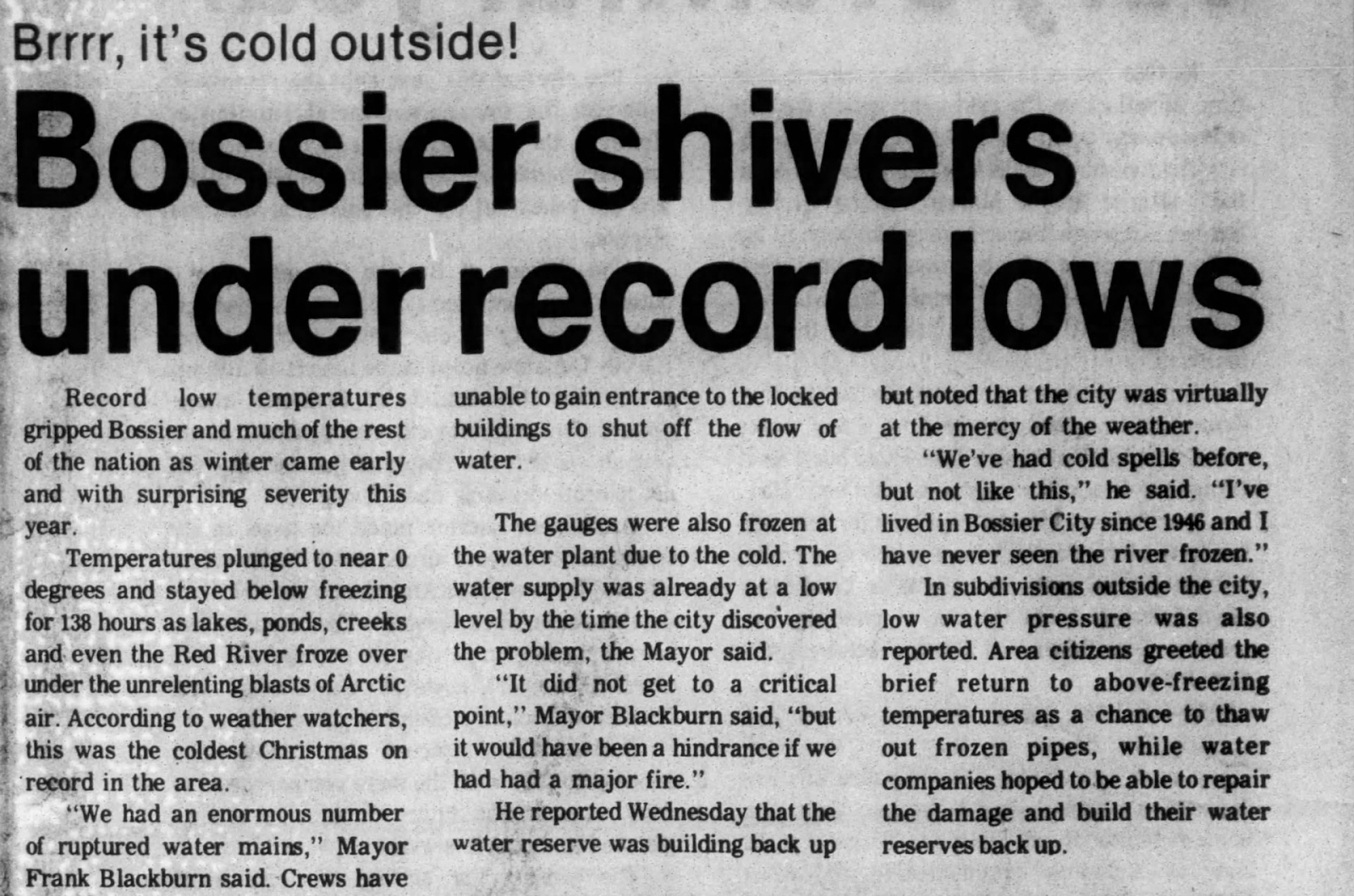
The waters of the Red River, normally free flowing, came to a halt in December 1983, and 41 years later, this event is still a source of wonder and awe. Few times in local history have cold temperatures made their presence known on such a grand scale or created such a stunning display.


As residents prepared for Christmas in ’83, the weather gave no hint of what was to come. According to author and National Weather Service observer Billy Andrews, conditions were nothing out of the ordinary. “The first ten days of the month were typical of December weather ... ranging from above to slightly below normal on temperatures,” he writes in his book “Outstanding Weather Phenomena in the ARK-LA-TEX.” “Most of us would not remember that the high temperature on December 9th was 72 degrees.” Those mild temps would not last.


Bone-chilling arctic winds began blowing south from Canada and reached our area on December 16th, dumping nearly six inches of snow, according to Andrews. By the 21st, the daytime high never got above freezing. This unrelenting cold set the stage for a spectacle that hadn’t been seen here in nearly a century.


With temperatures plunging to new lows seemingly every day, chunks of ice began appearing in the Red River, amassing along both banks. As this buildup grew, open water slowly vanished. Helped by a record low of six degrees on Christmas Day, nature worked its magic; the mighty Red was stilled, its waters frozen. Like a vanquished foe, the river lay silent and motionless.


The curious braved the elements to witness this once-in-a generation occurrence, professional photographer Roger Braniff, Sr. among them. With camera in hand, he ventured out with members of his family. “We just decided to drive around to see what we could see,” he said. “We drove down to the river and were surprised by what we found.” The amazing photos he took are priceless, capturing the Red at its most unrecognizable. Braniff admitted being somewhat concerned watching people walk out onto the ice. “I didn’t know how thick it was and thought they could fall through,” he said.


In his book, Andrews states that from December 21st through the 27th, the area endured 138 straight hours of temperatures at or below freezing. “The extended period of very cold weather the latter half of the month … resulted in the coldest December of record,” he writes. “The magnitude of the ice jam ... probably has not occurred since February 1895.” Conditions during that 19th century winter were very similar to conditions in 1983, according to his book, with temperatures of 32 degrees or below lasting 168 consecutive hours.


Despite the passage of 41 years, the events of December ‘83 still play a role in Braniff’s life. After storing his images decades ago, he decided to post them to his Facebook page where they were noticed and shared by Mike and Mark Mangham of Twin Blends: Northwest Louisiana History Hunters and garnered lots of likes and comments. Then came my phone call with questions for this article. The attention has been unexpected. “I’ve been amazed, actually,” Braniff said. “I had the photos filed away for 35 years.” Their coming to light again demonstrates that sometimes life’s unexpected moments can have the most lasting impact.


If you have any photos or other information relating to Bossier Parish history, the History Center may be interested in adding the materials to its research collection by donation or by scanning them and returning the originals. Call or visit us to learn more. We are open M-Th 9-8, Fri 9-6, and Sat 9-5. Our phone number is (318) 746-7717 and our email is history-center@bossierlibrary.org. We can also be found online at https://www.facebook.com/BPLHistoryCenter/ and http://bpl-hc.blogspot.com/

Images: 

  • The two photos are courtesy of Roger Braniff Sr. Photography
  • The headline is from the December 30, 1983 issue of the Bossier Tribune

Article by: Kevin Flowers

Wednesday, February 1, 2023

PART II A Chilling Account of the 1851 Bellevue Tornado

 In February of 1851, a tornado decimated the east-central Bossier Parish village of Bellevue. Sometimes spelled “Belle Vue,” this tiny, remote community was the seat of Bossier Parish from the parish’s beginnings in 1843 until 1888, when it moved to its present location of Benton. This is a continuation of last week’s story (1/25/23) of how the village fared in the aftermath of this unpredicted destructive, nighttime storm. An anonymous resident described their harrowing experience in a journal, which the “The Bossier Banner” reprinted on January 17, 1895:


“’My God!’ was the general cry among us, ‘the whole town is in ruins and many must be killed!’ And then breaking out like wild men, the first object we saw was the dwelling of Dick Hollingsworth, a mass of ruins crashed between the weight of a large tree that had fallen across its center; we were at the house in a moment; we saw Dick, with his arms around his wife and little ‘Doc,’ while Mrs. H. was holding her infant in her arms, the huge tree within three feet of them and the crashed and shattered masses of roof and timber all around there. There they stood, each a mute, pale stature of terror—neither of them moving and scarcely breathing! We called to him, and he looked as awakening from a dream and answered.


‘We are all safe here, but in God’s name’—and pointed to Bodenheimer’s. So complete was the wreck here that from our position we could see no sign of a house! Some small trees in the yard had been uprooted and hid the ruins from our sight. We, however, rushed forward and saw Mrs. B. running with her infant in her arms, as if pursued by some dread object, with a wild instinct, seeking for some refuge, after the danger was entirely over.”


The house was a complete wreck—the logs thrown every way—the floor sills lifted from the blocks upon which the house rested, and not one chair or other article of furniture but what was broken, but not one soul out of the seven that were in the room was injured.


By 1847, the earliest Jewish settler in the area, Jacob Bodenheimer, was living in Bellevue with his wife, Eliza Weil. The baby in her arms would have been their first child, Harriette, born in 1850. Jacob was one of the first business owners in Bellevue, including providing lodging for out-of-town visitors. Since, as mentioned in part I, court had recently been in session and there were visitors in town, it is likely that the seven inhabitants of the destroyed home included out-of-town visitors lodging with the Bodenheimer family of three. Also, at some point in 1851, Jacob’s niece and nephew, Fanny & Lazarus Bodenheimer immigrated to Bellevue on the encouragement of Jacob, who gave Lazarus his first job. It is possible that they, too, were among that group of seven that survived the violent tornado.


We made a tour around town, and found but one dwelling house that escaped from injury. Lawson & Hervey’s livery stable was blown flat down, with several horses under the wreck. The horses were prized [pried] out of the sides and roof, and no horse was lamed or injured in any way.”


“After the tornado passed, there was not a breath of wind to be felt; the rain fell in torrents, but none of us felt the rain until after we saw all safe—saw the women wildly hugging and kissing each other, and heard mutual congratulations—and night, deep, dark and impenetrable, hid the ruins of the town from our view.”


“We have had our romantic incidents, our deeds of horror, our times of sickness, gloom and death, but our history knows of no more thrilling event than that of the 20th day of February, 1851.”


It is amazing to have such a detailed narrative of surviving the destruction of a tornado that hit without warning over a hundred and seventy years ago. What we don’t have is any scientific data from that time. The ability to record, analyze, save and compare that data, of course, is what would have allowed some prediction of the event to the folks of Bellevue. Unfortunately, it would be another one hundred years before the existence of any kind of reliable tornado forecast system.


A method of “rules” to help predict tornado forecasting were developed in 1884 (Finley’s rules from a US Army Signal Sergeant) but these rules and continued investigation gained little traction when the government forbade any reports or predictions to even use the word tornado, for fear it would cause unwarranted panic. Tornado outbreaks in Missouri, Arkansas, and Tennessee on March 21,1952, killed over 150 people and led to public outcry and Congressional pressure for the issuance of tornado forecasts. As a result, the Severe Local Storms (SELS) Center was established within the Weather Bureau in June 1953.


If you have any information, stories, or photos about natural disasters in the history of Bossier, we would love to add material to the History Center’s research collection. Please come to the History Center to see our new display about the 1978 tornado in Bossier City, or read about other events in local weather history in our collection, at 2206 Beckett St, Bossier City, LA. We are open M-Th 9-8, Fri 9-6, and Sat 9-5. Our phone number is (318) 746-7717 and our email is history-center@bossierlibrary.org


For other fun facts, photos, and videos, be sure to follow us @BPLHistoryCenter on FB, @bplhistorycenter on TikTok, and check out our blog http://bpl-hc.blogspot.com/.