Showing posts with label Bossier Parish School Board. Show all posts

Wednesday, July 20, 2022

FILL THE SCHOOL BUS -- with Sour Cream!?


Here in Bossier it’s almost time for school to start! That means it’s a good time to make a pitch for United Way of NWLA’s Fill the Bus campaign.  Each of your Bossier Parish Libraries branches has a box available through Aug. 2nd to collect school supplies for this program. The United Way will distribute the supplies to Bossier schools and students who need them. 

Did you know almost a century ago there was another program where school buses were used to provide community aid for tough economic times. In 1930, the first full year of the Great Depression, the Bossier Parish School Board had shelves installed in the back of school buses so the buses could contain not only students, but sour cream! That might sound a bit odd, but sour cream was very deliberately chosen for what would now be referred to as a “cash cow” project. It was a project designed to bring local farmers additional cash with little ongoing investment beyond the initial one, which in this case was literally the purchase of a cow! 

Bossier parish farm agent H.F. Spencer, as well as agriculture agents across the region, encouraged farmers to get a cow, or maybe even a few cows, which could then produce cream that could be sold as a profitable “sideline” in the slower season of their farms, like late fall and winter. Agent Spencer believed that the cows could “bring in a nice little pay check during a season that is often barren for most farmers. Though they cannot hope to realize any great profit from such a program, they can, by using sour cream shipping as a sideline, make enough money to buy groceries and other necessities during the great part of the year.” 

Why sour cream? According to agent Spencer, as reported in the “Bossier Banner-Progress” in September, 1930, “It is not necessary to have dairy barns and practice extreme sanitation with sour cream as with marketing whole milk.” He instructed, “Cows may be milked in the usual way, the cream skimmed off by hand each day and put away in a cool place, preferably in a tub of cool water. Then when the shipping day is at hand the cream is taken to the station and the money received for it.” The farmer could keep the skim milk at home “to feed to hogs and poultry.” Spencer admitted the price for the sour cream was not as much as for milk, but given that refrigeration was prohibitively expensive (and electrification had not yet reached all of rural Bossier), he argued that with the lower overhead costs for sour cream, the profit from cream versus milk was just about equal.

The August 14, 1930, issue of the “Bossier Banner” reported that,

 “As evidence of the interest in the milk cow, the Bossier Parish School Board held a special meeting Monday to discuss plans and ways of aiding the farmers of the parish in the marketing of sour cream.  All members of the Board were very much interested in the movement, and have agreed to equip their school buses with racks for the transporting of cans of cream and other farm produce to the high school agricultural departments.” 

In other words, the buses would pick up both kids and cream on their drives through rural Bossier Parish, and bring them both to school! Once at the high schools, the cream was tested for butterfat in the agriculture department and then shipped to the Claiborne Cooperative Creamery in Homer, which would pay by the pound of butterfat. 

The Bossier Parish Libraries History Center can provide an abundance of interesting facts about Bossier Parish.  Visit us soon at 2206 Beckett Street, Bossier City. We are now open: M-Th 9-8, Fri 9-6, and Sat 9-5. Fill the Bus School Supplies will be collected from July 14 - August 2. Requested supplies include pencils/pens (black, red, blue), wide ruled lose leaf paper, glue bottles or sticks, safety scissors, and crayons. For more information, and for other intriguing facts, photos, and videos of Bossier Parish history, be sure to follow us @BPLHistoryCenter on FB, @bplhistorycenter on TikTok, and check out our blog http://bpl-hc.blogspot.com/

Photo: Claiborne Creamery, courtesy of the Claiborne Parish Library. The Claiborne Parish Cooperative Creamery provided farmers of the region, which included Bossier Parish, a cash market for milk and cream. The Creamery opened on June 16, 1929 and operated successfully until the business sold in 1960.

Article by: Pam Carlisle

Wednesday, December 1, 2021


 This Month In Bossier Parish History 

December: Through the Years


Dec. 3rd: National Roof Over Your Head

National Roof Over Your Head Day was created as a day to be thankful for what you have, starting with the roof over your head. There are many things that we have that we take for granted and do not stop to appreciate how fortunate we are for having them. 


1942: John D. Gleason Home Place, wood house with front porch and well to side, sloping roof.
"Just off Pleasant Hill Road"
1999.163.007 Davis Collection 


Strayhan home located in Brushey Community in Bossier Parish, Plain Dealing, LA. Home was built in 1800's. Eleven Strayhan children were born there.
2000.070.001A Coyle Collection


 Front of Heath cabin from an             angle.
 1997.0187.004 Upshaw Collection


Dec. 7, 1994: Jane Smith, former Principal of Haughton High, is named superintendent of the Bossier Parish School Board.  Smith became the first female to serve on the board .  Also, in 1994, she received the Bossier Parish and regional principal of the year award.


1992: Jane Smith, Principal

1992: Haughton High School Yearbook


Dec. 24 - 25: Merry Christmas from the Bossier Parish Libraries History Center!

A Blast From The Past::  Christmas Style. 

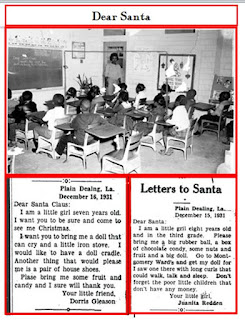
Please enjoy all the odds and ends of Christmas from our parish.  The photos are from our collection and the clippings are from various newspapers.


Wednesday, June 2, 2021

Bossier Parish’s 20th Flagaversary


Flags have been used since ancient times and were originally used mainly in warfare. Today, flags are used as a symbol, a signaling device, or for decoration. One of the most popular uses of a flag is to symbolize a nation or country. In the United States, every state, territory, and federal district has a unique flag, representing the uniqueness of each.

While every state territory and federal district honors the United States flag, you can think of state flags like a first name and the U.S. flag as the last name. Each flag has deep symbolism that speaks to the history of the state, territory, and federal district—each utilizing different styles and design principles.

Each state is made up of municipalities, counties/parishes, cities, towns, and villages. Some of these municipalities have a flag, and others do not. Those which do, display a variety of regional influences and local histories to show pride and symbolize some unique aspect of the area. Louisiana has 64 parishes and 303 municipalities, but like most states, not all of them have a flag.

Twenty years ago, Bossier Parish adopted its first official flag through a contest that was open to middle and high school students throughout the parish. The contest was in response to a Lincoln Parish schoolteacher's campaign to have all parishes adopt an official flag. Police Juror Jeff Rogers initiated the contest, and in announcing the contest, he said, "We won't limit the type of design or colors because we want to use the creativity of students."

Each school held a contest and selected its winners. These winners became semifinalists in the parish-wide contest. The semifinalists were whittled down to three finalists by a Police Jury committee. Then, the full Police Jury selected the grand prize winner, announcing the winner in June of 2001.

The winner was Jennifer Hankins, a Benton High School senior. A Shreveport Times article that announced her as the winner stated that she "worked on her piece for two weeks, completing it with a little help from her family and art teacher, Rose Ann Holomon." Hankins had just started taking art a couple of years before and loved painting with oil pastels. Holomon stated that "Hankins possesses raw talent that can take her into art professionally."

Hankins' flag design won because it best represented the parish. The flag has a green background with a white triangle going from the hoist to the end of the fly. The middle is an outline of the sun with deep red-orange rays along its border, symbolizing the warm climate. In the sun's center are other symbols of the area, including water, a crawfish, the parish seal, an outline of Bossier Parish pinpointing the Parish Seat of Benton, and the dogwood flower.

When announcing the contest, Rogers, stated "The winning student artist will receive a savings bond of at least $100 and will have his or her flag design displayed in a case in the courthouse's main hall. A plaque will list the winner's name and the school the student attends."

What do you want to know about Bossier Parish's history? Or, perhaps you have important information or artifacts about Bossier Parish History that you would like to share. Donations are a large part of our collection and are vital in helping us preserve Bossier Parish's history. Visit, call or email the Bossier Parish Library History Center for help with your research. We are at 2206 Beckett Street, Bossier City, 318-746-7717, history-center@bossierlibrary.org.

By: Amy Robertson