Showing posts with label Red River. Show all posts

Wednesday, July 23, 2025

Bossier West of the Red

When looking at the bounds of Bossier Parish, one would be forgiven for believing that the western bank of the Red River was entirely Caddo Parish, and the eastern bank was entirely Bossier Parish. One would also be quite wrong. Several portions of the traditional Caddo Parish side of the river are in fact Bossier Parish, leading to several instances of disconnected parish land. The reason for all this is due to the language used on the founding of Bossier Parish, as well as physical geographical changes over the past 182 years.


When the borders of Bossier Parish were first drawn, the area that would become Bossier was still Claiborne Parish (which in turn had once been a portion of the greater Natchitoches Parish). The official wording of the act states; “That all that portion or tract of Country in the Parish of Claiborne bordering on Red River and bounded as follows to wit.” The document then goes into detail about official bounds, following Loggy Bayou through Lake Bistineau, then following Bayou Dorcheat up to the Arkansas state line before turning back west and following the state line until meeting the Red River. The observant might notice that much of the above description does not match the current eastern bounds of Bossier Parish. This is due to Webster, and how it was founded out of three separate Parishes: Bossier, Claiborne, and Bienville. On the western bound, it is important to remember, however, that the river has shifted since the 1843 founding, as well as the fact that Caddo Parish was founded before either Bossier or Claiborne Parish. With Caddo Parish’s eastern bound set as the Red River, this created a situation where the bounds for Bossier Parish needed to be drawn in relation to Caddo Parish as well, not just the geographical bounds of the Red River.


First, there is Wright Island, one of the smaller portions of Bossier Parish across the Red River. The residential area has been annexed into the Shreveport municipal area, receiving things like fire, police, and sewage from Shreveport, while things like education are carried out by Bossier Parish. Indeed, according to the August 5th, 1961, edition of the Shreveport Journal, Caddo Parish School Board was approached about accepting the students of Wright Island, but the deal never came to fruition, seemingly due to another orphaned part of Bossier Parish, the Free State Park area. To the east, the Coates Bluff Apartments are the largest section of residential buildings on Wright Island, accompanied by a small number of homes to the west. Another, the Champion Lake area closest to the Red River, south of Anderson Island and Westgate Bridge, is also included on the Bossier side of the boundary line. This includes things like the YMCA, the Loyola Athletic Complex, and the Champion Lake Apartments, to name a few. Due to both areas being within Bossier Parish, as well as the East 70th Street Bridge (Jimmie Davis Bridge) area, most of southern Clyde Fant Memorial Parkway lies within Bossier Parish, not Caddo.


The other large portion of Bossier Parish still on the Caddo side of the Red River lies north of Downtown Shreveport, known as the Free State Industrial Park. Formerly the Free State Plantation, the Free State Industrial Park is dominated by two major features, the aptly named industrial park, and the Shreveport Downtown Airport. There are a few homes within the area as well, though residential homes are in the minority of properties in the Free State Park area. One final, and personally unexpected, region of disconnected Bossier Parish sits in downtown Shreveport. The Shreveport Aquarium, part of Riverview Hall, and the downtown fountains are all part of Bossier Parish. Thanks to the causes natural and man-made, the Red River has been shifted to its current position. Perhaps it is no surprise, therefore, that some portions of Bossier have become disconnected from the greater whole.


If you have any photos or other information relating to the history of Bossier City or Bossier Parish, the History Center may be interested in adding the materials to its research collection by donation or by scanning them and returning the originals. Call or visit us to learn more. We are open M-Th 9-8, Fri 9-6, and Sat 9-5. Our phone number is (318) 746-7717 and our email is history-center@bossierlibrary.org. We can also be found online at https://www.facebook.com/BPLHistoryCenter/ and http://bpl-hc.blogspot.com/

Image: Map of Bossier Parish west of Red River (BPL HC - 1997.086.015)

Article by: Jonah Daigle

Wednesday, December 11, 2024

Still Waters: The Freezing of a River and its Lasting Impact

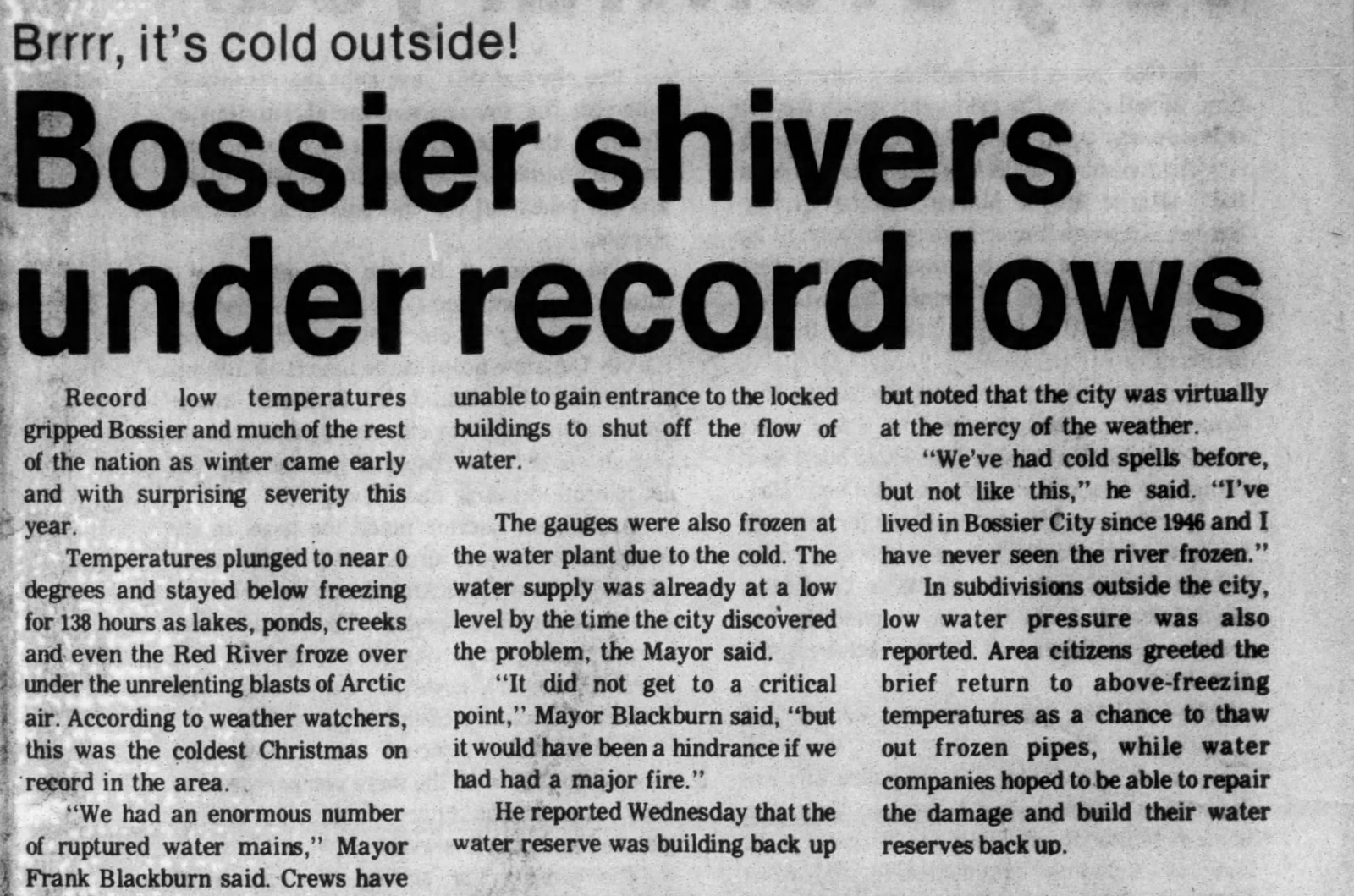
The waters of the Red River, normally free flowing, came to a halt in December 1983, and 41 years later, this event is still a source of wonder and awe. Few times in local history have cold temperatures made their presence known on such a grand scale or created such a stunning display.


As residents prepared for Christmas in ’83, the weather gave no hint of what was to come. According to author and National Weather Service observer Billy Andrews, conditions were nothing out of the ordinary. “The first ten days of the month were typical of December weather ... ranging from above to slightly below normal on temperatures,” he writes in his book “Outstanding Weather Phenomena in the ARK-LA-TEX.” “Most of us would not remember that the high temperature on December 9th was 72 degrees.” Those mild temps would not last.


Bone-chilling arctic winds began blowing south from Canada and reached our area on December 16th, dumping nearly six inches of snow, according to Andrews. By the 21st, the daytime high never got above freezing. This unrelenting cold set the stage for a spectacle that hadn’t been seen here in nearly a century.


With temperatures plunging to new lows seemingly every day, chunks of ice began appearing in the Red River, amassing along both banks. As this buildup grew, open water slowly vanished. Helped by a record low of six degrees on Christmas Day, nature worked its magic; the mighty Red was stilled, its waters frozen. Like a vanquished foe, the river lay silent and motionless.


The curious braved the elements to witness this once-in-a generation occurrence, professional photographer Roger Braniff, Sr. among them. With camera in hand, he ventured out with members of his family. “We just decided to drive around to see what we could see,” he said. “We drove down to the river and were surprised by what we found.” The amazing photos he took are priceless, capturing the Red at its most unrecognizable. Braniff admitted being somewhat concerned watching people walk out onto the ice. “I didn’t know how thick it was and thought they could fall through,” he said.


In his book, Andrews states that from December 21st through the 27th, the area endured 138 straight hours of temperatures at or below freezing. “The extended period of very cold weather the latter half of the month … resulted in the coldest December of record,” he writes. “The magnitude of the ice jam ... probably has not occurred since February 1895.” Conditions during that 19th century winter were very similar to conditions in 1983, according to his book, with temperatures of 32 degrees or below lasting 168 consecutive hours.


Despite the passage of 41 years, the events of December ‘83 still play a role in Braniff’s life. After storing his images decades ago, he decided to post them to his Facebook page where they were noticed and shared by Mike and Mark Mangham of Twin Blends: Northwest Louisiana History Hunters and garnered lots of likes and comments. Then came my phone call with questions for this article. The attention has been unexpected. “I’ve been amazed, actually,” Braniff said. “I had the photos filed away for 35 years.” Their coming to light again demonstrates that sometimes life’s unexpected moments can have the most lasting impact.


If you have any photos or other information relating to Bossier Parish history, the History Center may be interested in adding the materials to its research collection by donation or by scanning them and returning the originals. Call or visit us to learn more. We are open M-Th 9-8, Fri 9-6, and Sat 9-5. Our phone number is (318) 746-7717 and our email is history-center@bossierlibrary.org. We can also be found online at https://www.facebook.com/BPLHistoryCenter/ and http://bpl-hc.blogspot.com/

Images: 

  • The two photos are courtesy of Roger Braniff Sr. Photography
  • The headline is from the December 30, 1983 issue of the Bossier Tribune

Article by: Kevin Flowers

Wednesday, January 17, 2024

Still Waters: The Freezing of a River and its Lasting Impact

 The waters of the Red River, normally free flowing, came to a halt in December 1983, and 40 years later, this event is still a source of wonder and awe. Few times in local history have cold temperatures made their presence known on such a grand scale or created such a stunning display.


As residents prepared for Christmas in ’83, the weather gave no hint of what was to come. According to author and National Weather Service observer Billy Andrews, conditions were nothing out of the ordinary. “The first ten days of the month were typical of December weather ... ranging from above to slightly below normal on temperatures,” he writes in his book “Outstanding Weather Phenomena in the ARK-LA-TEX.” “Most of us would not remember that the high temperature on December 9th was 72 degrees.” Those mild temps would not last.

Bone-chilling arctic winds began blowing south from Canada and reached our area on December 16th, dumping nearly six inches of snow, according to Andrews. By the 21st, the daytime high never got above freezing. This unrelenting cold set the stage for a spectacle that hadn’t been seen here in nearly a century.


With temperatures plunging to new lows seemingly every day, chunks of ice began appearing in the Red River, amassing along both banks. As this buildup grew, open water slowly vanished. Helped by a record low of six degrees on Christmas Day, nature worked its magic; the mighty Red was stilled, its waters frozen. Like a vanquished foe, the river lay silent and motionless.


The curious braved the elements to witness this once-in-a generation occurrence, professional photographer Roger Braniff, Sr. among them. With camera in hand, he ventured out with members of his family. “We just decided to drive around to see what we could see,” he said. “We drove down to the river and were surprised by what we found.” The amazing photos he took are priceless, capturing the Red at its most unrecognizable. Braniff admitted being somewhat concerned watching people walk out onto the ice. “I didn’t know how thick it was and thought they could fall through,” he said.


In his book, Andrews states that from December 21st through the 27th, the area endured 138 straight hours of temperatures at or below freezing. “The extended period of very cold weather the latter half of the month … resulted in the coldest December of record,” he writes. “The magnitude of the ice jam ... probably has not occurred since February 1895.” Conditions during that 19th century winter were very similar to conditions in 1983, according to his book, with temperatures of 32 degrees or below lasting 168 consecutive hours.


Despite the passage of 40 years, the events of December ‘83 still play a role in Braniff’s life. After storing his images decades ago, he decided to post them to his Facebook page where they were noticed and shared by Mike and Mark Mangham of Twin Blends: Northwest Louisiana History Hunters and garnered lots of likes and comments. Then came my phone call with questions for this article. The attention has been unexpected. “I’ve been amazed, actually,” Braniff said. “I had the photos filed away for 35 years.” Their coming to light again demonstrates that sometimes life’s unexpected moments can have the most lasting impact.


If you have any photos or other information relating to unusual weather phenomena in Bossier Parish, the History Center may be interested in adding the materials to its research collection by donation or by scanning them and returning the originals. Call or visit us to learn more. We are open M-Th 9-8, Fri 9-6, and Sat 9-5. Our phone number is (318) 746-7717 and our email is history-center@bossierlibrary.org. We can also be found online at https://www.facebook.com/BPLHistoryCenter/ and http://bpl-hc.blogspot.com/


Images: 

  • Both photos are courtesy of Roger Braniff Sr. Photography.  
  • The image shows a headline in the Bossier Tribune from December 30, 1983.
Article by: Kevin Flowers

Wednesday, November 15, 2023

Water Fights: Bossier City’s New Municipal Water Supply, 1959

 Recently this column relayed how in the 1920’s, after several devastating fires, a young Bossier City desperately needed a municipal water supply. In 1928, when Bossier City connected to Shreveport’s water system that was fed by Cross Lake, the connection happened with much fanfare. The event was marked by an “industrial parade” with beginning and ending ceremonies on either side of the Red River. The parade was a tribute to the industrial resources of Shreveport-Bossier. The less celebratory part of that story was the simultaneous, unsuccessful lawsuits filed to stop the connection.

About 30 years later, Bossier City disconnected from the Shreveport water supply and opened a water treatment plant and delivery system of its own, using the Red River as its water source. The actual disconnect was not done with any fanfare - in fact the change-over happened in secret and caught Bossier residents by surprise, for reasons I have not yet discovered. But once the changeover took place and was “out in the open”, again there was both spectacle and controversy to accompany the arrival of water to the homes and businesses of Bossier City.


A bond had already passed in 1956 allowing for the city to build its water treatment plant. The bond had passed after the distribution of false information, claimed Ned Touchstone of the “Bossier Press,” citing a statement issued prior to the bond vote that the water would not be taken from the Red River. Instead, it was purported to be taken from deep wells near the river, stating that would avoid some of the salt content in the river.

Mr. Touchstone’s newspaper led the fight to halt construction of the new water system, with the main argument against it being the City of Dallas’ problems with using Red River water for its city water. Newspapers around the country reported on the problem of Dallas’ salty city water in 1955 and 1956, following a drought going back to the late 1940’s.

On Thursday, May 7, 1959, Touchstone reported that there was a “secret attempt” to switch Bossier to the Red River water. He remarked that it was no longer secret thanks to his investigating and to the tastebuds of “Bossier housewives:”

More than a score of them [housewives] had called the “Bossier Press” during the last three days to complain about the “different, flatter taste [of the city water]. At 8 a.m. Wednesday, a “Bossier Press” representative drove to the new water plant and found it in full operation. An employee at that plant protested that it wasn’t in use, ‘but we’re just running the machines to get used to running them.’” Touchstone reported that at 9:15, the Shreveport water commissioner also would not disclose if Bossier had discontinued its water purchase, but at 4 pm, Bossier City Mayor Jake Cameron confirmed that, “the practice of mixing relatively small amounts of Red River water with Cross Lake water had been discontinued in favor of the new source.”

A story in the May 10, 1959, “Bossier Tribune” confirmed that the “Water Link with Shreveport is Severed April 28.” Bossier City’s Commissioner of Finance and Utilities, Clyde W. Fowler announced that the city’s $1,150,000 water plant had gone into fulltime operation and that calls he was receiving were favorable on the taste and quality of the water. He added that unlike Shreveport, there isn’t an algae problem with the water source. A photo in the issue showed city officials making a “Toast to a New Era,” as they sipped glasses of water processed through the new plant.


The article also announced the official dedication ceremonies for the treatment facility to be held on May 23rd, followed by an open house with tours of the new plant. Another announcement of the dedication proclaimed that “hill-billy singer” Jimmy Davis (former Louisiana Governor) would be there for entertainment. Current Governor, Earl Long, was invited as guest of honor but sent his regrets. Mayor Jake Cameron was to slash the ribbon.

The plant was said to be deemed a “model of its kind in the South” by engineers and was featured in the November, 1959, issue of the “American City,” a national trade magazine for municipalities. Bossier City was the first municipality to source its water from the Red River.

Does your family have any photos, letters, or other items relating to early infrastructure of Bossier City? The History Center would also like to expand our collection of fire department and police department material. If you have photographs, papers, uniforms, or other items, please consider donating them to the History Center or simply making them available to us to scan. Contact us at 318-746-7717 or email history-center@bossierlibrary.org or visit us at 2206 Beckett St., Bossier City. We are open: M-Th 9-8, Fri 9-6, and Sat 9-5. For other intriguing facts, photos, and videos, be sure to follow us @BPLHistoryCenter on FB, @bplhistorycenter on TikTok, and check out our blog http://bpl-hc.blogspot.com/.


Images: 

  • “Toast to a New Era,” from the Bossier Tribune, Sunday, May 10, 1959
  • Headline, “Water is On!” from the front page of the Bossier Press, Thursday, May 07, 1959
Article by: Pam Carlisle 

Wednesday, July 24, 2019

The Red River's Second Raft

Talfor, R. B, photographer. Scenes of the great Red River raft -/ R. B. Talfor, photo. Photograph. Retrieved from the Library of Congress, <www.loc.gov/item/2008680997/>.
In 1838, when Captain Henry Miller Shreve finished clearing the Red River of the Great Raft, he warned Congress that without ongoing maintenance the raft would reform. Unfortunately, Congress disregarded Captain Shreve’s warning, and within a year the raft began to reconstitute itself. By 1841 there was a 20-mile raft that formed above Shreveport.

Since the first railroad was not completed in Bossier until 1884, communities along the Red River relied on the use of the river and its connected waterways of bayous and lakes as their primary source of transportation of goods, mail, livestock, and people.

Despite many efforts and some funding, attempts to clear the raft during the 1840s and 1850s were overall unsuccessful. None the less it was common for communities and individuals to make every effort to open the waterways to be navigable.

One such call to action can be seen in The Bossier Banner, Friday, November 25, 1859, where the writer was urging “the good people of Bossier to raise a sufficient fund to open the bayous and Lake Bodceau [sic].” And that the “outlay in cleaning and opening navigation in the bayous and Bodceau [sic] to Shreveport would be but a trifling sum in comparison to the good resulting from such an enterprise...Surely any enterprise resulting in good to our parish should meet the warm encouragement of its citizens: and particularly when said enterprise would result in an economical outlay, and immediate benefit two-folds equivalent to the expenditures.”

During the 1860s the raft continued to grow as the country was otherwise engulfed in its Civil War  which raged on until 1865. Finally, in 1871 Congress authorized the Corps of Engineers to clear the Red River which began in the spring of 1872.

Lt. Eugene Woodruff was commissioned with clearing the second Great Raft. Not only did he use the snag boats that Capt. Shreve had invented, but he also used crane boats and steam-operated saws. Perhaps one of the most significant advantages Woodruff had over Shreve in removing the raft was the use of the recently invented explosive, dynamite. Thanks to that, what took Shreve 6 years to accomplish, only took Woodruff 1 year.

Woodruff and his engineers not only performed the work needed to clear the raft; they also dredged the channel, created reservoirs, and constructed dams in anticipation of future floods. Unfortunately, Woodruff had the great misfortune of contracting yellow fever and died in August 1873 before the work was complete. His brother George oversaw the completion of the project which was finished before the end of that year.

Until the raft was cleared, a significant part of daily news was a “River and Weather” column published in The Shreveport Times. During this time weather forecasting was not commonplace; therefore, the weather report in this column was on the previous day’s weather. The vital information, however, were the updates on the condition of the river. It reported on the rise and fall of the river and the effects of the raft on steamboats and ships making their way from port to port along the river and its connected waterways.

On Wednesday, July 24, 1872, The Shreveport Times’ “River and Weather” report shared the following weather information. “The sun was very hot yesterday, but a cool breeze most of the day kept our good people from suffocating. It was the third day that we had no showers, which is a long dry spell for these showery times.”

After the weather report, it offered a lot of information on the coming and going of the steamers and on the current river conditions. A small sampling of this report is as follows.

“The river at this point receded nearly five inches in the last twenty-four hours, making the fall in all from the highest water of the season, eighteen feet and one inch. The officers of the Lotus No. 3 report the lower river falling fast with six or seven feet on most of the bars. At Perot’s they found five and one-half feet, which was the shoale place. None of the bars have washed out any yet. It is thought the Emilie La Barge, a large side-wheel boat drawing all the water in the river, will have some trouble in getting here. We venture to say that Capt. Silver will bring her through or pull her in two. … We are ‘hankering’ after something late and interesting from above the raft, but no stray traveler comes this way. We are aware that the river is dead low, but we are anxious to know how Capt. Jim Crooks, of the Royal George, stands his misfortune. His bad luck will be the death of him yet … The steamers Frank Morgan and Royal George are caught above the raft and will have to put the summer in the best way they can.”

To learn more about the Great Raft and local waterways, visit the Bossier Parish Libraries History Center at 2206 Beckett Street, Bossier City.

By: Amy Robertson