Showing posts with label Local History Column. Show all posts

Wednesday, March 2, 2022

The Early History of Red Land

Jerome Bonaparte Mading's gravestone
at Salem Cemetery
According to the late local historian Dale Jennings, “The name ‘Red Land,’ was first appropriated by the planter Jerome Bonaparte Mading in establishing Bossier Parish’s first post office in November 1846. The post office was on his property four miles northwest of the future site of Red Land, which would not receive its own post office until 1879.” The village began around 1859, and the name, ‘Red Land,’ came from the region’s reddish soil, colored by the high iron ore content.

Salem Baptist Church
The first church in Bossier Parish was established about two miles southwest of Red Land by H.M. Hargis. He began meetings in 1842 and constituted Salem Baptist Church in November 1844 with its first pastor, Moses S. McDonald. Its first church building was a log structure built in 1848 and located on the common grounds of Salem Cemetery. The church later relocated to Red Land.

In the 1850s, the Louisiana State Legislature sanctioned male and female “seminary” schools at several locations in Bossier Parish. These private institutions were an alternative to an unsatisfactory public school system or individual private tutoring. Red Land’s civic leaders applied for and received approval for such a school.

Red Land Seminary's new building 1959
The 1859 supporters of the Red Land Seminary, some being the old church families, were instrumental
in establishing the town of Red Land. Those early families included Roden, Covington, Allen, Boggs, Mading, Winham, Leggett, Martin, Campbell, Barnett, Dixon, Swindle, McWillie, Cavett, Curry Kirkland, and Wallace.

As lauded in the newspaper, the favorable location for the seminary must have been equally appealing as the location for a village. The establishment of the school apparently provided the impetus for the founding of Red Land at the boundary of Martin Martin’s tract and the seminary tract of land.

That same year Doctor John Scott established his practice on Martin Martin’s land. Martin granted Dr. Scott building privileges without rent to construct a medical building and out-buildings. Martin also donated a piece of land to the mercantile partnership of Campbell & Cavett. The general store of brothers-in-law John B. Campbell and Moses C. Cavett was just east of Dr. Scott’s office and across from the school.

The Red Land Masonic Lodge #145, organized in 1857, had its lodge hall above the store. However, it is unknown when the mercantile partnership was formed or when the store was built. In 1865 Campbell and Cavett sold their Red Land holdings, including the store, to Martha Ann Edens Swindle and her husband, John Jones Swindle. Other stores include two grocery stores, one owned by Thomas W. Power and another by George Washington Phelps.

According to Jennings, “It was said that during the early part of the 1880s, the women of Red Land strongly objected to the grocery stores selling alcohol on Sundays, calling them, ‘saloons.’ They evidently doubled as drinking places. (None of the census reports between 1860 and 1880 show Red Land to have had an innkeeper, saloon keeper or a bartender). In 1884, a delegation from the church was said to have approached the grocery store proprietors and asked them to close on Sundays. They refused, resulting in a November 1884 local option election for or against the overall sale of ‘intoxicating liquors’ in Ward 4. The prohibitionists won by a vote of 61 to 41.”

Red Land was never impressive in size but provided the basic needs of its isolated farming community. However, Red Land never acquired a hotel or other such commercial enterprises not being on a railway, waterway, or major roadway. With the construction of the railroads through Bossier Parish in the 1880s, the overwhelming advantage went to towns that became shipping and receiving points on the railway. Red Land declined fast, hastened by the fire of 1890, which destroyed what was said to have been its last store.

The following is the report from the Bossier Banner, 10 April 1890:

“Fire At Red Land. —The large two story building at Red Land, Bossier parish, owned by J. J. Swindle, and occupied as a general store by Henry J. Boggs, was destroyed by fire Monday night about 11 o’clock. The cause of the fire is yet unkown. The hall of Red Land Lodge, No. 148, F. and A.M., was in this building and was a total loss, including all the furniture and records since its institution, about thirty years ago. The Red Land post office was also destroyed, including all supplies and records since 1879.”

By: Amy Robertson

Wednesday, January 26, 2022

The Only Major Crime of 1949

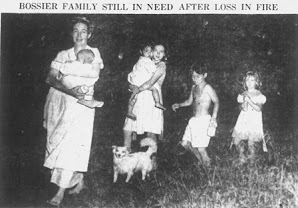
In the fall of 1949, fire swept through a group of 25 cabins in Bossier City called Shirley’s Tourist Courts. They were located at 1402 East Texas Street and arranged in a u-shape configuration. The blaze began in the pre-dawn hours, forcing one family of eight and their dog to flee for safety as they helplessly watched everything they owned go up in flames.

“A small boy, who resided nearby, said he looked out his window to see fire catch in two cabins simultaneously. ‘First, there were two explosions,’ he said, ‘and then fire started coming out of the window.’” The wind immediately carried the fire to other cabins. Of the 25 cabins, only five were untouched, while 13 cabins burned to the ground and seven were damaged. The total destruction was estimated at $38,000. The owner was out of town at the time of the fire.

Bossier Fire Commissioner Fred Jones,
Deputy Sheriff Maurice Miller, and
Police Officer James C. Cathey, Jr.
After Barksdale AFB and Bossier City firefighters extinguished the fire, the first inspection revealed apparent signs of arson. Bossier authorities found two one-gallon gasoline bottles with burning candles underneath them on gas burners in two of the cabins. In other cabins, gas jets were on, and they found heavy glass similar to the one-gallon jars found on top of the stove. Deputy State Fire Marshall Herman Jones said that the blaze “definitely looks like arson.”

The following week the State Fire Marshal Hugh W. Stewart announced that two Bossier City men were charged with aggravated arson of Shirley’s Tourist Courts. The accused were Robert Paul Hogg, owner, and J. L. Morris, a welder employed by Hogg. Morris had confessed to setting the fire. During the trial, “Morris testified that he was offered $1,000 by Hogg, a life-time job and lots of whiskey and pretty girls.”

The state’s star witness, Morris, pled guilty as charged, receiving a five-year suspended sentence, and was placed on probation. Hogg was convicted and sentenced to a prison term of eight years. At the time, he was on parole for a five-year federal sentence for embezzlement, for which he served one year in federal prison before being paroled. In violation of his parole, he was returned to Georgia to complete his federal prison sentence, and in 1952 he was moved to Angola to finish his time for the arson.

According to the testimony of an insurance agent, Hogg would have gained little from the insurance payout. Most of the money would have gone to pay off both mortgages. He had a first mortgage of $13,000 and a second mortgage held by the previous owner, T.R. Hester, of $18,400. With the insurance estimate of $38,000, Hogg would have made out with a little over $6,000.

If you’re wondering how much that would be in terms of today’s dollar, then he would have pocketed approximately $70,000 after paying off the two mortgages totaling about $386,000. Hester ended up having to sue Hogg and the insurance companies for the money due him on the second mortgage. The fire was the only major crime that year, according to the then newly elected Bossier City Police Chief Burgess E. McCranie.

Visit the Bossier Parish Libraries History Center to learn more about fires or crimes or anything about Bossier Parish history that interests you. We are next to the Central Library
branch at 2206 Beckett Street, Bossier City. Can’t come in, call 318-746-7717 or email history-center@bossierlibrary.org with your request. For fun facts, photos, and videos, be sure to follow us @BPLHistoryCenter on FB, @bplhistorycenter on Tiktok, and check out our blog http://bpl-hc.blogspot.com/.

By: Amy Robertson
Wednesday, January 19, 2022

Special Needs School Comes to Bossier


Around this time in 1972, the groundbreaking for a much-needed facility took place here in Bossier parish for the Northwest Louisiana State School. It was an act of the Louisiana Legislature that made the facility a reality. And the culmination of work started by the Caddo-Bossier Association for Retarded Children, who sought a residential facility in Northwest Louisiana.

At that time, there were 1,800 special needs children on the waiting list for admission to state schools. And the only schools available were located in the central and southern sections of the state. The nearest one for Bossier residents was on the outskirts of Pineville, making visiting children a hardship for parents of Northwest Louisiana.

After being elected in 1968, Senator Jack Montgomery made it his number one mission to see a state school established in Northwest Louisiana. At the groundbreaking, in introducing Governor John J. McKeithen, Montgomery gave credit to all area solons for their help getting the project for this area. He specifically thanked Senator J. Bennet Johnston for “taking the initial interest in the project and then helping me to see that the project was kept active and to become a reality.”

Gov. McKeithen admitted the failure of the state to keep up with the needs of the intellectually disabled in regards to facilities available, and the Northwest Louisiana State School was “a tremendous step in the right direction.” The John D. Caruthers family donated the 90-acres for the facility. Gov. McKeithen praised them for their “devotion and interest in such a needed project to actually give the land for the facility.”

At the time of the groundbreaking, the estimated cost of the overall project was $7.5 million. Federal and state funds, a total of $2 million, were secured to build the first phase of more than 100,000 square feet, a 108-bed non-ambulatory unit, and two 24-bed cottages for ambulatory patients 17 years of age and older. The goal was to house between 650 and 750 patients upon completion of the entire project.

The first phase also included an administration building, professional service building, total care facility, educational building, kitchen and dining area, personal service building, and a maintenance and warehouse building.

The goal was to develop the facility into an all-purpose school capable of handling all psychological ranges and handicaps. This school was the fourth all-purpose state school in Louisiana. Providing an environment more closely related to everyday life was a primary goal in designing the facility.

“State Department of Hospital officials said future plans hope to include a gymnasium, training building, recreation building, a diagnostic center, a canteen and an auditorium. Outdoor facilities in the future stage include a swimming pool, picnic area, softball and baseball fields and space for track and field events.”

The Northwest Louisiana State School is now called the Arc of Acadiana. They are “committed to securing for all people with disabilities the opportunity to develop, participate, and live life to their fullest potential.” This facility has been a vital part of Northwest Louisiana for nearly 50 years.

By: Amy Robertson

Wednesday, January 12, 2022

Bossier Librarian Organizes Victory Book Campaign

Anytime there is war, organizations like the American Red Cross jump into action to support the troops. Shortly after America entered World War II, the Red Cross, the United States Organization for National Defense, and the American Library Association joined together to address the need for books for our rapidly growing military.

Immediately after the national book campaign announcement, the Bossier Parish Libraries council called a meeting with representatives from each town in the parish, where they made plans to back the campaign. A call to action appeared in The Planters Press, asking all Bossierites to donate to the cause. All books were welcomed, with used books being cleaned and repaired as needed.

According to the announcement, “These books will be sent to army camps in this area. Many of our boys who are in camp or who will be later, have had to discontinue their studies of various types, some of them would continue their work if the necessary text books were available, and of course books for recreation hours are always needed. The Victory Book Campaign slogan is ‘Give the Book You Are Now Reading.’”

Collection containers were placed in the schools throughout the parish. Each branch of the Bossier Parish Libraries accepted donations, and the bookmobile collected donations at each stop. And, in Bossier City, containers were also placed at City Hall, Barksdale Drug, the Planters Press, Bossier State Bank, the Bossier Tribune, and the Post Office.

Portrait of Mary Elisabeth Williams by A. Menosco.
Bossier Parish Library Collection: 2000.093.001.
Parish Librarian Elisabeth Williams appointed committee members to oversee various aspects of the campaign. Mrs. S.E. Norris led working with Bossier City Schools. Mrs. Nelson covered Haughton. Publicity in Bossier City was assigned to Mrs. Morris and Mrs. Dupuy. The containers for Bossier City were placed by Rev. A.P. Smith and Roy E. Horton. And A.R. Teague oversaw radio publicity.

The types of books needed also appeared in the announcement. The list included topics like applied psychology, current affairs, business, accounting, up-to-date technical books, mechanical drawing, photography, music, poetry, sports, geography, biography, history, novels, writing, math, mysteries, and westerns. All books donated were stamped, “Gift of the people of the United States through the Victory Book Campaign.”

The books were distributed across the nation to Army camps, Naval stations, Coast Guard stations, Merchant Marine libraries, and United States Organization centers. Five-million books were collected within the first five months of the campaign. The campaign ran from the beginning of 1942 through 1943, with approximately seventeen million books passing through the campaign clearinghouse in New York.

For the past eighty-one years, the Bossier Parish Library has proudly provided access to materials, programs, and technologies that enrich, educate, and inspire the residents of this great parish. To learn more about the Bossier Parish Library’s history, visit the BPL History Center at 2206 Beckett Street, Bossier City. Follow us @BPLHistoryCenter on FB, @bplhistorycenter on Tiktok, and check out our blog, http://bpl-hc.blogspot.com/.

By: Amy Robertson

Wednesday, January 5, 2022

Bossierites Help End the Polio Epidemic

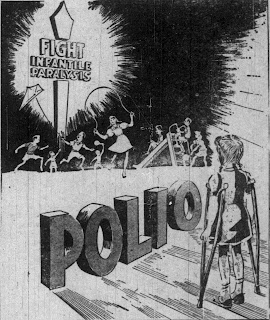
Most people know that the March of Dimes is a nonprofit foundation that "leads the fight for the health of all moms and babies." But do you know why this organization was founded? It began as the National Foundation for Infantile Paralysis, founded by President Franklin D. Roosevelt in 1938, to combat polio.

Like many viruses, the poliovirus has existed for centuries, with the first clinical description of the disease appearing in 1789. The first polio epidemic outbreak in the United States occurred in 1894. By 1905, the contagious nature of poliomyelitis was discovered, and a few years later, scientists discovered the disease was caused by a virus.

Most polio victims were children under ten; only one-fifth of all reported cases were in people 15 years of age and older. Seventy-five years ago, the poliovirus, also known as infantile paralysis, was the most feared disease in the U.S. Late summer intensified this fear as it was dubbed "polio season."

Every year at this time, the annual nationwide March of Dimes fundraising campaign is held. The time coincided with President Roosevelt's birthday, and the idea was to show the President that the people were with him in the fight against polio. Across the nation, committees and chapters were formed promoting the fundraiser.

In 1940, the Bossier Parish superintendent of schools, R.V. Kerr, served as chairman of the fundraising drive. Civic groups like the Benton Lions Club sponsored local events. In 1946, Bossier City held its first March of Dimes campaign, which came to close with the President's Birthday Ball, a common feature of the annual fundraiser seen across the nation.

Bossier City March of Dimes drive, c 1946.
James Allen Collection: L043
Bossier City's first campaign exceeded the expectations of those directing the campaign. Different groups of volunteers representing various clubs and organizations were in charge of solicitation each day of the drive. The Bossier City drive contributed about $1700 to the parish March of Dimes fund. Local elementary school children throughout the parish contributed $1153 to the parish fund that year.

The road to a vaccine was long during that time, without the scientific knowledge and technology we have today. At its peak in the 1940s and 1950s, polio would paralyze or kill over a million people worldwide every year. By the 1950s, polio had become one of the most serious communicable diseases among children in the U.S. Every year Bossierites organized and ran March of Dime drives. Mayor Burgess proclaimed January 1956 as National Polio month.

Through the work of volunteers, money raised by the March of Dimes supported research and education efforts, serving as an alliance between scientists and volunteers. The March of Dimes pioneered the polio vaccine research, making it possible to develop the Salk vaccine. Polio vaccine filed trials sponsored by the March of Dimes in 1954 at select locations nationwide. Bossier Parish was one of four parishes in Louisiana to participate in these trials, dubbed the greatest public health experiment in history.

After successful trials, vaccination clinics were held the following year. Efforts were slowed by vaccine shortages, but by 1957, the annual number of cases was reduced by over 90% following mass immunizations promoted by the March of Dimes. With a safe and effective vaccine, the dedication of health workers, and parents who vaccinate their children on schedule, the poliovirus was eradicated from the United States in 1979.

By: Amy Robertson

Wednesday, December 29, 2021

The Wheels of Change Ends an Era

Plain Dealing Depot c 1910s.
Bryce Turnley Collection: 1997.062.108
The American railroad system was built around the turn of the nineteenth century. Today, many towns in America owe their existence to being selected for a railroad depot. Whether pre-existing or established by the railroad, any place chosen as a depot experienced significant growth from the commerce that followed. Plain Dealing enjoyed such growth as a depot on the Cotton Belt Railroad.

The depot was built there in February 1888, with the track reaching Shreveport a couple of months later. Mrs. Julia Rule, one of Shreveport's most popular women and newspaper columnists, was given the honor of driving the golden spike in Bossier City. The following month telegraph offices were opened at Vanceville, Benton, Alden Bridge, Plain Dealing, and Bradley, AR.

Plain Dealing Depot c 1910s. Photograph by John H. Allen
Located in the center of town, the depot was a vital landmark used in the town's charter to specify the town limits in terms of distance from the depot. According to Manry, "Young and old would meet the northbound train from Shreveport every evening. Drummers would be ushered to waiting hacks, and friends and relatives would be helped down the steps from the train cars. All the daily news that was fit to hear was repeated at the depot when the train arrived."

Plain Dealing Depot, c 1950s.
Bryce Turnley collection: 1997.062.321
In 1971, after 83-years in operation, the announcement of its closing was reported to The Shreveport Journal by correspondent J.A. Manry. The closing of this depot was the end of an era, evidence of the wheels of change. While for many decades, the trains serviced passengers and freight. But with the advent of automobiles and airplanes led most railroad companies to stop pulling passenger cars and focus strictly on hauling freight.

With the focus on freight, the decision to close the depot in Plain Dealing was in the name of efficiency, to allow freight trains to highball through town. The last depot agent here was Ben Bethany. He was transferred to Waldo, AR. Tomorrow will be the 50th anniversary of the closing of the depot. The railroad's last Morse circuit was dismantled while railroad officials gathered to check it out. Cuspidors, clocks, coal shuttles, lanterns, hand grenades, cotton hooks, ticket cases, and trucks were inventoried and hauled away.

Plain Dealing Depot.
Source: The Shreveport Journal, Dec. 31, 1971
The big question lingering in everyone's mind was, what would happen to the old depot building? The St. Louis Southwestern Railway Company offered to give the building to the town as long as it moved it away within three months. At that time, Mayor Leon Sanders stated, "he would consult with the town's inhabitants and the town council would decide its new location and the purpose for which it will be used."

However, meeting minutes of the Town of Plain Dealing reveal that "After a lengthy discussion, a motion was made by Alderman Southerland and duly seconded by Alderman Pittman that the donation be declined and that the mayor be authodized [sic] to draft a letter to the Railway Company stating the reasons for the refusal. This motion being put to vote carried unanimously." Unfortunately, the minutes did not give insight into the reasons for the refusal.

By: Amy Robertson

Wednesday, December 22, 2021

Holiday Happenings Last Century

A lot was happening on this day in 1921. People were driving into town to wrap up shopping for the Christmas holiday. Community newspaper correspondents spread the news of holiday happenings throughout Bossier Parish. Pages of local newspapers were dotted with wishes for a Merry Christmas and a Happy and prosperous New year.

There were announcements of those returning home for the holidays and those traveling out of town to spend Christmas with loved ones. For those that were sick during the holiday season, there were well wishes for a speedy recovery in time to enjoy Christmas festivities. And with schools closing until the New Year, many teachers and students returned home for the holidays.

Since the advent of the American oil boom, there had been daily reports of the progress of oil prospectors across the parish. Holidays were no exception. The Bellevue oilfield had seven more wells, with four in operation. The work of the Roy Company at the Scanland No. 1 site was temporarily suspended due to labor trouble; operations were expected to resume after Christmas.

U.S. Christmas Seal, 1921-23, Unknown author
Public domain, via Wikimedia Commons
The U.S. post office announced they would permit the
application of Christmas stickers and Red Cross seals on the address side of letters and other mail, provided they do not interfere with the address. The decision resulted from the suspension from December 1st to January 1st of the rule that forbade such stickers.

The following week, community correspondents for the Bossier Banner gave accounts of Christmas in their communities. Around Brushy, the correspondent reported that "Christmas was a rather dull season in this community." And that "Some of the residents of the Brushy community attended the Christmas tree given at Alden Bridge Christmas eve night. A good time was reported."

Reports from Carterville stated, "The Christmas tree and program at the Covington School House was enjoyed by all present." Pleasant Hill reported that "Old Santa gave us a wintery Christmas this year."

In Plain Dealing, "Mrs. Sarah Highlander entertained a number of the young people of this section with a tacky party Christmas eve night. There was a large crowd present and all seemed to enjoy themselves very much." Meanwhile, "The community Christmas tree at the High School Auditorium, while a complete success, was not as well attended as it would have been had the heavy rain not fallen early in the evening, causing the streets to be quite sloppy. The singing by the quartet was fine, after which old Santa Claus did his part."

Around Kingswood, the report stated, "The season was greatly enjoyed by our little community. There was a Christmas tree at the school house, with a nice program by the school children; then a bell rang to announce the arrival of old Santa, which was a joyous sight to the children. The tree was laden with presents for every one and, regardless of the bad weather all had a grand time."

While many were visiting friends and family and having a jolly good time, some community members worked hard. Like Sheriff Adair and Deputy Sheriff Job Wilson, who were accompanied by a few of the residents of the Dean's Point southeast of Benton, spending most of Christmas day locating and destroying a bootlegger's still.

By: Amy Robertson

Wednesday, December 15, 2021

Castle of Dreams on the Hill

Giddens Castle c 1931
In 1931 a Shreveport businessman named Tandy Key Giddens purchased 40 acres of land known as Reed's Hill in Princeton. He erected an observation tower on the highest point of the property that looked like a castle. The design of the building, known as Giddens Castle, was inspired by fourteenth-century German medieval castle on the Rhine River.

The stucco-covered frame building was four stories high, the first two stories forming a cross and the last two being octagon-shaped. On top was a flagstaff and sighting turret easily accessed by a winding stairway. Giddens' purpose of his tower was that "people from all over the country could gather and enjoy the scenery." On a clear day, one could see into two adjoining states, Arkansas, Texas, and several parishes in Northwest Louisiana From the tower.

Several weeks after the castle was completed, Giddens estimated between 15,000 and 20,000 people visited the castle. The crowds were attributed to newspaper accounts of the tower. While visitors came to look at the beautiful scene provided by nature, they also got to enjoy Giddens' collection of fine arts and antiques from around the world. His collection included chandeliers from the court of King Louis XVI, an ancient lamp post from the garden of Jerome Bonaparte of Parisa painting by Crimouxand helmets worn by Napolean Bonaparte's officers.

Paul L. Carriger, 1961. Photo by Jack Barham

Often referred to as the "castle of dreams," a fitting name since building the castle was a dream come true for Giddens, and it housed the dreams of others. Including the dream of Paul L. Carriger, who created and operated an experimental radio and television laboratory. It was the first short-wave station in the south, licensed to transmit both sound and picture. Station W9XX went on air with its first test program on Dec. 1, 1931, but it took a couple of months before they transmitted their first television pictures. The station was on the ground floor, and the transmitting laboratories were on the second floor.

According to Carriger, they "were able to transmit picture over a radius of about 100 miles during daylight hours." Having the only receive in this section of the country, making it challenging to test ranges farther than that because they would have to drive the receiver to the selected location and then return to the castle to perform the test.

However, they could receive pictures from such distances as Kansas City, Chicago, and the Purdue University in Lafayette, Indiana. Carriger was proud that "the pictures they transmitted with their equipment were perfect television pictures with no ghosting effects or fading." Unfortunately, Paul was a bit before his time, and due to a lack of public interest and financial and technical resources, the request for a station permit was denied.

Giddens Castle after additions made for night club c1935
A couple of years later, developers built an addition to the castle, creating a large and luxurious nightclub for the social elite. 
The nightclub changed hands and, at one point, was under investigation for allowing gambling. Club Castle was the last nightclub before going up in flames in 1936. The antique chandelier from Louis XIV of France was hanging in the ballroom and destroyed by the fire. Thanks to quick action taken by those on the scene, a large portion of Giddens' collection survived the fire as they were housed in a nearby building.

Today, this area is commonly referred to as Giddens Hill and is now home to Hilltop Campgrounds & RV Park.

By: Amy Robertson


Wednesday, December 8, 2021

Bossier Parish Enters American Oil Boom

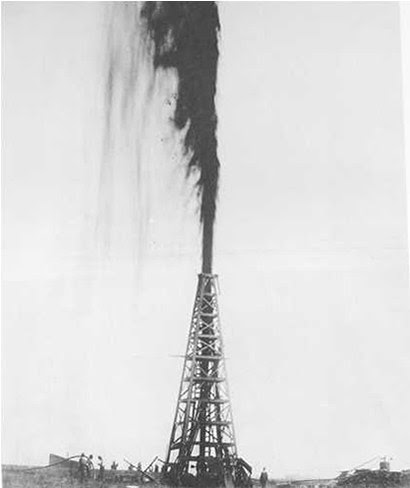
Lucas Gusher, Spindletop Hill, Texas, 1901 

Did you know that Louisiana is among the top ten producers of crude oil in the United States? The beginning of the American oil industry came when on Jan. 10, 1901, a drilling derrick at Spindletop Hill near Beaumont, Texas, produced an enormous gusher of crude oil, coating the landscape for hundreds of feet. News of the Lucas Gusher was heard around the world and ignited "oil fever." Oil prospecting became a big business. People were anxious to make similar discoveries and investors began shelling out tons of money searching for oil.

In 1909, the first oil well that struck oil in this parish was located at Oakland Plantation. Though it was deemed a success because the goal was to find oil and that they did, they felt the vein they struck was too small and decided against extracting it. The oil well was relocated and led to the discovery of natural gas in that section, a common occurrence when prospecting for oil. Nonetheless, the news of striking oil was received with joy throughout the parish and fueled the desire to find more oil here.

R.O. Roy, 1938
Owner of R.O. Roy & Company
Prospectors drilled many discovery wells all over the Parish in hopes of finding "black gold." The first big producer was a shallow pool located at Bellevue that was discovered by R. O. Roy and his associates on Nov. 14, 1921. They put down about a half dozen deep wells and nine shallow wells in their search for the hidden pool of oil. According to the newspaper report, "It was one of the shallow wells that 'brought in the bacon.'"

Bellevue Field oil wells, Bossier Parish, early 1900s
Written on the photo: Nacatoch sand well at 305 feet,
Flowing 1200 barrels a day. 
It was described as a 'wonder' well, because it was the shallowest producing oil well in the Southwest. They reached the pool of oil at a depth of only 397-feet and 10-inches. Before that, the shallowest well was 625 feet deep near Houston, TX. With only a two-inch pipe for the oil to flow through, the well produced at least 60 barrels per hour, approximately 1,500 barrels per day. Had they used the standard four-inch pipe, the daily output would have been upwards of 6,000 barrels.

According to an article by W.S. Ingram published in The Shreveport Times in 1926, "it was the Bellevue shallow field that wrote a new chapter into oil history of the United States." He also stated that "Other wells quickly followed, what was believed the world's shallowest hole flowing 400 barrels from 289 feet, and one of the largest, flowing 3,500 barrels from 336 feet. The total production of this shallow field for the first six months being pipeline runs of 103,700 barrels. The production of this marvelous field for the year ending October 1, 1925, totaled (official figures) 1,327,068 barrels. For the same period there were 32 completions, three being gassers, and 12 producers with initial production of 3,623 barrels.

"This wonder field became the talk of the country and because of the unheard of depth at which the initial production of 1,500 barrels through a two-inch pipe, was obtained, most people were inclined to discount reports of the production. But a visit to the jungle where the holes were located soon convinced the most skeptical. The hole was drilled with a light rotary rig, the table being not more than 30 inches in diameter and the derrick only 38 feet high 'watch charm rigs' as they were termed by a Texas operator. But this field has produced millions of dollars of oil, has caused to be constructed physical property worth millions more and brought Bossier parish and north Louisiana into the limelight of the oil and gas world."

By: Amy Robertson

Wednesday, December 1, 2021

Two Robberies, a Broken Marriage, and a Murder

The first railroad to come through Bossier Parish was the Vicksburg, Shreveport, and Pacific in 1884. Communities lucky enough to be selected for railroad stations and depots were opened to new economic opportunities, stimulating the development of towns and communities. While they attracted more people, industry, and commerce, they also attracted criminals. In addition to train robbers, there were also station holdup crooks, pickpockets, con men, and bootleggers to contend with.

On Dec. 3, 1886, a bold burglary took place at the storehouse of John Franklin Lay at Bodcau Station on the VS&P Railroad. Details of the robbery and how they nabbed the thief appeared in The Bossier Banner the following week.

It was a Friday night between 11 and 1 o'clock when Lay, Levi F. Head, and two or three others were asleep in the store, a common practice in those days. They closed the store at 10 p.m. and went upstairs to retire. They were awakened by a "heavy sound from below like some object had been hurled against the front door or wall." They jumped out of bed and quickly got dressed, struck a light, and went down to the storeroom, where they found that someone had busted the front door open with a large stick of wood.

Upon inspection, they discovered a small desk, which contained over a hundred dollars in gold and about twenty-five to thirty dollars in paper money, was removed from the store. Upon searching the grounds, they discovered the desk some distance from the store. The thief took the gold but overlooked the cash in his haste to abscond the scene.

In the next day or two, a neighboring man named Isaac Gallimore became the prime suspect. They described him as playing the part of "gay Lothario" with a woman named Francis Williams. The name Lothario was used to describe men that were unscrupulous seducers of women. According to the article, "It was through her displaying a plethoric stocking to one of the amateur colored detectives sent out by Lay that Isaac was so quickly 'given away.'"

The detective asked Isaac to change a ten-dollar bill for him. Isaac replied that Francis had all his money. When the detective asked her for change, she pulled her money out, primarily twenty-dollar gold pieces, and could not make the change. This information and the fact that Isaac was headed to Bellevue for a license to marry Francis gave them reason enough to seek an arrest warrant.

Head swore out a warrant the following Monday. Justice A. J. Murff issued the warrant given to Deputy Sheriff Thomas N. Braden, who arrested Isaac while the clerk was issuing the marriage license. Needless to say, the marriage was broken before it began. The money was recovered from Francis, and she was left mourning the loss of her man and the money.

Fourteen years later, Lay's store was burglarized again. This time Lay was closing the store, and while he was bending over to fasten the bottom of the door, a number 3 shot was fired into his chest. The motive appeared to be robbery, as a drawer containing $20 was missing from the store and was found empty at a neighboring gin house between two bales of cotton.

The two suspects arrested were John and George Gallimore, but after further investigation, they were released. Not knowing who murdered Lay, the jury recommended that the Governor offer a suitable reward in the case.

Lay was a native of Bossier Parish, born in 1853. His death was mourned by his three sisters, brothers-in-law, and many other relatives and friends. The money stolen on the night of his murder is equivalent in purchasing power to about $658.55 today.

By: Amy Robertson

Wednesday, November 24, 2021

Remembering "Happy" Cornish

“Happy” Cornish, born William Clayton Cornish, was a native of Plain Dealing. He started his athletic career at Plain Dealing High School as a star athlete playing football and track & field. While earning his M.S. in Education at Louisiana Normal College at Natchitoches (now Northwestern State University), Cornish was a headliner athlete. He was a three-letter man in football (quarterback), track & field, and baseball. Still, he also excelled in poll-vaulting and javelin throwing. He was one of eight people inducted into the Northwestern State University’s N-Club Hall of Fame in 1973.

After college, Cornish coached the Bossier City High School Bearkats for eight years, from 1933-1941, where he quickly proved his skills as a coach. His first year there, the Bearkats were undefeated in their regular season. In 1941, he received his Master’s degree at LSU, and he became principal of Elm Grove High School. After that, he spent two years at Louisiana State University as a physical education instructor. From 1945-1951 Cornish was the head of Centenary’s Physical Education Department.


The following article appeared in the Shreveport Journal, Jan. 13, 1961, detailing how Cornish revived Centenary athletics after World War II:

“Shortly after the outbreak of World War II, Centenary de-emphasized its athletics, abandoned football, basketball, and boxing. When the warfare began to diminish, Centenary College persuaded Cornish to move into its athletic director’s office in a period that found veterans marching back to the campus.

“Happy’s athletic curriculm [sic] for the students was sound with emphasis on conditioning—principally on an intramural scale.

“Flow of veterans picked up tempo in their return to the classrooms with many of the battle scarred men boasting previous football and basketball experience on outfits at other colleges. With the veterans showing the way, Cornish’s athletic program was hiked to include a campus fraternity football league. Interest soared, frequently the fraternities rented Byrd High School stadium for games that were played under the lights. Byrd and St. John’s 9now Jesuit) offered to loan equipment to the teams.

“One day Cornish was seated in his office when he was greeted by a surprise telephone call.

“It was from Camp Polk, La., an Army training center. A colonel of Camp Polk advised that he had an Army football team troubled by a lack of opponents and asked if Cornish would be interested in bringing a team of Centenary All-Stars to the military base for an exhibition.

“Cornish explained that the college did not have a piece of football equipment other than a few footballs for use in touch football games and told the officer he would investigate the possibility for developing the game.

“Next, Happy summoned a few of the leaders of the various fraternities to review the offer. The idea ignited with enthusiasm.

“Equipment was obtained (via loan from excess material in store rooms at local high schools) and a call was issued for Centenary All-Stars.

“The players gathered—some of whom had played varsity football before entering the armed forces and others who were fresh from schoolboy careers. Drills were limited and the squad romped through about two seasons.

“Cornish secured a battered schoolbus [sic] for the trip to Camp Polk, The Stars arrived at Camp Polk, suited up and returned to their bus for a quick jaunt to Deridder where a packed stadium greeted the team on its entrance to the field.

“Loaded with material from the Pacific Coast, Midwest, Southwest and Southeast Conferences and bolstered by several All-American players, Camp Polk mauled the Centenary Stars.

“Nobody cried because the game had been arranged strictly for the morale of the servicemen in the Polk area.

“Cornish’s stars were invited to dine with Polk’s athletic officials; the meal was completed and the squad was preparing to return to Shreveport.

“Cornish was making his departure from the dining hall when he was summoned by one of the Army officers, only to hear a surprising story about an excess of football equipment. Polk’s excess togs were offered to Centenary. Cornish advised that he had no actual football team.

“Athletic leaders of the fraternities were asked to join the conversation. The equipment was accepted and divided among the school’s Greek organizations.

“Two weeks later, Camp Polk officials telephoned Cornish again. This time to inquire about possibility for a second football game with the Stars—a 15,000 seater at the time.

“Tickets were printed and distributed and on the night of the game a crowd of 10,000 gathered to watch Centenary’s brief return to the gridiron.

“It was Cornish who started Centenary on the return to the hardwood. With Nickie Lester, Omar Shively, Cotton Bobbins and Dayton Waller a cage outfit was formed for games with local independent teams. A year later, Cornish had his cagers playing a collegiate schedule that was stepped up when Jack Clayton was hired to take over the hardwood program.


“Cornish’s efforts to bring back football to Centenary resulted two years later in the college’s one-year revival of the sport in a shake-up of the athletic department. New coaches were hired. Cornish departed to become athletic director and head coach of Furman University with Clayton moving to Western Kentucky.” …

Everywhere he went, the students, faculty, and fans all loved him. When Cornish died in 1977, the 1935 BHS football team members paid for a wind-chime memorial for his church, Kelley Memorial Baptist Church.

By: Amy Robertson