Showing posts with label Christmas. Show all posts

Wednesday, December 18, 2024

Holiday Viands (Good Food!) in Old Bossier

During the holiday season in Bossier Parish, delicious food is always on the menu. From the parish formation in 1843 to today, treasured recipes are the backbone of family gatherings and community events. Newspaper articles from the 19th century are full of words and delicacies we might not recognize now, but the celebratory spirit and impulse to gather with special friends and family and favorite foods remain.


Rupert Peyton, newspaperman and a recorder of Bossier Parish history, was born in 1899 in Webster Parish and grew up as a child and young man on a farm in the Plain Dealing area of north Bossier Parish. He recalled, “Of all the seasons of the year Christmas time was the most enjoyable. Though we seldom received many presents such as toys, we always had plenty of good things to eat, oranges, apples and candies. It was also the time for feasting on such things as roast turkey, cakes and pies. It also meant family reunions. We usually gathered for Christmas day at some relative’s home there to play and enjoy ourselves with our many cousins … Eggnog was one of the delights of the day for both old and young. The older folks would spike the nog with whiskey, which they drank and it added to the gayety of the occasion. We children, however, got no whiskey in our nog, it was served to us unspiked, but that made little difference with us children.”


For 19th century Bossier Parish residents, Christmas eve was an especially celebratory time. Clare M. Nelson wrote in her August 28, 1987 independent study paper, “Christmas Customs of the Northwest Louisiana Pioneers, 1850-1880,“ that following a night of dancing, which rarely ended before midnight, “Christmas morning came early and usually brought visits from friends and family.” These visitors enjoyed eggnog offered by hosts and hostesses.


Ms. Nelson continued that the main Christmas meal was served at mid-day. It included the usual fare of meat, vegetables, relishes such as chow-chow (made typically from pickled, chopped green tomatoes, onions, cabbage, and seasonal peppers or other vegetables), cucumber pickles, and pickled peaches. Cornbread and “beaten biscuits” (that were more like a slightly soft cracker than the fluffy, airy biscuits popular today) were eaten with freshly-churned butter. She pointed out that oysters were a special Christmas treat and therefore a popular hostess gift.


The desserts would include cakes, puddings and pies. As an example of the ingenuity of nineteenth century homemakers, “vinegar pie” would be made when no fruit was available or affordable and were said to taste remarkably like lemon pie. The most delighted-in cake might be the fresh coconut cake. Since they cost as much as an extravagant ten cents each, coconuts were also a special Christmas present. After the milk had been drained from the coconut and the meat grated for a cake, the shell was carefully saved and used as a dipper bowl or an ornament.


A tongue-in-cheek article in the Shreveport Times of January 18, 1883, which began with the premise that remote Bellevue, the parish seat until 1888, “is the Paris of Bossier Parish,” remarked that the town earned its high-tone reputation for its renowned whiskey. The article continued the story of Bellevue with less mockery when it described Bellevue’s “Holiday Week,” which exemplified many of the traditions described among the “Christmas Customs” article, above:


“On Thursday night (likely December 20th) the ladies gave a church fair in the courthouse. They had a great many tables filled with choice viands (a fancy, archaic word for fancy foods) of every description; also, an abundance of presents or gifts, alluring to the eye but very painful to the purse….The big ball that followed the fair was attended by some of the fairest ladies in Bossier and Webster. She whose rosy lips had been dallying with a pound or so of salad, nuts and cakes a few minutes ago, was now whirling gracefully in the mazy waltz, coquetting behind her fan with auburn haired gentleman who erstwhile had ravenously tackled a turkey, etc. The enchanting strains of the Bellevue string band infused with life and gaiety everyone present, and upon the midnight air the sounds of revelry and joy broke, and youth and beauty and innocence reigned supreme.”


From the staff of the Bossier Parish Libraries History Center, we wish you all the best this Christmas and holiday season. If you have any information, stories, or photos about Christmas and other holiday traditions in Bossier Parish, we would love to add them (or scanned copies) to our History Center’s research collection. We are located at 7204 Hutchison Drive (formerly called 850 City Hall Drive) just across Beckett Street from the old Central Library and History Center in Bossier City, LA. All Bossier Parish Libraries locations will be closed Tuesday and Wednesday, 12/24 and 12/25. Normal operating hours for Bossier Central Library and History Center are M-Th 9-8, Fri 9-6, and Sat 9-5. Our phone number is (318) 746-7717 and our email is history-center@bossierlibrary.org


For other local history facts, photos, and videos, be sure to follow us @BPLHistoryCenter on FB, @bplhistorycenter on TikTok, and check out our blog http://bpl-hc.blogspot.com/.


Images: 

  • Photo of beaten biscuits, which were traditionally made by literally beating the dough against something hard (like a tree stump) with any number of tools at-hand, like a hammer or sideways axe. Photo by Stuart Spivack from Cleveland, Ohio, USA - Flickr, CC BY-SA 2.0, https://commons.wikimedia.org/w/index.php?curid=7587136.
  • Rupert Peyton, who once wrote for the Shreveport Journal, the Bossier Press and the Bossier Tribune and other local publications.
  • Picture of Bellevue, C 1900 - 1910.
Article by: Pam Carlisle

Wednesday, December 20, 2023

Christmas Presents in Christmases Past: Stories from the History Center’s Oral History Collection

 What was your favorite childhood Christmas present ever? Chances are, no matter how long ago, your memory of finding it Christmas morning is as clear as a bell. Perhaps the memories are especially held close if they are memories of a leaner time, when your family still made sure some childhood wishes came true, or a patient sense of anticipation was rewarded. We have an abundance of those kinds of memories recorded in the History Center’s collection of oral history interviews conducted over the past twenty-five years.


Mrs. Minnie B. Walker Payne was born in 1926 and grew up in the community of McDade in south Bossier Parish. Minnie remembered when her father would hook up the mules to the wagon at three in the morning, heading for Shreveport to buy toys for Christmas, such as dolls and little cooking sets and children’s wagons.


Mrs. Mathilde Gatlin McLelland, also from McDade, remembers the Great Depression as “a time when my parents started looking so worried.” So she was amazed as a seventh-grader that they managed to give her a bicycle. She couldn’t wait to ride it – and rode it right off the porch into her mother’s rose bush!


Mrs. Ophelia Burks, of Haughton, was born October 25, 1903, into a family of hardworking sharecroppers. She said normally she and her siblings didn’t have time for games. Christmas was a day for fun though. Leading up to the big day, however, there was lots of work to do. They even had to sweep thoroughly under their house to make everything looking good for the arrival of Santa. (Parents, take note: Ms. Ophelia said as a girl she loved cleaning house when it was for Santa Claus.) Santa’s elves could’ve had a toymaking lesson from Ms. Ophelia’s father, who went out in the woods and cut some small pine trees and made wagons for the children. Ophelia remembered that he “put the little tongue and everything in it where you could pull it. That’s what we had for Christmas.” Her mama put little stockings up on the wall “and stick us a little apples and candy in there. Oh, we thought we were living then!” she remembered with laughter.


Gloria Daigle Roberts, who was born in 1927 and lived as a child in the 1930’s near present-day Bossier Elementary, where her mom operated the private cafeteria for the school when it served all grades, couldn’t believe that one Christmas morning the living room in their multigenerational family home was wall-to-wall, floor-to-ceiling presents, “like we never knew that it was the Depression or that we didn’t have anything.”


John Williams, born in Koran in 1920, remembered his mother kept the children’s Christmas presents locked in an “armie” (armoire). He knew it was always things to eat, which they would find in their stockings – an apple, an orange and a few pieces of candy. When his mother went into town for Christmas, she would buy all the cloth to make his sister’s clothes. She would cut, he would sew and his sisters would get their new clothes for the year at Christmastime.


Rev. Carl Hawkins Sr., who grew up in Princeton in the 1930’s, said he and his siblings always looked forward to Christmas because, like John Williams, that was the time when they got fruits. He said they didn’t get fruit like children have now anytime of the year. They had to wait until Christmas, and find the treats in their stockings. “We would get one apple, one orange, one, two little pieces of candy, couple of pecans, couple of English walnuts and maybe sometimes a few grapes. That’s about it, and one little toy.” For the boys that was often a little cap buster (toy cap gun). He didn’t know why he so dearly wanted a cap buster because he didn’t go to any Western movies at that young age, but “we always wanted to see if we could go running around across the old woods with our cap busters like we were cowboys.” His sisters always got dolls and they all had “Firecrackers. Firecrackers was a big thing. We didn’t worry about shooting firecrackers on the 4th of July; we shot all our firecrackers at Christmas. We didn’t shoot too many at New Year’s either, because we would have shot them all up by New Year’s.”


Clark Strayhan of Brushy in north Bossier Parish and born in 1920, said Christmas was very frugal in their household but they always got something. The present that made the most impression on him was the pedal car he wanted so badly. “In those days [there] wasn’t any such thing as antifreeze at night. If it was going to freeze, you either drained your radiator or you covered it with blankets and quilts. I got this little pedal car and boy, it was pretty and Santa Claus had covered the motor up with a quilt to keep it from freezing. That tickled me and I said, ‘Look what Santa Claus did!’”


We hope Santa Claus treats you and your family well, too. If you have any information, stories, or photos about Christmas and other holiday traditions in Bossier Parish, we would love to add them (or scanned copies) to our History Center’s research collection. Contact us at 318-746-7717 or email history-center@bossierlibrary.org or visit us at 2206 Beckett St., Bossier City. We are open: M-Th 9-8, Fri 9-6, and Sat 9-5. For other intriguing facts, photos, and videos, be sure to follow us @BPLHistoryCenter on FB, @bplhistorycenter on TikTok, and check out our blog http://bpl-hc.blogspot.com/.


Images: 

  •  Minnie Payne, age 4, and her mother, 1930.
  • 1997: Mrs. Mathilde Gatlin McLelland  1997.076.003 
  • Ophelia Burks, The Shreveport Times 15 Jul 2005VF001-7066
  • 1999: Gloria Roberts taken at Bossier High Reunion, Classes of 1940-1944.  1999.119.009
  • John C. Williams, Sr.     2019.049.312
  • Rev. Carl Hawkins Sr., who grew up in Princeton, La. as a young C.M.E. minister
  • Clark Strayhan attending the Plain Dealing Dogwood Program held in the Plain Dealing Library in honor of former Dogwood Queens.      2001.021.049
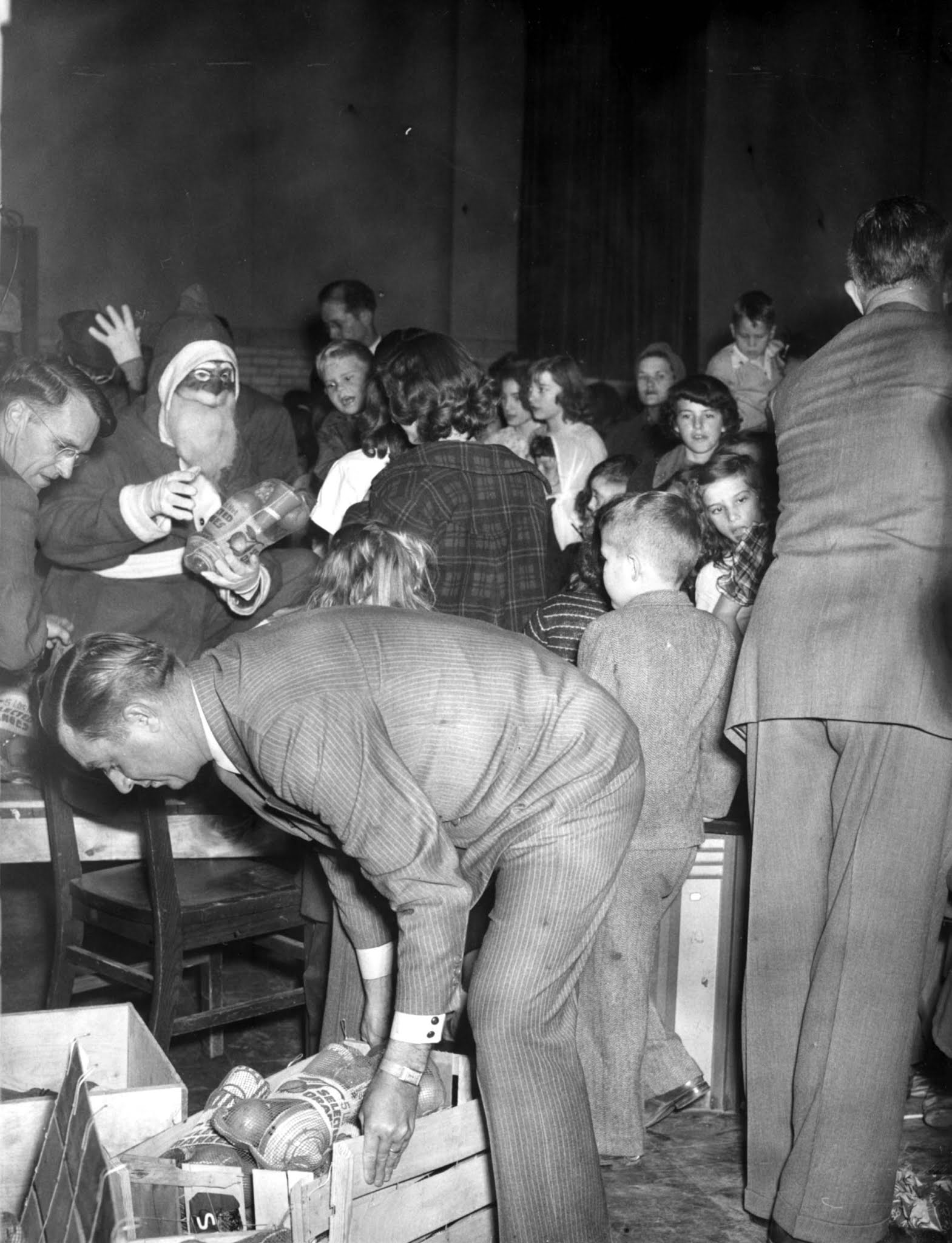
  • Photograph of a masked Santa Claus at the first parish-wide Christmas Party sponsored by the Bossier Parish Chamber of Commerce, held at Bossier High School.  Men from the Chamber are handing out oranges, a Christmas-time treat. 21 Dec 1949.

Article by: Pam Carlisle

Wednesday, December 28, 2022

War Takes No Holiday: Saving the Phone Calls for Uncle Sam

 During World War II on the home front, civilians sacrificed and saved so that the soldiers, especially those overseas, would have what they needed to fight to victory. Barksdale Air Field promoted the “Jeep-O” civilian /G.I. ride-sharing program to conserve gas and seats on the buses, and homemakers and school children were rationing food and saving and collecting cooking fats. A particularly poignant sacrifice, especially during the holidays, was severely limiting time on the telephone with family and loved ones.


An advertisement from Southern Bell Telephone and Telegraph Company in the December 3rd, 1942, “Planter’s Press” newspaper of Bossier City featured a smiling young woman telephone operator with the caption, “I am a Soldier of the Wires”. This operator persona decided with the holidays approaching to “speak right out and ask for the help [she feels] sure everyone is willing to give” even though, writing as someone with far-away family, it’s a pretty tough ask:


"This December, war will take no holiday and Uncle Sam will be using the telephone more than ever. Therefore, we operators are asking you to help us by not making holiday greeting long distance calls this year. We urge that no such calls be made, especially on Christmas Eve, Christmas Day, or New Year's Eve."


Even after New Year’s celebrating was over, the demand was still high. The pleas to yield the phone lines continued in the January 7, 1943 issue of the “Planter’s Press:”


“The New Year, 1943, is the ‘end of the beginning.’ A greater burden of toil and conflict lies ahead. And while America’s sons fight in desert and jungle, telephone communication lines at home will carry an ever-increasing load of calls vital to Victory.


Telephone materials are still going to battle in the form of guns and shells. So, to get the most out of our present equipment, we will continue to need your help in keeping long distance lines clear of all but necessary calls. And remember, the greater the distance you talk, the greater the chance of your call getting in the way of important war calls.


Phone customers were also requested to make their calls in the daytime so that lines were available in the evening when soldiers were at liberty to make calls. (Though the “Barksdale Bark” newspaper encouraged the men on base to call in daytime, if at all possible, since it was the less-busy, though more-expensive time on the phone lines. Customers were also asked to keep the lines and operators free by looking up phone numbers themselves in the Directory.


Most of these requests were shown in clever ‘ads’ from the phone company itself, Southern Bell Telephone and Telegraph, which served most of the American South. But these ads corresponded with an order from the War Department, which appeared in the 15 October 15, 1942, Bossier Banner-Progress:


The Board of War Communications ordered long distance telephone calls relating to the war effort and public safety be given priority over all other calls, effective November 15. Calls concerning moving armed forces during combat operations, urgent orders for the armed forces, immediate dangers due to presence of the enemy and disasters materially affecting the war effort or public security will get first priority. Operators will give precedence to top priority calls at all times.


If your family has any Bossier Parish WWII stories to tell or photos to share, or if you have any information, stories, or photos about local efforts to help out servicemembers during WWII, we would love to see them or to copy them, with permission, to add to the History Center’s research collection. Please visit us at the Bossier Parish Libraries History Center. Don’t forget we have a monthly World War II’s Day coffee and conversation group that meets the second Tuesday of the month, which will continue in the New Year, at the History Center from 10:30-noon. Our next meeting is on January 10th.

We are located at 2206 Beckett St, Bossier City, LA and are open M-Th 9-8, Fri 9-6, and Sat 9-5. Our phone number is (318) 746-7717 and our email is history-center@bossierlibrary.org


Article by: Pam Carlisle


Images: 

1) The Planters Press: 30 Nov 1944

2) The Planters Press:03 Aug 1944

3) The Planters Press:14 Dec 1944

For other fun facts, photos, and videos, be sure to follow us @BPLHistoryCenter on FB, @bplhistorycenter on TikTok

Wednesday, December 21, 2022

Christmas Memories in Bossier

 Childhood holiday memories frequently appear in our oral history interviews, as well as in journals and scrapbooks in our History Center’s archival collection. These were times filled with gatherings, delicious food, the spirit of generosity, and memorable moments with loved ones. Taking a look at these recollections reminds us that these enjoyable times are long-standing traditions in our community.

Minnie B. Walker Payne was born in 1926 and grew up in the south Bossier Parish community called McDade. She remembered when her father would hook up the mules to the wagon at three in the morning to go to Shreveport to buy Christmas toys, such as dolls, little cooking sets, and wagons.

Mathilde Gatlin McLelland, also from McDade, remembers her childhood during the Great Depression as “a time when my parents started looking so worried.” So, she was amazed as a seventh-grader that they managed to give her a bicycle. She couldn’t wait to ride it – and rode it right off the porch into her mother’s rose bush!

Rupert Peyton, a newspaperman and a historian of Bossier Parish history, wrote “Of all the seasons of the year Christmas time was the most enjoyable. Though we seldom received many presents such as toys, we always had plenty of good things to eat, oranges, apples and candies. It was also the time for feasting of such things as roast turkey, cakes and pies. Eggnog was one of the delights of the day for both old and young. The older folks would spike the nog with whiskey which they drank and it added to the gayety of the occasion. We children, however, got no whiskey in our not, it was served to us unspiked, but that made little difference with us children.”

“It also meant family reunions, we usually gathered for Christmas day at some relative’s home there to play and enjoy ourselves with our many cousins. One of our favorite sports at this time was shooting firecrackers and we were always warned to be careful with fireworks and never did we have an unfortunate accident.”

Gloria Daigle Roberts awoke one Christmas morning in disbelief – the living room was wall-to wall, floor-to-ceiling presents, “like we never knew that it was the Depression or that we didn’t have anything.” John Williams, born in 1920, remembered his mother kept the children’s Christmas presents locked in an “armie” (armoire). He knew it was always things to eat, which they would find in their stockings – an apple, an orange, and a few pieces of candy. When his mother went into town for Christmas, she would buy all the cloth needed to make his sister’s clothes. She would cut, he would sew and his sisters would get their new clothes for the year at Christmastime.

Clark Strayhan of Brushy in North Bossier Parish said Christmas was very frugal in their household but they always got something. The present that made the most impression on him was the pedal car he wanted so badly. “In those days [there] wasn’t any such thing as antifreeze at night. If it was going to freeze, you either drained your radiator or you covered it with blankets and quilts. I got this little pedal car and boy, it was pretty and Santa Claus had covered the motor up with a quilt to keep it from freezing. That tickled me and I said, ‘Look what Santa Claus did!’”

From the staff of the Bossier Parish Libraries History Center, we wish you all the best this holiday season! If you have any information, stories, or photos about Christmas and other holiday traditions in Bossier Parish, we would love to add them (or scanned copies) to our History Center’s research collection. Contact us at 318-746-7717 or email history-center@bossierlibrary.org or visit us at 2206 Beckett St., Bossier City. We are open: M-Th 9-8, Fri 9-6, and Sat 9-5. For other intriguing facts, photos, and videos, be sure to follow us @BPLHistoryCenter on FB, @bplhistorycenter on TikTok,

Wednesday, December 14, 2022

Fun with Words, North Louisiana-Style

 It’s the holidays, and if you’re lucky, you may be spending extra time with family and relatives, perhaps in multiple generations. Some inter-generational differences can cause friction, while others are cause for fascination, or at least gentle amusement. The different words and phrases used by folks of different generations, or even different geographic areas, can be an example of the latter.


Recently, I’d been feeling “under the weather.” A coworker asked if I’d been “feeling peaky” then asked if I knew what that meant. I replied I did, and that it must be like the expression my 87-year-old father used, feeling “peaked,” pronounced PEAK-id. That saying reminded me of the expression my grandmother used for feeling poorly. She’d say, “I feel punk”, which as a kid in the 1980’s used to make me howl with laughter, envisioning my grandmother in the punk rocker style of the time.


This banter about old or regional expressions brought to mind a resource in our collection, a 1961 PhD dissertation from Louisiana State University in Baton Rouge called, “A Word Atlas of North Louisiana” by Mary Lucille Pierce Folk. This study showed that for words or expressions of ‘feeling somewhat poorly,’ the most common word at that time in North Louisiana was not “peaky” or “punk”, but “puny!”

Image: Map 1302 from “A Word Atlas of North Louisiana,” Ph.D. dissertation of Mary Lucile Pierce Folk, Louisiana State University, 1961


Mrs. Folk used students from Louisiana Tech University to interview informants in every North Louisiana parish and then mapped the responses parish by parish. The students were also informants themselves, representing the “young” cohort. They also interviewed middle-aged and elderly people.


Food names are featured prominently in Mrs. Folk’s study. Many of these entries reminded me of the various food terms I had to learn when I moved here as a native New-Englander. For example, “English peas” was listed as the most common term for the tiny, round green vegetable sometimes known as “green peas,” or up North, generally just known as “peas”. Here, as Mrs. Folks’ study showed, peas have an entire vocabulary unto themselves. “Corn on the cob” was most commonly reported in the study as “roasting ears.” The term “syrup” is used for cane syrup (definitely not maple syrup), followed by the term “molasses.”


Peanuts were “peanuts,” at least to 58% of respondents, which still left 40% of respondents to call them “goobers.” Unlike most other words in the entire study, a rare one-hundred percent of respondents called a “fried cake with a hole in the center” a “doughnut.”


Some other interesting findings were: Seventy-seven percent of informants called a jail a “calaboose,” a word I’d never heard before. Another word, “courting” was favored over the word “dating,” chosen by 50% of respondents, versus 21%. That left another quarter of respondents with intriguing expressions, such as “wooing” or “sparking.” (Those terms sound much more exciting than my Yankee grandmother’s term, “get next to!”)


One of the most fascinating of the word maps for this time of year is the one for the greeting used on Christmas morning. For the vast majority of respondents (70%), the greeting was “Christmas gift!” as opposed to “Merry Christmas!” Unsure that I was actually reading correctly that “Christmas gift” was used as an exclamation, I did some online searching for the term. In fact, it was used as an exclamation, but it was more than just that. At least pre-1950, the saying was a way to claim the first gift of the day. By the time the custom trickled down over the years, there wasn’t necessarily a particular prize like getting the first gift, but there was still some glory to be had in being the first in the family to say it, according to a writer in “Garden & Gun” magazine. She remembered her South Carolina grandmother calling on the telephone at practically the crack of dawn on Christmas, even though they’d be seeing her later in the morning at a family Christmas brunch, just to be the first to say, “Christmas gift!”

         
Image 1: Small Christmas tree decorated with American Red Cross bags and pieces of paper.  Writing on back:  "D.A. Rials, Christmas tree, just make believe 1917, decorated with scraps of paper - no gifts)
0000.014.036
Image 2: Slide from Princeton High School, box labeled "Princeton 1974-75"
Labeled in pencil "Xmas Tree"    2016.037.298     

It can be captivating to page through Mary Folks’ dissertation to see the words and phrases used commonly a mere 60 years ago that, in many cases, have now all but disappeared. The dissertation is available online at LSU’s Digital Commons website or you can visit the History Center to read a copy. Be forewarned that Mary Folk studied and mapped the vocabulary of white residents only, in 1961, and many of the terms used, especially for racial and ethnic groups, are today considered categorically offensive.


Image: Map 1307 from “A Word Atlas of North Louisiana,” Ph.D. dissertation of Mary Lucile Pierce Folk, Louisiana State University, 1961


Mary Folk’s dissertation is a precursor to the nationwide collection, the Dictionary of American Regional English, or DARE. DARE’s fieldwork was carried out in 1965–1970 and had both black and white informants. The collection was so extensive that the first volume was originally published in 1985 and the fifth not until 2012. In 2013, a sixth volume of maps and supplements came out, as well as the first digital edition. The Bossier Parish Libraries do not carry this extensive resource but there’s an intriguing 100-word sample list available for free at daredictionary.com.


Another fun linguistic resource, for which the Chief Editor of DARE served as an advisor, is the documentary film “American Tongues,” which is available to stream for free with your library card through Kanopy. The film’s summary quips: “Southerners talk too slowly. New Yorkers are rude. New Englanders don't say much at all. Anybody who lives in the U.S. knows the clichés about how people in the various parts of the country handle the English language. “American Tongues” is the first documentary to explore the impact of these linguistic attitudes in a fresh and exciting manner.”


If you need help accessing Kanopy, contact or visit us at the Bossier Parish Libraries History Center. You can also visit us to peruse our oral histories collection to hear or read local dialects. We are located at 2206 Beckett Street, Bossier City. We are open: M-Th 9-8, Fri 9-6, and Sat 9-5. For more information, and for other intriguing facts, photos, and videos of Bossier Parish history, be sure to follow us @BPLHistoryCenter on FB, @bplhistorycenter on TikTok


Article by: Pam Carlisle

Santa Made Special Appearances in Bossier Parish History

 The tradition of Santa Claus and hanging stockings for him to fill was an established custom in this area by the 1850s. In the December 23, 1880 issue of “The Bossier Banner,” the editor remembered how boys had envied girls their long stockings at Christmastime when he was young. In homes where stockings were not hung, Santa would fill boxes or baskets with nuts, fruit, candy and perhaps a toy or book for the children. In its December 20, 1883 issue, “The Bossier Banner” reported that Santa Claus was at Dr. W. J. Mobley’s store in Bellevue.


A visit from Santa Claus was documented in the December 28, 1922 “Bossier Banner:” “About one o’clock, Santa Claus appeared, walking through town and shaking hands with the children, telling them his car had broken down but he would be here for Sunday night’s gifts.” He called at the schoolhouse, delivering gifts to all the pupils. He passed through the building, wishing all joy, and kept up such a noise Professor S.J. Smith left his classroom to call for peace and quiet. However, on seeing the cause of the commotion, he “quietly resigned his authority to the spirit of Christmas.” Then Santa went out and borrowed a horse from one of the school boys and rode out of town singing, “Santa Is Coming”.


In another 1922 visit, a Sunday school class of 42 children arrived at Winona Plantation by automobile. Santa drove up in his car and entered the house through a window, delivering gifts from the Christmas pine. Snowy popcorn was thrown over the tree, giving the appearance of heavy snow. Red berries were used in decorating the entire house.


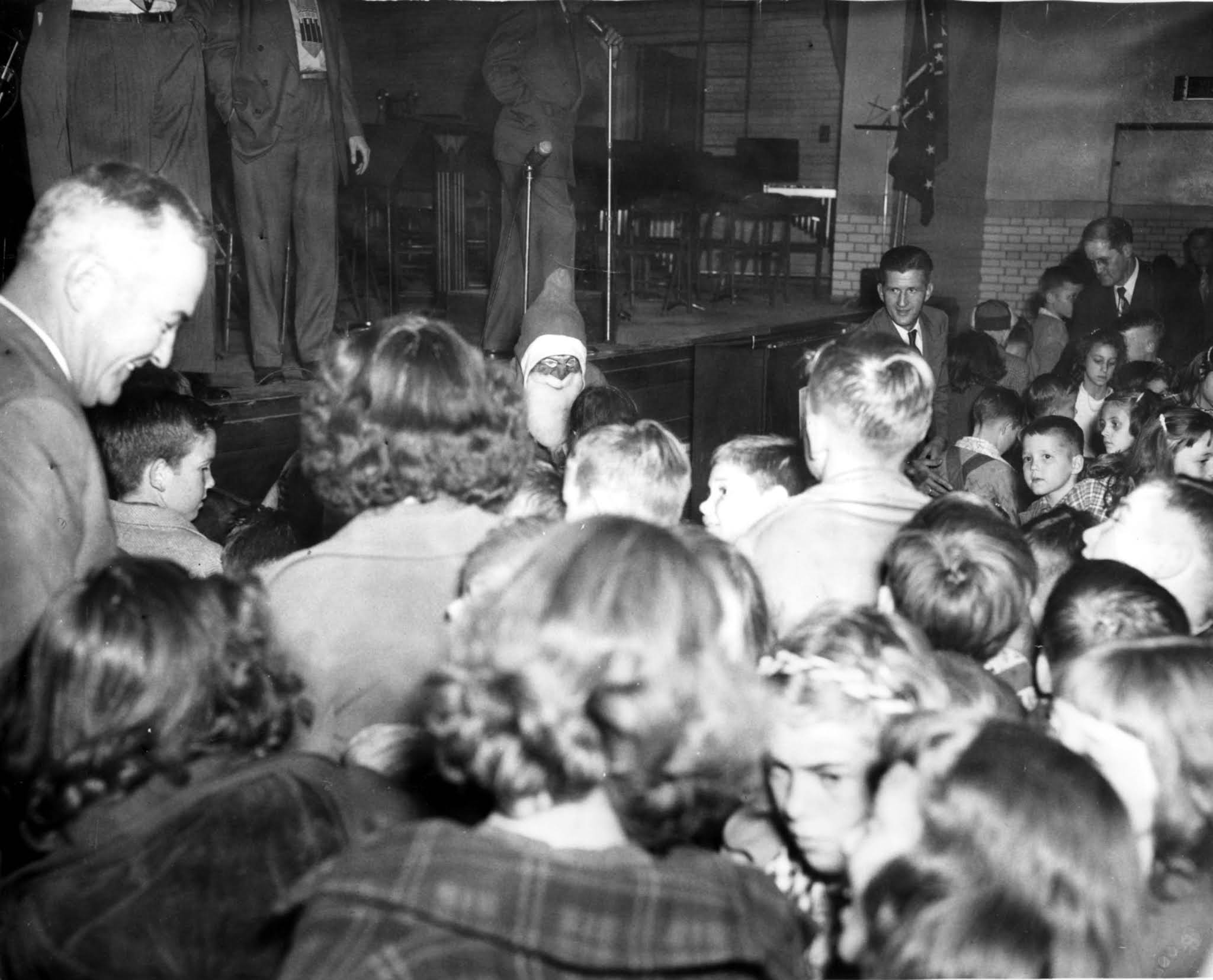
In 1949, families attended a parish-wide Christmas Party at Bossier High School sponsored by the Bossier Parish Chamber of Commerce. A masked Santa helped chamber officials when they handed out large bags of oranges to children, a very special treat then!


One of the most thoroughly reported local Santa sightings was just a few days before Christmas in 1956. Santa made a visit at the invitation of Mr. W.R. Hudson, principal of Bossier Elementary School, for the school’s “Santa Parade.” Santa rode in a firetruck down Barksdale Boulevard and several other Bossier city streets.


Mr. Claus had a lot to accomplish in this 1956 trip. He spent some time visiting with Mr. Hudson and apparently got some information “about behavior and grades of certain local school children. It is understood that Mr. Claus gets the same kind of information from other principals in Bossier Parish.” (This does sound a bit intimidating, though one could guess those sources served their purpose prior to the “scout elf” system of surveillance that is in place today in many households).


Another purpose of his visit was to “clear with Barksdale [Air Force Base] officials. A new ID card was issued to him and military policemen were given instructions to give the top-laden sleigh fast clearance. Radarmen have been alerted to the type of blips which will be made on their screens by the reindeer, so that their appearance will not be mistake for the approach of enemy planes.”


Finally, as stated “in a personal interview with a Bossier Press reporter,” Mr. Claus revealed that “he is constantly surprised with how much Bossier City grows from Christmas to Christmas. ‘Bossier is one of the cities I have to constantly check. It would be awful if I missed one of these new streets – sure would have some disappointed children.’” The Bossier Chamber of Commerce did give him a new map, so hopefully that prevented any trouble. Santa continued, “We usta tell Bossier City from the air by spotting the tanks of the old refinery [likely the Loreco, then Citgo Refinery in the vicinity of the Waller


subdivision.] After that, we navigated on the searchlight at Barksdale [Air Force Base]. But today, we spot the neon on Highway 80 just after we leave Texarkana.” (Santa must have been euphemistically referring to the “Bossier Strip,” a string of nightclubs and other establishments with a booming business on mid-twentieth-century Texas Street, that were advertised on-site with state-of-the art neon signs.)


Santa revealed a crucial piece of information about the changes he’d seen in Bossier City. He described how he used to get hay and feed for the reindeer at the multiple livery stables on Barksdale Boulevard, which was old downtown Bossier’s main street. “All of those livery stables are gone now,” he lamented, “and the deer get terribly hungry as they come in to Bossier from working extra hard to dodge those jet bombers, from Barksdale. I understand, though, that [local businessman] Cecil Woodward will have out a few bales of hay for us this year.”


We hope Santa Claus treats you and your family well, too. If you have any information, stories, or photos about Christmas and other holiday traditions in Bossier Parish, we would love to add them (or scanned copies) to our History Center’s research collection. Contact us at 318-746-7717 or email history-center@bossierlibrary.org or visit us at 2206 Beckett St., Bossier City. We are open: M-Th 9-8, Fri 9-6, and Sat 9-5. For other intriguing facts, photos, and videos, be sure to follow us @BPLHistoryCenter on FB, @bplhistorycenter on TikTok


Images: 

1.) Santa in 1949 at a community Christmas party at Bossier High School, sponsored by the Bossier Chamber of Commerce

2.) W.R. Hudson, principal of Bossier Elementary School. 1956-1957 photo.


Article by: Pam Carlisle


Wednesday, December 22, 2021

Holiday Happenings Last Century

A lot was happening on this day in 1921. People were driving into town to wrap up shopping for the Christmas holiday. Community newspaper correspondents spread the news of holiday happenings throughout Bossier Parish. Pages of local newspapers were dotted with wishes for a Merry Christmas and a Happy and prosperous New year.

There were announcements of those returning home for the holidays and those traveling out of town to spend Christmas with loved ones. For those that were sick during the holiday season, there were well wishes for a speedy recovery in time to enjoy Christmas festivities. And with schools closing until the New Year, many teachers and students returned home for the holidays.

Since the advent of the American oil boom, there had been daily reports of the progress of oil prospectors across the parish. Holidays were no exception. The Bellevue oilfield had seven more wells, with four in operation. The work of the Roy Company at the Scanland No. 1 site was temporarily suspended due to labor trouble; operations were expected to resume after Christmas.

U.S. Christmas Seal, 1921-23, Unknown author
Public domain, via Wikimedia Commons
The U.S. post office announced they would permit the
application of Christmas stickers and Red Cross seals on the address side of letters and other mail, provided they do not interfere with the address. The decision resulted from the suspension from December 1st to January 1st of the rule that forbade such stickers.

The following week, community correspondents for the Bossier Banner gave accounts of Christmas in their communities. Around Brushy, the correspondent reported that "Christmas was a rather dull season in this community." And that "Some of the residents of the Brushy community attended the Christmas tree given at Alden Bridge Christmas eve night. A good time was reported."

Reports from Carterville stated, "The Christmas tree and program at the Covington School House was enjoyed by all present." Pleasant Hill reported that "Old Santa gave us a wintery Christmas this year."

In Plain Dealing, "Mrs. Sarah Highlander entertained a number of the young people of this section with a tacky party Christmas eve night. There was a large crowd present and all seemed to enjoy themselves very much." Meanwhile, "The community Christmas tree at the High School Auditorium, while a complete success, was not as well attended as it would have been had the heavy rain not fallen early in the evening, causing the streets to be quite sloppy. The singing by the quartet was fine, after which old Santa Claus did his part."

Around Kingswood, the report stated, "The season was greatly enjoyed by our little community. There was a Christmas tree at the school house, with a nice program by the school children; then a bell rang to announce the arrival of old Santa, which was a joyous sight to the children. The tree was laden with presents for every one and, regardless of the bad weather all had a grand time."

While many were visiting friends and family and having a jolly good time, some community members worked hard. Like Sheriff Adair and Deputy Sheriff Job Wilson, who were accompanied by a few of the residents of the Dean's Point southeast of Benton, spending most of Christmas day locating and destroying a bootlegger's still.

By: Amy Robertson

Wednesday, December 1, 2021


 This Month In Bossier Parish History 

December: Through the Years


Dec. 3rd: National Roof Over Your Head

National Roof Over Your Head Day was created as a day to be thankful for what you have, starting with the roof over your head. There are many things that we have that we take for granted and do not stop to appreciate how fortunate we are for having them. 


1942: John D. Gleason Home Place, wood house with front porch and well to side, sloping roof.
"Just off Pleasant Hill Road"
1999.163.007 Davis Collection 


Strayhan home located in Brushey Community in Bossier Parish, Plain Dealing, LA. Home was built in 1800's. Eleven Strayhan children were born there.
2000.070.001A Coyle Collection


 Front of Heath cabin from an             angle.
 1997.0187.004 Upshaw Collection


Dec. 7, 1994: Jane Smith, former Principal of Haughton High, is named superintendent of the Bossier Parish School Board.  Smith became the first female to serve on the board .  Also, in 1994, she received the Bossier Parish and regional principal of the year award.


1992: Jane Smith, Principal

1992: Haughton High School Yearbook


Dec. 24 - 25: Merry Christmas from the Bossier Parish Libraries History Center!

A Blast From The Past::  Christmas Style. 

Please enjoy all the odds and ends of Christmas from our parish.  The photos are from our collection and the clippings are from various newspapers.


Wednesday, November 10, 2021

Twentieth Century Letters to Dear Santa

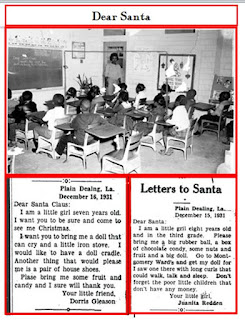
It is Dear Santa Letter Week; a tradition as old as time. Every year, children around the world begin writing their letters to Santa to be sure they make it to the North Pole in time. Over the years our local newspapers have been Santa’s helpers by publishing letters to Santa Claus in the local paper and making sure the letter arrives safely to Santa at the North Pole. The following are letters to Santa that Bossier Parish children have written over the decades.

“Dear Santa Claus:

Please bring me a airgun and a watch and chain.

Goodbye. George M. Gilmer. Age, nine years.” - 1907

“Dear Santa,

I am a little boy 9 yrs. Old and go to school at plain Dealing La. I am crazy about my teacher her name is Mrs. Carrie Lusk. I want you to please bring me a air rifle, fire works, candies fruits and nuts, also a ball. Please Santa visit all the little children that hasen’t [sic] any father or mother.

from your little boy, Perry Pittman” - 1929

“Dear Santa Claus:

I am a little girl six (6) years old and in the first grade. I have been listening to you over the radio, and I saw you in the parade last Saturday. I want you to bring me a wardrobe trunk with a doll and her clothes, and a manicure set. My little sister wants a milk wagon with two horses pulling it, a doll, and a car, and little brother wants a big truck and a train. But, Santa, if you don’t have enough toys for all the poor children give them some of ours, for I don’t want them to be disappointed.

Lots of Love, Nelda Louise McClanahan.” - 1933

“Dear Santa Claus:

I am a little girl just four years old. I have been a good little girl, so when you come to my house this Christmas, please leave me a baby doll. Put it on my Christmas tree. I want the doll to have blue eyes, wear a pink dress and real shoes and socks. Also, please bring me a big red ball with Snow-White on it, a little purse and toy kitty. My stocking will be hanging up by the fire. Put in it for me just a lot of candy, fruit, nuts—and some firecrackers. My stocking is long, but it may not be long enough, so if you can’t get my presents in it, you may use my shoes also.

Your Little Friend, Becky Kilgore.” - 1938

“Dear Santa Clause:

I am a little girl eight years old and in the third grade. I go to Plain Dealing School. I have a little sister three years old. Her name is Carolyn. Dear Santa, don’t forget us on Christmas. I would like to have a Dr. and Nurse set, a doll house and furniture, toy washing machine and a doll. My little sister wants a doll and a wardrobe, a dump truck, a tin set. I am going to sleep good on Christmas. —Jo Ann and Carolyn Farrington.” - 1948

“Dear Santa,

I want a B.A.R. Automatic Rifle. $3.98, Cowboy Guitar with chord player, $4.98, Atomic War Ship, $2.97, Sparkling Combat Tank, $3.98, Honeymoon Express, 88¢, Super Cub with Gasoline motor, $6.95, F-84G Thunderjet, 88¢.

Charles Clements” - 1959

“Deer [sic] Mr. Claus,

I have been a very good, but my brother has been bad so you don’t have to bring him anything. I told you what I wanted when I saw you and I hope you remember.

Jim Stanley” - 1966

“Dear Santa Claus,

I would like you to land on my roof. And go in the house, go in by the door. Then go wake me up and let me see roughdoff [sic].

Love, Nancy Hartwell” - 1977

“Dear Santa,

I’ve been a good boy. My name is Cody. Please bring me a computer.

I love you, Cody” - 1987

Christmas has always been a magical time of year for children. Reading their letters over the decades reveals how war, the economy, and technology have changed their concerns and wants over the years.

By: Amy Robertson

Wednesday, December 23, 2020

The Christmas Spirit of 1949

First parish-wide Christmas Tree party sponsored by the Bossier Chamber of Commerce,
held in the Bossier High School auditorium, 21 Dec. 1949. 

1949 was an exciting time to be in Bossier City at Christmas time. The Bossier Chamber of Commerce sponsored the first parish-wide Christmas tree gala. The local retail merchants' committee of the Bossier Chamber of Commerce arranged for colorful lighting that was installed on Traffic Street from the old post office to Barksdale Boulevard, and on Barksdale Boulevard from Traffic Street to Bennett Street. The newspapers called it "Bossier City's most elaborate display of the Christmas Spirit."

Local merchants financed the affair, and civic organizations and citizens sent donations to provide presents for the children. Original plans for the gala called for an outdoor celebration on the property that belonged to Cecil Woodward in the 700-block of Barksdale Boulevard. It is there that a 12-foot Christmas tree was set-up for the occasion. When inclement weather threatened the festivities, the Christmas tree was relocated to the Bossier High School auditorium, where a crowd of about 650 people gathered to enjoy the Christmas festivities.

After a brief welcome statement from the Bossier Chamber President, D.L. Patrick, clowns and a group of "talented fun-provokers" entertained the crowd. The Bossier High School's 85-piece band played several Christmas carols and other numbers. An 80-voice choir in several selections accompanied the band. The audience joined in the singing of "Silent Night" and "Jingle Bells."

The most welcome guest to attend the Bossier Christmas party was Santa Claus, with all of the merriment he brings. According to an article in the Bossier Banner, "When he appeared near the end of an hour long program in the Bossier high school auditorium, he was greeted with shrieks and yells from more than 200 children. He gave each of them a bag of fruit, nuts, candy and toys."

This gala, like so many holiday events, was about community and giving. This event is one example of how local clubs and organizations work together with the community to provide holiday cheer for all. That same year, the Bossier City Lions Club promoted a Christmas Joy Fund in its third year.

In an article in The Planters Press, it was made clear that "Although inaugurated by the local Lions club the Joy Fund is not the fund of any particular group. It belongs to all the citizens as co-sponsors. All clubs and organizations and all citizens are invited to take part." That year many groups and citizens played a vital role in collecting donations for the fund.

The Bossier High School band members had "tag days" in the downtown shopping area, and they had their annual school concert in which they charged one article of food or clothing for admission. The Red River Motor Company contributed to the transportation of the food and clothing to the distribution center.

The Bossier City Mothers Club surveyed the needs of those less fortunate and prepared the packages of holiday cheer for delivery. Men of various local clubs, including the Lions Club, assisted in distributing the Christmas goods. During that time, the fund raised about $600 every Christmas season, which would be a little over $6500 today. All excess funds remaining at the end of any given year were kept in this "sacred fund" to use the following year.

Various groups have sponsored funds, such as the Bossier City Christmas Joy Fund, for over a century in this Parish. After all, Christmas is a time for giving. May you all have a joyous holiday season.

To learn more about local clubs and organizations, visit the Bossier Parish Libraries History Center at 2206 Beckett Street, Bossier City. Questions, call 318-746-7717 or email us at history-center@bossierlibrary.org. Be sure to follow us @BPLHistoryCenter on FB.

By: Amy Robertson

Tuesday, December 1, 2020

This Month In Bossier Parish History

 December: Through The Years


Dec. 1, 1972: Bossier School Supt. John McConathy announced the new program for an Adult Education Learning Center. 


Bossier Banner: Dec.1, 1972


1974: Bossier Learning Center

2016.037.291


Dec.9, 1920: Weekly news from 100 years ago

* Miss Lois Swindle, now teaching at Linton


c.1920-1930's: Lois Swindle

2018.010.097 Corley Collection


* There are 529 automobiles in the parish


c.1920's: Unidentified group of adults and children in a Model T style car. 
2020.019.019   Shirley Collection


Dec.15, 1950: Bossier City business men Arthur Ray Teague, B.E. McCraine, R.V. Kerr and several others formed a sports promotion club called the Quarterback club. 


Bossier Banner: Dec.16, 1950


1952: Patricia Ann Mullarkey, Hop Fuller (Mayor) and Arthur Ray Teague

1998.047.184 Bossier Chamber of Commerce collection


May 5, 1956: Mayor Burgess McCraine, and Shreveport mayor James Gardner presenting Roy Rogers with a key to the city. 

2016.019.030


Dec.25: Merry Christmas! Wishing everyone a happy and safe holiday. 


1938: Christmas card sent to Mariece Gleason of Plain dealing

Inside card: Merry Christmas to you. AA day that brings warmth and welcome. A time that keeps each door ajar. Merry Christmas and gay festive greetings. To you wherever you are.   From Loise and Walter

2019.005.099  


1943: V-mail letter from World War II.  From Private Archie D. Gladney to Mrs. Viola Gladney of Cotton Valley

1998.040.001 Hardiman Collection


1974: Princeton High School

2016.037.298


Dec. 20, 1951: Bossier Banner


Dec.22, 1961: The Times