Showing posts with label Bossier Parish Libraries. Show all posts

Wednesday, July 29, 2026

Old Stories, New Storytelling

 The original Bossier Parish Libraries Historical Center opened to the public in 1999 as part of an expansion of the original Central Branch on Beckett Street. Though it had rotating exhibits in table cases and glass cabinets, it also had permanent exhibits, which had been designed and constructed at the same time as the building that would host them. These exhibits were housed in in-wall displays on either side of the foyer, and were the first things that one saw when one entered the History Center. There was a diorama of a Caddo village, created by amateur archaeologist Louis Baker; a steamboat exhibit; a log cabin exhibit; and more. Each exhibit represented an aspect of Bossier Parish’s past, and each exhibit was created in cooperation with historians and Bossier Parish locals.


For several years, the original History Center served the public as a research facility, archive, museum, and meeting space. However, by the mid-2010s, talk had turned to renovating the Central Branch, which would include moving the History Center into a different area of the library. Eventually, it was decided that instead of renovation, an entirely new location would be built to house both Central and the History Center. This gave the History Center a unique opportunity: since our new home was being built from the ground up, we could give our old exhibits a serious glow-up, and even put in brand new ones.


Unique and exciting this opportunity might be, but it also brought up many questions. What stories should these exhibits tell? What was the best way to tell them? How would all of this be accomplished with the resources presented? The History Center staff discussed all of this and more for years, with each other, with library and parish administration, and with Prevot Design, Dorand Design Studios, and Downtown Fabworks, who were chosen to bring the new History Center and its exhibits to life. All the while, the History Center also juggled the new building’s construction, the new building’s opening in April of 2024, and the History Center’s move to the new building during the summer of 2024. Finally, in April of 2026, all of that planning came to fruition, as Downtown Fabworks began installing the new permanent exhibits.


The History Center has always been about showcasing as many pieces of Bossier Parish’s past as possible, and these new exhibits take it to the next level. Anyone who steps through our doors can see the Caddo diorama inside of a Caddo hut, and read about Old Shed Road while walking through (a small portion of) it, and view the interior of a dog trot log cabin that seems to have been built right through our wall. Just like in the old building, each exhibit represents an aspect of Bossier Parish’s past. Some, such as the dog trot, we share with other places in this country, but Old Shed Road, a nine-mile-long toll road that was totally covered by a shed to enable farmers to transport their cotton by wagon during rainy periods, is thought to be the only thing like it in this country’s recorded history. Though all of these exhibits were fabricated by Downtown Fabworks, the designs are pulled from photographs and historical documents, a lot of which is housed in the History Center. In addition, the items inside the exhibits are from the History Center’s collection, and so are, for the most part, authentic artifacts from Bossier Parish’s past, donated by Bossier Parish residents or their loved ones. From the spinning wheel in the log cabin to the cotton gin. Even the murals on the walls derive from photographs in the History Center’s collection, and are of people from Bossier Parish history, donated to us by the people of Bossier Parish. These exhibits are therefore a blend of old and new, a culmination of centuries of creation and care.


“History is who we are and why we are the way we are,” and that is why it is of the utmost importance to share it. It can be challenging to do so in a way that is educational, interesting, and respectful of the people of the past, but that is our goal with our new exhibits. The History Center is scheduled to reopen later this year; when it does, people will be able to see the old with new eyes, the culmination of dozens of people’s efforts over centuries. Their creation was a long process, but I believe it will prove to be well worth it.


Bossier Parish Libraries History Center in the Bossier Central Library complex remains closed while our new exhibits are installed. However, we are continuing to share history in a variety of ways. You can explore many of our collections on our website, www.bossierlibrary.org. Look for the History and Genealogy page under Resources. Feel free to contact History Center staff by phone or email for assistance. Our phone number is (318) 746-7717 and our email is history-center@bossierlibrary.org.


Our next meeting of World War II’s Day, a monthly coffee and discussion program on a variety of WWII-related topics, will be Tuesday, August 11th at 10:30 AM in the Bossier Central library complex’s large meeting room. Because August 6, 2026, is the 81th anniversary of the atomic bombing of Hiroshima, Japan, Dr. Cran Lucas, Emeritus Professor of Biological Sciences at LSU Shreveport, will present "Hiroshima and the Aftermath". During the spring and summer of 1966, Dr. Lucas was part of an overseas study group from Lewis and Clark College. He and his cohorts spent five months in Japan including a visit to Hiroshima. Dr. Lucas will discuss the atomic bombing of Hiroshima, its immediate aftermath, and the long-term effects on its extant population and later generations. We hope you can make it, and stay tuned for the re-opening date of the History Center and its new exhibits!


Images: Sneak preview of two of the History Center’s new exhibits: “Old Shed Road,” and “The Red River, Winding through Bossier’s History.” BPL History Center photos by Kevin Flowers.


Article by: Jaylie Rester

Wednesday, August 6, 2025

When History was in the Making in the History Center: A Hurricane Katrina Remembrance

It’s been twenty years, on August 29, since our neighbors on the Gulf Coast had to face the devastation of Hurricane Katrina (and soon after that, Hurricane Rita). Their lives were transformed, and for a while, life here at the Bossier Parish Library was transformed too. It never occurred to us the critical role a public library might play in disaster response, several hours away from the disaster, but we learned on our feet. Hundreds of evacuees poured into the Bossier Parish Central Library and History Center so they could use the computers to look at satellite photos of their homes, to try to contact friends and relatives whose whereabouts were unknown, to watch a New Orleans news channel via the Internet and to fill out their FEMA (Federal Emergency Management Agency) applications.

The evacuees also came to the library as a place to spend time outside of a crowded shelter or relative’s house and as a place to let their kids be kids in our cheerful Children’s Department.

Our librarians did what librarians do – they provided lots of information, from local bus schedules to how to get food assistance - but they expanded their role well beyond that. They provided sympathetic ears and hugs and friendships. They collected books the displaced children could keep, so they wouldn’t have to worry about returning them in a completely unpredictable future time.

History Center staff noticed that history was being made all around us. We put all the tools necessary for doing oral history interviews, like tape recorders, blank tapes, consent forms and notebooks in a box where they were easily accessible. Every staff member was encouraged to record oral history interviews with hurricane evacuees as they came in, no appointment necessary.


We recorded stories of several evacuees who used the library in the days and weeks following the hurricanes, including Nell Charney, an elderly woman who lived by herself in a second-floor apartment in New Orleans’ midtown. She rode out the storm and spent days in her apartment, surrounded by water that reached to the ceiling of the apartment below, without power or any means of communication with the outside world. She was eventually rescued, she believed, by members of the Coast Guard who reached her by boat. They had no way to get her out of her apartment but by breaking her window and helping her though it, thus beginning her journey that eventually found her settling in Bossier City near relatives. She had dramatic memories of the rest of the evacuation:

And of course the boats were having to be very careful because they couldn’t see what was underneath the water, except you could see maybe just the tip of a lamppost … might be sticking up out of the water. So, they were all having to be very careful. We started toward the Broad Street Overpass…

After being dropped off at the overpass, Ms. Charney noted:

It’s a good thing I had on my hat, because that sun was beaming down, and I didn’t know if, when we’d ever get picked up, up there. The helicopters were flying around, but none came down. There had been…evidently, there had been crowds of people on this overpass earlier. Maybe even the day before; because there was all this debris, uh, strung, you know, out along. Lot of food, apples,…some good stuff. Like lanterns, there was a nice lantern there. People had, uh, been there with their possessions and they had just had to leave a lot of it when they got picked up.

In addition, we collected oral history interviews of library staff, recording and transcribing their stories of family members and other loved ones directly or indirectly affected by the monster storms, and of being “on the front lines” helping patrons who were hurricane survivors and evacuees. Former Children’s Services Director Lucille Marabella recalled that library staff “…genuinely showed how much we cared for these folks. It was something that I will never forget for many reasons, personal as well as professionally. Hopefully we can learn from it.” Former Reference Librarian Martha Matlock recalled in her interview that, “I learned a lot about myself during that period of time; how important it is to think that you are connected to about just anybody that walks in that door in some way. And, don’t let them ever go away empty handed…If you can’t give them what they need, send them some place where they can find it.”


The transcripts of these recordings are available for reading at the History Center, or they can be emailed to out of town family members or researchers. As stated by past History Center Director Ann Middleton, these interviews evoke strong memories of what it was like to be in Bossier as an evacuee, or as a provider of a safe haven for family members, or as a concerned public servant during a heart- wrenching time. We are able to share these thoughts and feelings through the generosity of the people who agreed to record an interview for posterity.


We are located at 7204 Hutchison Drive, Bossier City, LA and are open M-Th 9-8, Fri 9-6, and Sat 9-5. Our phone number is (318) 746-7717 and our email is history-center@bossierlibrary.org. For other local history facts, photos, and videos, be sure to follow us @BPLHistoryCenter on FB, @bplhistorycenter on TikTok, and check out our blog http://bpl-hc.blogspot.com/.

Images: 

  • Nell Charney
  • Lucille Marabella – BPL photo
Article by: Pam Carlisle

Wednesday, October 23, 2024

Family History Month: “Generation to Generation”

In a house which becomes a home, one hands down and another takes up the heritage of mind and heart, laughter and tears, musings and deeds. Love, like a carefully loaded ship, crosses the gulf between the generations….So begins one of my favorite poems, “Generation to Generation” by French author Antoine de Saint-Exupéry (best known for “the Little Prince”). I’m sharing it here because October is Family History Month.


Family History Month is celebrated and promoted to ensure that family stories are remembered for decades (and centuries) to come through research and education. It was not a coincidence that the Senate resolution to declare this commemorative month passed unanimously in 2001 just two and half weeks after the tragic and terrifying events of 9/11. The hope behind the act was that learning family history could work to unite communities, as well as provide context for and examples of, and resilience despite suffering and struggles. The U.S. Senate declared, “…Whereas as individuals learn about their ancestors who worked so hard and sacrificed so much, their commitment to honor their ancestors’ memory by doing good is increased; Whereas interest in our personal family history transcends all cultural and religious affiliations... Now, therefore, be it resolved, that the Senate designates the month of October 2001, as Family History Month…”


My grandparents Lillian and Algot Ekstrom of Worcester Massachusetts lovingly did not neglect to hand down their heritage, and my grandmother, especially, told stories that were remembered across generations – stories of childhood pranks on her beloved sisters or playmates, stories of fellow residents in her Massachusetts neighborhood’s trademark triplex (known as “triple decker”) houses, and of a beloved grammar school principal who took the students on nature walks, instilling in the lifelong city girl a lifelong love of nature and a famous green thumb.


Saint-Exupéry’s poem continues, Let us build memories in our children, lest they drag out joyless lives, lest they allow treasures to be lost because they have not been given the keys. We live, not by things, but by the meanings of things. It is needful to transmit the passwords from generation to generation.


I was incredibly fortunate my grandparents passed down those “passwords” and that I got to spend so much time in their home that was filled with meaningful things –stashed in an attic desk were love letters my grandmother wrote while she was in nursing school to her future husband of 69 years, my grandfather, designer dresses, hats and shoes of the 1920s, that passed down from the wealthy industrialist yet progressive family that employed my great grandmother, a young widow from Sweden who was raising 4 daughters, my mother’s and uncle’s prized story books, dolls and trucks, a gallery of my grandfather’s paintings (like many Swedes in his city, he worked in the steel and wire industry, but self-taught, he prolifically painted nature and wildlife) and the brightly-painted wooden horses (Dala horses) passed down through the family or bought as souvenirs from their trip of a lifetime to Sweden with their church.


History Center staff are eager help you research and record your family’s history, and we carefully preserve and make accessible the history of many Bossier Parish families. We also can share the inspiration and research skills we’ve gained from our own and our patrons’ family history searches, whether local or not. Our online resources span the globe. We are in the new Bossier Parish Libraries Central Complex at 850 City Hall Drive, Bossier City, LA (across Beckett Street from the original History Center and “old” Central Library). We are open M-Th 9-8, Fri 9-6, and Sat 9-5. Our phone number is (318) 746-7717 and our email is history-center@bossierlibrary.org


For other fun facts, photos, and videos, be sure to follow us @BPLHistoryCenter on FB, @bplhistorycenter on TikTok


Images: 

  • Lillian Carlson nursing school portrait 1930s
  • Astrid, Ruth and Lillian Carlson, Bancroft Tower, Worcester, MA, 1922
  • Dala horses. Image by Gustav.jg - Own work, Public Domain, Wikimedia Commons
  • History Center research area in the new Bossier Parish Central Complex Library
Article by: Pam Carlisle

Wednesday, September 18, 2024

Reading and Roller Coasters, Log Rides and Library Cards

September is Library Card Sign-up Month. As Bossier Parish Community Engagement Librarian Andrea Gilmer wrote in her column last week (9/4/24) the campaign began as a challenge laid down by then-Secretary of Education William H. Bennet to members of the American Library Association in 1987. The challenge, that the librarians chose to accept, was to see that every child obtains a library card, and every child uses it. Just two years later, the librarians of Caddo and Bossier Parishes had come up with a nearly foolproof plan to reach that goal right here in northwest Louisiana. That was because their plan was put into action at a beloved (especially by kids) local institution, Hamel’s Amusement Park.

Hamel’s Amusement Park began by Charles M. “Milton” Hamel Sr. as a dairy farm in the 1930’s. By 1960, after adding a variety of animals at his own expense for the enjoyment of local children, his dairy farm included a nice-sized zoo, encircled with a mile-long train so visitors could see the free-roaming animals. With rides and attractions added by the Hamel family, especially Milton’s son who became operations manager following his father’s death in July, 1969, Hamel’s became an amusement park complete with roller coaster, Ferris wheel, and other major rides, thus becoming the main family entertainment attraction in the Shreveport-Bossier area until its closure in 1999.


Hamel’s, local librarians knew, was the perfect place to get kids and families excited about summer, and therefore, the perfect place to get them excited about summer reading. It was also the perfect place to make receiving their own library cards a special and memorable event. They began forming many partnerships to make a multi-parish library card sign-up campaign and summer reading program kick-off happen there, beginning in 1989.

First, in partnership with KTBS TV station, all second graders in Caddo and Bossier schools were issued library cards and bused to Hamel’s for a special event to receive them, watch performances and story times on stage, and have some time on the rides. Second graders were chosen as the benchmark year for children to receive their library cards because, explained Sally Tanner, supervisor of libraries for Bossier Parish Schools in the May, 1992, Bossier Perspectives school board newsletter, this is the age at which children begin to read independently and to read for pleasure.

After several days of getting all second graders to the park, the finale of the library card campaign at Hamel’s was a time was set aside for the public of all ages to visit Hamel’s and get in free with a library card. For visitors who didn’t yet have a library card, librarians were standing by at the park gate to issue one on the spot. Or, one could pay a dollar to enter and the proceeds would go to literacy organizations, which were also represented at the event.


Additional partners for the library days at Hamel’s included ARKLA gas, AT&T Pioneers and of course, Hamel’s Park. It was no surprise Hamel’s was willing to cede their park for some early-season educational fun. Milton Hamel, the father, had been known for his involvement in community organizations and charities focused on children, including the Caddo Foundation for Exceptional Children, the Salvation Army Boys Club Advisory Board, and Boy Scouts and Girl Scouts, among many others. His son Milton followed suit, and had also served Louisiana’s Fourth Congressional District as the Board of Elementary and Secondary Education (BESE) representative for two terms in the 1980s.

The library card signup program at Hamel’s was so successful that after only its second year, and the participation of about 14,000 schoolchildren and a doubling of library summer reading program registrations, the campaign won a community service award from the Louisiana Reading Association.

Sadly, Hamel’s closed at the end of the 1990’s, its demise partially brought on by costly damage from a tornado, and the desire of Milton Hamel to move on to other economic development projects. The site is now home to Riverpark Church, which retained some structures of the park and still hosts some community events on the property, such as Paws in the Park in October to raise money for local animal rescues. And if you were a fan of the park’s Pinfari metal roller coaster, and you’re willing to travel to Lakeside Amusement Park in Denver, Colorado, you can still take a ride on it. It was just moved, reassembled and re-opened in the Denver area in 2023!

You can, of course, still visit the Bossier Parish Libraries anytime to sign up you or your child for a library card. If you do that this month, you can take a picture with an oversize version of our library cards located at each Bossier Parish Libraries branch. Be sure to share it on social media and tag us so we can like your post! Come visit the Bossier Central Complex, which now includes the History Center, at 850 City Hall Drive, Bossier City, LA (across Beckett Street from the original History Center and “old” Central Library). We are open M-Th 9-8, Fri 9-6, and Sat 9-5. Our phone number is (318) 746-7717 and our email is history-center@bossierlibrary.org


For other fun facts, photos, and videos, be sure to follow us @BPLHistoryCenter on FB, @bplhistorycenter on TikTok, and check out our blog http://bpl-hc.blogspot.com/.

Images: 

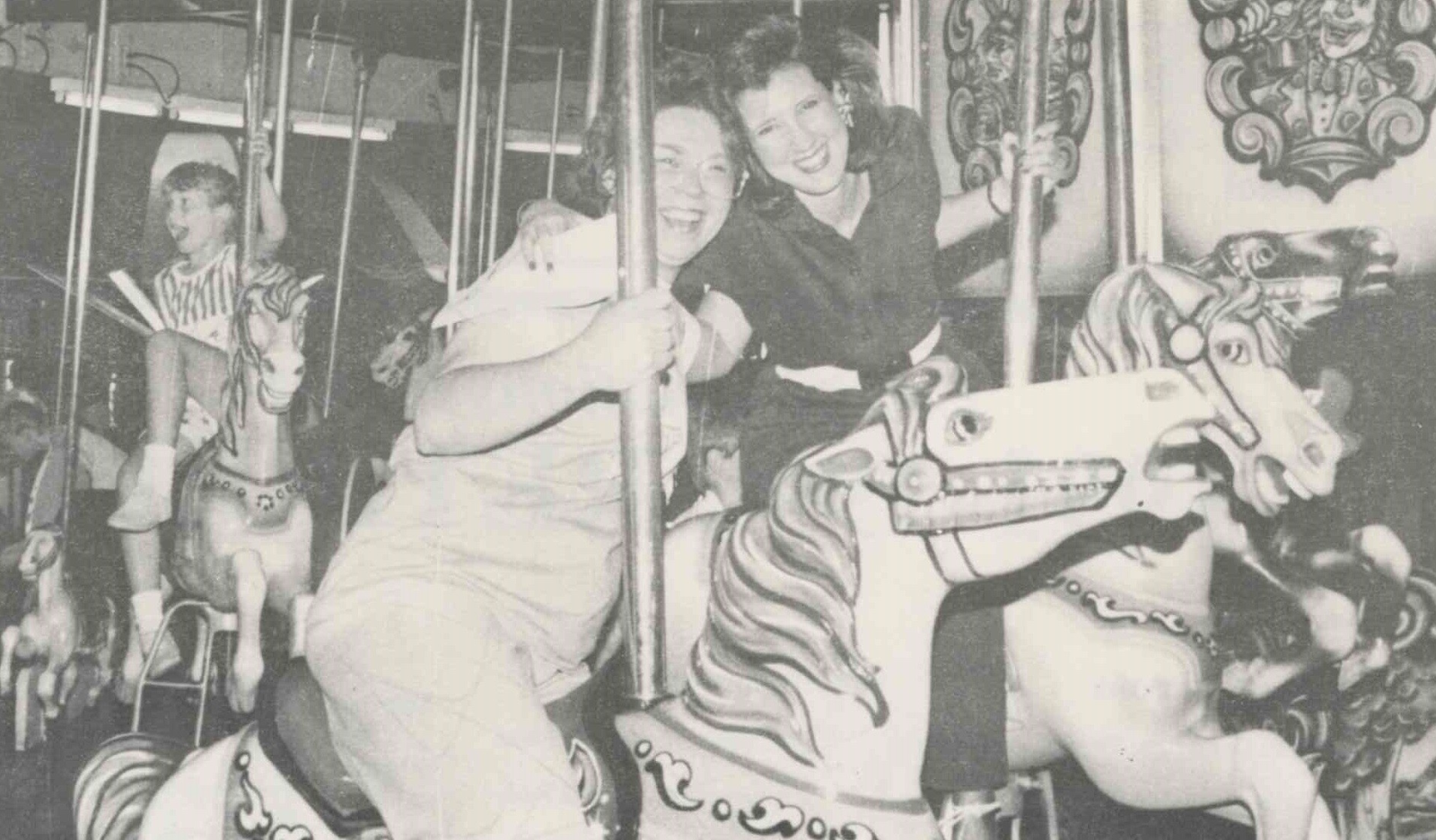
  • “Judy Covington, Resource Director at Stockwell Place, and Libraries Supervisor Sally Tanner take to the merry-go-round” – photo from the May 1992 Bossier Perspectives newsletter for Bossier Parish School Board employees. Howard Jones collection, BPL History Center
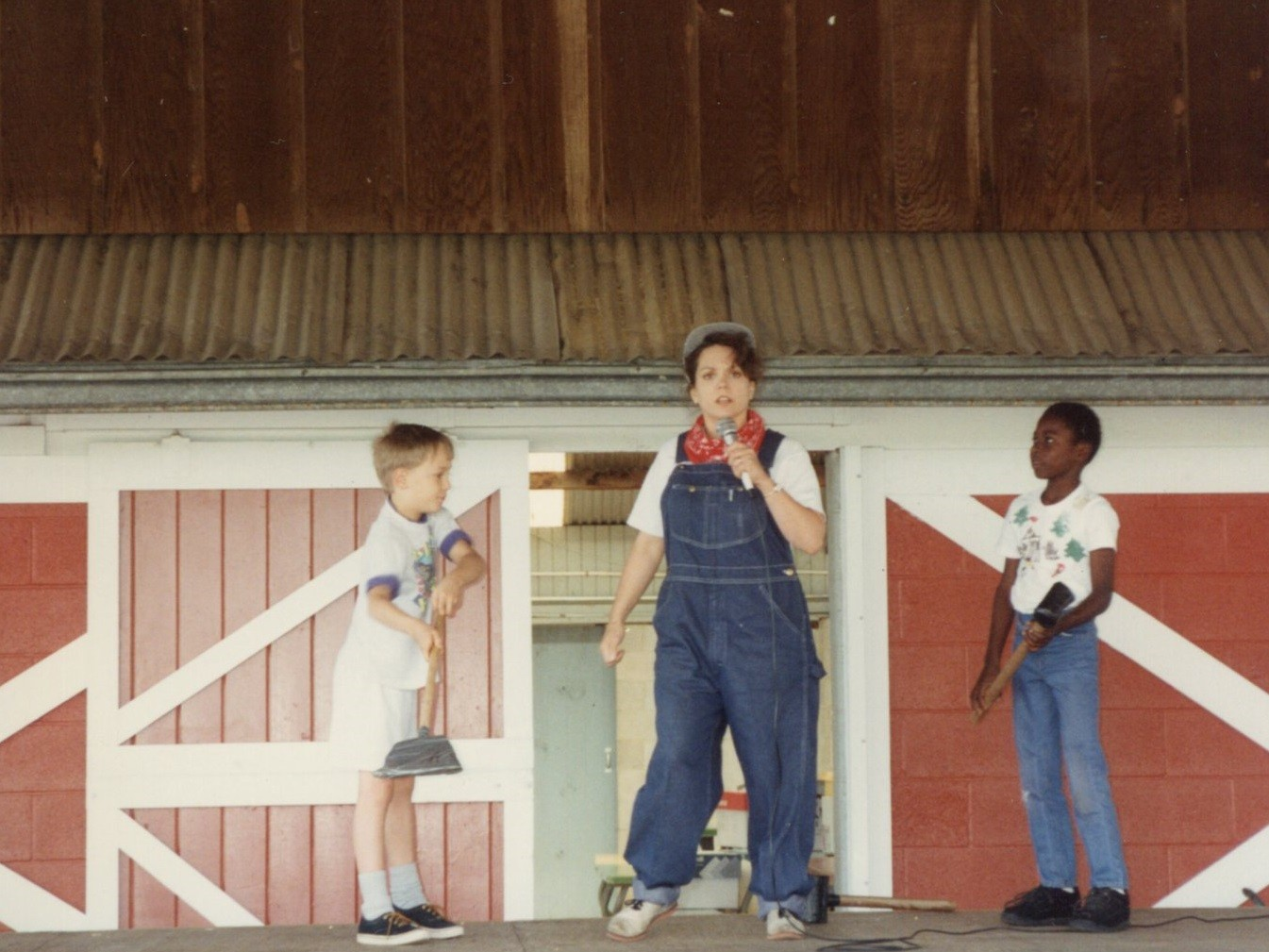
  • Performer and children on stage at Hamel's Amusement Park for Second Grader's Day when 1600 children received library cards, summer 1993, BPL History Center collection
  • Creshaun Harris and Sharen Smith, Bossier Central Complex employees with a Bossier Parish Libraries “library card”
aticle by: Pam Carlisle

Wednesday, August 7, 2024

History Center Moves to New Home Inside Central Library Complex

The Bossier Parish Libraries History Center has a new home. Early last month, the center “packed its bags” and relocated to space inside the Bossier Central Library Complex at 850 City Hall Drive. Although there is still some unpacking of those bags to be done, the center is open for visitors.


Since 1999, the History Center has been documenting and preserving the story of Bossier Parish and its people, and through those 25 years, the center has amassed quite a collection of everything from documents and photographs to furniture and clothing, thanks to the generosity of those who’ve donated items. A letter sent home by a soldier serving on the Korean War battlefield to his worried mom, a pair of devices that were the predecessors of today’s GPS, and a cotton gin that, to our knowledge, is one of only a few of its type left in existence, are just some of the artifacts that the center is honored to have in its collection.


Actually, the accumulation of items dates back to the early 1960s, when the Bossier Parish Library began compiling information related to the history of the parish. As the number of items grew, so too did the need for a dedicated place to house them. A proposal was made to construct a history center for the parish, and in late 1997, ground was broken. A year and two months later, construction was completed and a grand opening was held January 24, 1999. Visitors could see sights such as a diorama depicting life in a Caddo Indian village, and a cabin showing how early parish settlers would have lived.


Educational programs also became available at the History Center. Presentations focusing on genealogy research and highlighting various aspects of local history were offered. Currently, there are approximately 28 different presentations that can be scheduled at or away from the History Center.


A research area is open in the new location to those who may be looking into their family history or simply want to know more about Bossier Parish. Computers are available for research projects, and History Center staff can provide assistance when needed. Books are also available on many different topics of local and national history.


One exciting change still to come is the addition of interactive displays, which will allow visitors to experience history in a unique way. Being able to walk through an example of Bossier’s old Shed Road or enter a Caddo Indian hut are just two of the means by which visitors will be transported back in time to better understand what our parish was like more than a century ago and many centuries ago. These displays are scheduled to be in place sometime this fall or early next year.


Using photos, videos, displays, presentations, oral histories and more, the History Center will continue to tell the narrative unique to the place we call home. As Historian David McCullough said, “History is who we are and why we are the way we are.” Sharing this truth will remain a focus of the History Center, bridging the gap between past and present.


If you have any information or items relating to the history of Bossier Parish, the History Center may be interested in adding the materials to its research collection by donation or by scanning them and returning the originals. Call or visit us to learn more. We are open M-Th 9-8, Fri 9-6, and Sat 9-5. Our phone number is (318) 746-7717 and our email is history-center@bossierlibrary.org. We can also be found online at https://www.facebook.com/BPLHistoryCenter/


Images: 

  • Former History Center under construction/ photo by Shanna Faulk
  • Renderings of new History Center exhibits/Prevot Design
Article by: Kevin Flowers

Wednesday, April 24, 2024

Anna P. Tooke Memorial Library Branch: Worth the Wait

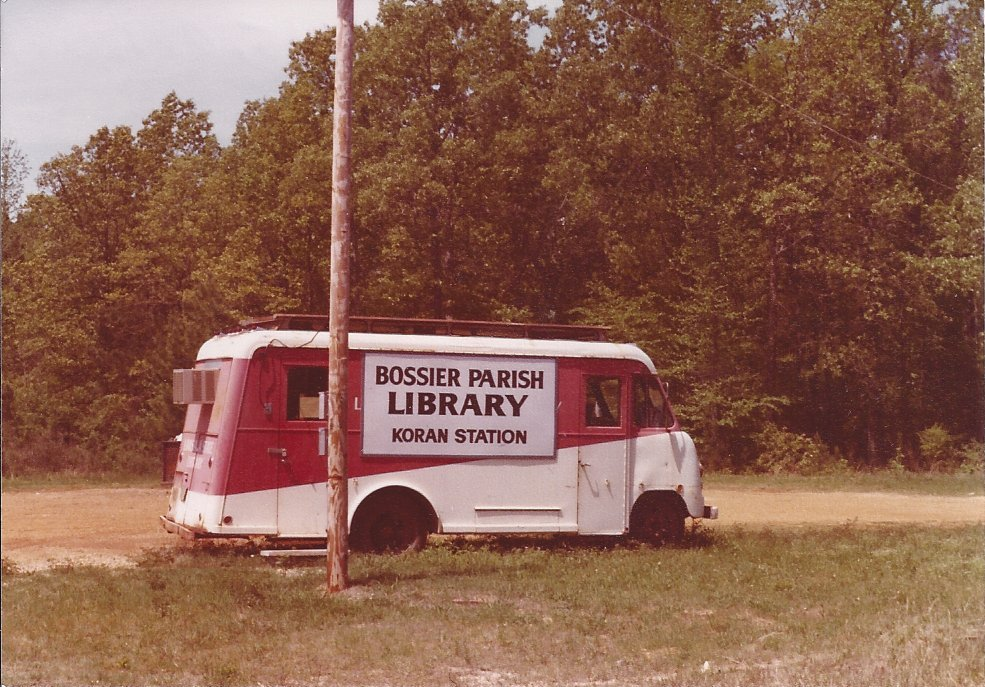
Until the past few weeks when the new Bossier Central Complex Library opened in Bossier City, the newest building in the Bossier Parish library system was the Koran community’s Anna P. Tooke Memorial Library, a modern building nestled in the woods close to Lake Bistineau. This lovely building had come a long way from the original Koran community branch library, the system’s southernmost branch, which was a parked, defunct, converted-Ford bookmobile, that provided no seating, toilets, heat or reliable cooling, and was located on an old dumpsite.


The parish government (police jury) paid to move the immobile bookmobile to the former dumpsite, where it was parked next to a dumpster. In the early 1980’s the American Legion approved moving the old bookmobile to their land on Highway 527 near Johnson Koran Road. Circulation went up in this more visible location.

Finally, a mobile building replaced the bookmobile in 1987. Even as a temporary utility building that was only 616 square feet, it was a major upgrade, boasting quadrupled book capacity, room for four child-size seats chairs and four adult patron seats, and magazine racks. It also had a heating and cooling system, but still, no bathroom. When that was needed, there was a convenience store nearby. If the staff member needed to run to the store’s facilities, they’d just put up a temporarily closed sign. And like in the parked book mobile, it was only open one day a week, Wednesdays. Storytimes were packed, and patrons appreciated the personal attention of library staff member Ms. Nita, who would have a stack of books waiting for them, based on her knowledge of their personal preferences. The community clamored for better facilities, but no land to put it on was forthcoming.


In 2012, police juror Bob Brotherton decided he and his cousins could change that. They agreed to donate three acres of land on Fairview Point Road, near Camp Joy Road to the Bossier Parish Police Jury for a library in memory of their grandmother, Anna P. Tooke. Mrs. Tooke had been a teacher in Haughton of English and Library Science for almost 40 years and who had raised Mr. Brotherton in a book-filled home. The library on this land was constructed for the Koran and Elm Grove communities in 2014. The branch opened to the public in Spring 2015 along with a playground, covered patio with outdoor tables, and a walking path, which the Tooke descendants hoped would make the library not only a place to get books and information, but also a community gathering spot.

Almost right away, the Anna P. Tooke Memorial Library served its purpose as a community center when the library served as a sandbag distribution center during bad flooding in Koran in 2015. During the Covid lockdowns of 2020, the Tooke library parking lot became a spot for bingo games, with players staying in their vehicles for social distancing. It also hosts scenic Easter egg hunts on the playground, patio and other areas of the property.

The striking building, with its large windows, features deep overhangs from the sloping roof that eases the visual impact on the surrounding landscape of fields and forest, and blends the indoor and outdoor spaces. The building contains natural sustainable materials and passive solar elements to ease its environmental impact, too. For these special elements, the building’s architect, Prevot Design Services won the American Institute of Architects Shreveport Honor Award in December, 2015.

If you have any stories, photos or other information relating to the history of Bossier Parish libraries, or of Bossier Parish citizens who have contributed to community life in Bossier, the History Center may be interested in adding the materials to its research collection by donation or by scanning them and returning the originals. Call or visit us to learn more. We are open M-Th 9-8, Fri 9-6, and Sat 9-5. Our phone number is (318) 746-7717 and our email is history-center@bossierlibrary.org. We can also be found online at https://www.facebook.com/BPLHistoryCenter


Images: 

  • The first Koran Community Branch Library, housed in a broken-down book mobile, opened in 1977
  • In 1987 the Koran Community Branch was housed in a commercial mobile building.
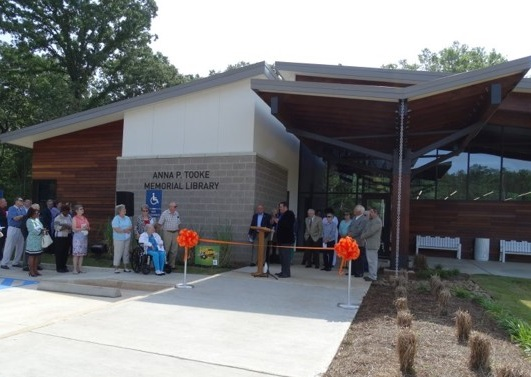
  • The May 15, 2015, ribbon cutting at the Anna P. Tooke Memorial Library for the Koran and Elm Grove communities of south Bossier Parish
Article by: Pam Carlisle