Showing posts with label Bossier Parish History Center. Show all posts

Wednesday, July 29, 2026

Old Stories, New Storytelling

 The original Bossier Parish Libraries Historical Center opened to the public in 1999 as part of an expansion of the original Central Branch on Beckett Street. Though it had rotating exhibits in table cases and glass cabinets, it also had permanent exhibits, which had been designed and constructed at the same time as the building that would host them. These exhibits were housed in in-wall displays on either side of the foyer, and were the first things that one saw when one entered the History Center. There was a diorama of a Caddo village, created by amateur archaeologist Louis Baker; a steamboat exhibit; a log cabin exhibit; and more. Each exhibit represented an aspect of Bossier Parish’s past, and each exhibit was created in cooperation with historians and Bossier Parish locals.


For several years, the original History Center served the public as a research facility, archive, museum, and meeting space. However, by the mid-2010s, talk had turned to renovating the Central Branch, which would include moving the History Center into a different area of the library. Eventually, it was decided that instead of renovation, an entirely new location would be built to house both Central and the History Center. This gave the History Center a unique opportunity: since our new home was being built from the ground up, we could give our old exhibits a serious glow-up, and even put in brand new ones.


Unique and exciting this opportunity might be, but it also brought up many questions. What stories should these exhibits tell? What was the best way to tell them? How would all of this be accomplished with the resources presented? The History Center staff discussed all of this and more for years, with each other, with library and parish administration, and with Prevot Design, Dorand Design Studios, and Downtown Fabworks, who were chosen to bring the new History Center and its exhibits to life. All the while, the History Center also juggled the new building’s construction, the new building’s opening in April of 2024, and the History Center’s move to the new building during the summer of 2024. Finally, in April of 2026, all of that planning came to fruition, as Downtown Fabworks began installing the new permanent exhibits.


The History Center has always been about showcasing as many pieces of Bossier Parish’s past as possible, and these new exhibits take it to the next level. Anyone who steps through our doors can see the Caddo diorama inside of a Caddo hut, and read about Old Shed Road while walking through (a small portion of) it, and view the interior of a dog trot log cabin that seems to have been built right through our wall. Just like in the old building, each exhibit represents an aspect of Bossier Parish’s past. Some, such as the dog trot, we share with other places in this country, but Old Shed Road, a nine-mile-long toll road that was totally covered by a shed to enable farmers to transport their cotton by wagon during rainy periods, is thought to be the only thing like it in this country’s recorded history. Though all of these exhibits were fabricated by Downtown Fabworks, the designs are pulled from photographs and historical documents, a lot of which is housed in the History Center. In addition, the items inside the exhibits are from the History Center’s collection, and so are, for the most part, authentic artifacts from Bossier Parish’s past, donated by Bossier Parish residents or their loved ones. From the spinning wheel in the log cabin to the cotton gin. Even the murals on the walls derive from photographs in the History Center’s collection, and are of people from Bossier Parish history, donated to us by the people of Bossier Parish. These exhibits are therefore a blend of old and new, a culmination of centuries of creation and care.


“History is who we are and why we are the way we are,” and that is why it is of the utmost importance to share it. It can be challenging to do so in a way that is educational, interesting, and respectful of the people of the past, but that is our goal with our new exhibits. The History Center is scheduled to reopen later this year; when it does, people will be able to see the old with new eyes, the culmination of dozens of people’s efforts over centuries. Their creation was a long process, but I believe it will prove to be well worth it.


Bossier Parish Libraries History Center in the Bossier Central Library complex remains closed while our new exhibits are installed. However, we are continuing to share history in a variety of ways. You can explore many of our collections on our website, www.bossierlibrary.org. Look for the History and Genealogy page under Resources. Feel free to contact History Center staff by phone or email for assistance. Our phone number is (318) 746-7717 and our email is history-center@bossierlibrary.org.


Our next meeting of World War II’s Day, a monthly coffee and discussion program on a variety of WWII-related topics, will be Tuesday, August 11th at 10:30 AM in the Bossier Central library complex’s large meeting room. Because August 6, 2026, is the 81th anniversary of the atomic bombing of Hiroshima, Japan, Dr. Cran Lucas, Emeritus Professor of Biological Sciences at LSU Shreveport, will present "Hiroshima and the Aftermath". During the spring and summer of 1966, Dr. Lucas was part of an overseas study group from Lewis and Clark College. He and his cohorts spent five months in Japan including a visit to Hiroshima. Dr. Lucas will discuss the atomic bombing of Hiroshima, its immediate aftermath, and the long-term effects on its extant population and later generations. We hope you can make it, and stay tuned for the re-opening date of the History Center and its new exhibits!


Images: Sneak preview of two of the History Center’s new exhibits: “Old Shed Road,” and “The Red River, Winding through Bossier’s History.” BPL History Center photos by Kevin Flowers.


Article by: Jaylie Rester

Wednesday, August 6, 2025

When History was in the Making in the History Center: A Hurricane Katrina Remembrance

It’s been twenty years, on August 29, since our neighbors on the Gulf Coast had to face the devastation of Hurricane Katrina (and soon after that, Hurricane Rita). Their lives were transformed, and for a while, life here at the Bossier Parish Library was transformed too. It never occurred to us the critical role a public library might play in disaster response, several hours away from the disaster, but we learned on our feet. Hundreds of evacuees poured into the Bossier Parish Central Library and History Center so they could use the computers to look at satellite photos of their homes, to try to contact friends and relatives whose whereabouts were unknown, to watch a New Orleans news channel via the Internet and to fill out their FEMA (Federal Emergency Management Agency) applications.

The evacuees also came to the library as a place to spend time outside of a crowded shelter or relative’s house and as a place to let their kids be kids in our cheerful Children’s Department.

Our librarians did what librarians do – they provided lots of information, from local bus schedules to how to get food assistance - but they expanded their role well beyond that. They provided sympathetic ears and hugs and friendships. They collected books the displaced children could keep, so they wouldn’t have to worry about returning them in a completely unpredictable future time.

History Center staff noticed that history was being made all around us. We put all the tools necessary for doing oral history interviews, like tape recorders, blank tapes, consent forms and notebooks in a box where they were easily accessible. Every staff member was encouraged to record oral history interviews with hurricane evacuees as they came in, no appointment necessary.


We recorded stories of several evacuees who used the library in the days and weeks following the hurricanes, including Nell Charney, an elderly woman who lived by herself in a second-floor apartment in New Orleans’ midtown. She rode out the storm and spent days in her apartment, surrounded by water that reached to the ceiling of the apartment below, without power or any means of communication with the outside world. She was eventually rescued, she believed, by members of the Coast Guard who reached her by boat. They had no way to get her out of her apartment but by breaking her window and helping her though it, thus beginning her journey that eventually found her settling in Bossier City near relatives. She had dramatic memories of the rest of the evacuation:

And of course the boats were having to be very careful because they couldn’t see what was underneath the water, except you could see maybe just the tip of a lamppost … might be sticking up out of the water. So, they were all having to be very careful. We started toward the Broad Street Overpass…

After being dropped off at the overpass, Ms. Charney noted:

It’s a good thing I had on my hat, because that sun was beaming down, and I didn’t know if, when we’d ever get picked up, up there. The helicopters were flying around, but none came down. There had been…evidently, there had been crowds of people on this overpass earlier. Maybe even the day before; because there was all this debris, uh, strung, you know, out along. Lot of food, apples,…some good stuff. Like lanterns, there was a nice lantern there. People had, uh, been there with their possessions and they had just had to leave a lot of it when they got picked up.

In addition, we collected oral history interviews of library staff, recording and transcribing their stories of family members and other loved ones directly or indirectly affected by the monster storms, and of being “on the front lines” helping patrons who were hurricane survivors and evacuees. Former Children’s Services Director Lucille Marabella recalled that library staff “…genuinely showed how much we cared for these folks. It was something that I will never forget for many reasons, personal as well as professionally. Hopefully we can learn from it.” Former Reference Librarian Martha Matlock recalled in her interview that, “I learned a lot about myself during that period of time; how important it is to think that you are connected to about just anybody that walks in that door in some way. And, don’t let them ever go away empty handed…If you can’t give them what they need, send them some place where they can find it.”


The transcripts of these recordings are available for reading at the History Center, or they can be emailed to out of town family members or researchers. As stated by past History Center Director Ann Middleton, these interviews evoke strong memories of what it was like to be in Bossier as an evacuee, or as a provider of a safe haven for family members, or as a concerned public servant during a heart- wrenching time. We are able to share these thoughts and feelings through the generosity of the people who agreed to record an interview for posterity.


We are located at 7204 Hutchison Drive, Bossier City, LA and are open M-Th 9-8, Fri 9-6, and Sat 9-5. Our phone number is (318) 746-7717 and our email is history-center@bossierlibrary.org. For other local history facts, photos, and videos, be sure to follow us @BPLHistoryCenter on FB, @bplhistorycenter on TikTok, and check out our blog http://bpl-hc.blogspot.com/.

Images: 

  • Nell Charney
  • Lucille Marabella – BPL photo
Article by: Pam Carlisle

Wednesday, May 21, 2025

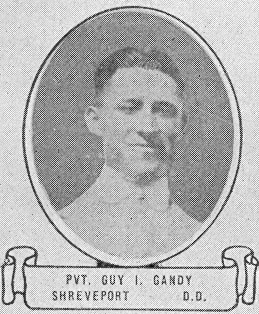
Guy I. Gandy - Far Away yet Close at Heart

In honor of Memorial Day, here is the story of a local “doughboy” (American soldier in the Great War, later known as WWI) who is memorialized right in Bossier City, as a namesake of the Gandy-Brown VFW Post #4588, and in his final resting place in the country of France. Private Guy Ira Gandy is buried in the Meuse-Argonne American Cemetery in some of the most beautifully tended landscapes Europe has to offer.


The Meuse-Argonne is one of the American military cemeteries maintained by the American Battle Monuments Commission (ABMC), a government agency founded in 1923 that now manages 26 cemeteries and 35 monuments created after a variety of wars across four continents. The land is generously donated in gratitude to America, and is never taxed in these foreign countries. Forty percent of these cemeteries and monuments are in France, a nation that saw much of the carnage of the first World War on its own soil. 14,000 of the young Americans killed in France are buried in the Meuse-Argonne American Cemetery east of Paris in the Alsace-Lorraine region near the borders with Belgium, Luxembourg and Germany. It’s the largest American cemetery in Europe.


The white marble cross memorializing Pvt. Guy Ira Gandy in the Meuse-Argonne American Cemetery, is a long way from Homer, Louisiana where he was born in March, 1895. He was raised in rural Claiborne Parish, but became an orphan at the age of 9 when his father John Alexander Gandy passed away. His mother Leona passed away when Guy was only six. The 1910 census lists him as a young teenage orphan living with a family in Webster Parish. By June, 1917, when he registered for the WWI draft, he is listed as living in Bossier Parish, as a “dairy” and “truck” farmer working for the major Bossier landowner W.T. Colquitt of the West Bend Plantation. Records show his three older Gandy half-siblings were living in Bossier Parish, as well. In early December, 1917, he married Glennye McGraw in Shreveport. According to an article in the Shreveport Times, before being sent to a temporary military training facility in New Orleans, he took a job with the Cotton Belt railroad, but by August, 1918 he was already departing New York City for Europe on the Aquitania with the 306th supply and ammunition trains (truck convoys) of the 81st Infantry, known as “the Wildcats.”


The 81st went to the hotly contested region of Alsace-Lorraine that had been annexed by Germany in 1871 after the Franco-Prussian War, a strategic and symbolic “prize” that France wanted back with a vengeance. He had barely been overseas two months when Guy Gandy, like so many soldiers, succumbed to illness. He died on October 9, 1918, at the age of 23. For Gandy, pneumonia felled him. For so many others, it was the 1918 worldwide influenza epidemic (sometimes misleadingly referred to as the “Spanish flu”) that spread like wildfire through the packed training and field camps of young men worldwide. In fact, the official history, “The Medical Department of the United States Army in the World War,” Volume II: Administration, published in 1927, states that during the stay of the 81st Infantry Division in the St. Dié sector where Gandy died, battle casualties were very light, but the division suffered greatly from illness. During the period from September 20 to October23, 1918, division field hospitals admitted 1,049 influenza cases and 165 cases of pneumonia. (An uncorroborated article in the Planters Press newspaper of Bossier City on November 1, 1945, said that Gandy’s pneumonia was caused by being mortally wounded in the tiny St. Dié village of Chatillon Ser Seine on Oct 5th.)


On the same day as Gandy’s tragic death, October 9, 1918, the Shreveport Times announced that “Mr. and Mrs. Guy Gandy are proud parents of a son, who arrived Sunday, October 6. He will be called Guy, Jr., for his soldier father, who is now in France.“ The happy news of the arrival of baby Guy Martin Gandy was not clouded by the news of his father’s death until November 10, 1918, when the Times reported that Mrs. Gandy had received a cablegram informing her that her husband had died.


The first burial on Guy Ira Gandy’s Army record is the French Military Cemetery in Raon-L’Etape, Vosges, on October 10, 1918. An American field hospital of the 81st Infantry Division was located there, so it is possibly where Gandy died. Soon after, a temporary American military cemetery was established in Raon-L’Etape and Gandy was disinterred and reburied on 1/27/21. Initial burial at a field hospital would have likely meant burial in a mass grave, or at least a temporary or hastily constructed one. His final interment was at the carefully planned and maintained American Military Cemetery of Meuse-Argonne on October 17, 1921. Each time he was reburied, Glennye Gandy was notified.


Glennye Gandy’s brother Henry Ernest McGraw also fought in the Great War. He returned home and died in Shreveport in 1936 at the age of 40. Glennye married Dewitt Talmage Heard in 1925. (She passed away in 1942). Glennye Gandy Heard’s and Guy Ira Gandy’s son, Guy Martin Gandy, served in the Navy in WWII on a mine sweeper in the Pacific. He, too, returned home and lived to the age of 80.


If you have stories or photographs of people connected to Bossier Parish who served or lived through the sacrifices of WWI, please visit or contact us at the History Center. We are located at 7204 Hutchison Drive, Bossier City, LA and are open M-Th 9-8, Fri 9-6, and Sat 9-5. Our phone number is (318) 746-7717 and our email is history-center@bossierlibrary.org

For other local history facts, photos, and videos, be sure to follow us @BPLHistoryCenter on FB, @bplhistorycenter on TikTok, and check out our blog http://bpl-hc.blogspot.com/.

Images: 

  • Pvt. Guy I. Gandy  from SOLDIERS OF THE GREAT WAR (IN THREE VOLUMES), Memorial Edition, Copyright, 1920, SOLDIERS RECORD PUBLISHING ASSOCIATION
  • Meuse-Argonne American Military Cemetery courtesy of American Battle Monuments Commission, via Wikimedia Commons
  • 306th Supply Train delivering beef in Vosges, France, October 24, 1918. US Army Signal Corps photo via North Carolina Digital Collections
Article by: Pam Carlisle

Wednesday, May 14, 2025

History Center Uncovers Story Behind Flea Market Find for Vietnam Veteran

Sharing stories from history is part of why I so enjoy being a staff member of the History Center. Researching and writing about people and events from the past is interesting to me. One recent opportunity to research military history reminded me that sometimes the most extraordinary stories can come from the most unlikely places.


In 1970, a student-led organization called Voices in Vital America introduced POW/MIA bracelets to ensure that service members who were prisoners of war or missing in action in Vietnam not be forgotten. Each bracelet, made of nickel or copper, contained the service member’s name and date of capture or disappearance and would be worn until he returned home. It was just such a bracelet that I had the chance to investigate early last month after taking a phone call at the History Center from a gentleman in Florida.


Retired Marine Kermit McNeal was seeking answers to questions he had about a POW/MIA bracelet that he bought approximately two years prior while visiting a flea market. He wanted to know if the person named on the bracelet – Arthur Black - had survived the war, and if Black or his family would like to have the bracelet. Unfortunately, Mr. McNeal’s efforts to learn about the bracelet had been futile. “No one wanted to help me,” he said. After receiving no assistance from some other history organizations, he found the Bossier Parish History Center online and reached out.


His reasons for buying the bracelet were both noble and personal. As a Vietnam veteran, he thought it “undignified” to leave the bracelet behind. “I simply couldn’t walk away and leave it there,” he told me. But an incident on the home-front during the war also played a role in his decision. During his time of service, someone attempted to swindle money from his mother by claiming that he had been captured, and saying they could affect his release for a fee. Thankfully, the ruse didn’t succeed. “I was never captured, but just hadn’t written home in a while,” he said. “This bracelet represented someone who had been captured or was missing.”


The History Center is privileged to have a POW/MIA bracelet in its archive collection. It bears the name William Butler, an Air Force pilot who spent nearly 6 years as a prisoner after being shot down over North Vietnam in 1967. In a column published a year ago, History Center Public Historian Pam Carlisle shared how his bracelet impacted the lives of a Bossier City couple by creating an opportunity to learn his story. Similarly, the bracelet purchased by Mr. McNeal would open an avenue for him to learn Arthur Black’s story.


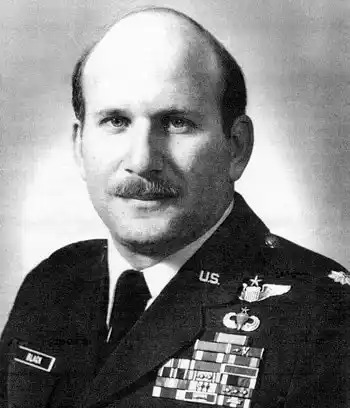
As I began researching Mr. Black and the date of September 20, 1965 shown on his bracelet, I was surprised by the amount of information available. He served as an Air Force pararescueman, sometimes called a PJ (for parajumper). His job was extremely dangerous. The National Museum of the United States Air Force describes it this way: “The PJ's unique mission in Vietnam was to ride into a combat zone aboard a slow, vulnerable helicopter, and descend into jungles, swamps, mountains and forests on a cable and winch. On the ground, they stabilized and helped hoist the injured to safety, often under fire.”


According to the museum’s website, pararescueman wore flight crew helmets and armored “flak” jackets for protection and carried weapons such as .38-caliber pistols, M-16 rifles and survival knives. Basic medical kits were used to tend the wounded. The website states that because of the heroic work done by Black and other PJs in Vietnam, more than 4,000 lives were saved.


It was while attempting to recover a pilot whose plane had gone down that Black’s helicopter crashed after being fired upon by enemy troops. He and three others aboard were immediately captured, beginning nearly eight years of beatings, torture and other abuse. In a recent interview with the Times of San Diego newspaper, he talked about how the ordeal caused him to review his life. “I thought about the past, all the things that I had done good and bad. I considered … what my parents were going through. And I figure they were having a harder time than me.”


After 2,703 days in captivity, Mr. Black came home. Released in 1973, he received a presidential commission to second lieutenant and continued his Air Force career by becoming a pilot himself and retired with the rank of major in 1987. He resides in Carlsbad, California, and thanks to the assistance of Carlsbad Mayor Keith Blackburn, I was able to contact Mr. Black and share with him how Kermit McNeal had discovered his bracelet. Honored to learn of this and grateful that McNeal hadn’t left it behind, Black said he was welcome to keep it.


That a flea market find could lead to uncovering such stories amazed me. That it offered the chance to interact with these two veterans was a privilege. Mr. McNeal thanked me for my efforts, saying he was certainly happy to hear that Black survived the war, and said the bracelet would remain on display in his home. Opportunities like this make working at the History Center so appealing. I may never look at flea markets the same way again.


If you have any information or items relating to the history of Bossier Parish, the History Center may be interested in adding the materials to its research collection by donation or by scanning them and returning the originals. Call or visit us to learn more. We are open M-Th 9-8, Fri 9-6, and Sat 9-5. Our phone number is (318) 746-7717 and our email is history-center@bossierlibrary.org. We can also be found online at https://www.facebook.com/BPLHistoryCenter/ and http://bpl-hc.blogspot.com/


Images: 

  • Arthur Black/photo courtesy U.S. Air Force
  • William Butler's POW/MIA bracelet/History Center collection
  • Arthur Black as a pararescueman/photo courtesy Arthur Black
Article by: Kevin Flowers