Showing posts with label Bossier City History. Show all posts

Wednesday, August 6, 2025

When History was in the Making in the History Center: A Hurricane Katrina Remembrance

It’s been twenty years, on August 29, since our neighbors on the Gulf Coast had to face the devastation of Hurricane Katrina (and soon after that, Hurricane Rita). Their lives were transformed, and for a while, life here at the Bossier Parish Library was transformed too. It never occurred to us the critical role a public library might play in disaster response, several hours away from the disaster, but we learned on our feet. Hundreds of evacuees poured into the Bossier Parish Central Library and History Center so they could use the computers to look at satellite photos of their homes, to try to contact friends and relatives whose whereabouts were unknown, to watch a New Orleans news channel via the Internet and to fill out their FEMA (Federal Emergency Management Agency) applications.

The evacuees also came to the library as a place to spend time outside of a crowded shelter or relative’s house and as a place to let their kids be kids in our cheerful Children’s Department.

Our librarians did what librarians do – they provided lots of information, from local bus schedules to how to get food assistance - but they expanded their role well beyond that. They provided sympathetic ears and hugs and friendships. They collected books the displaced children could keep, so they wouldn’t have to worry about returning them in a completely unpredictable future time.

History Center staff noticed that history was being made all around us. We put all the tools necessary for doing oral history interviews, like tape recorders, blank tapes, consent forms and notebooks in a box where they were easily accessible. Every staff member was encouraged to record oral history interviews with hurricane evacuees as they came in, no appointment necessary.


We recorded stories of several evacuees who used the library in the days and weeks following the hurricanes, including Nell Charney, an elderly woman who lived by herself in a second-floor apartment in New Orleans’ midtown. She rode out the storm and spent days in her apartment, surrounded by water that reached to the ceiling of the apartment below, without power or any means of communication with the outside world. She was eventually rescued, she believed, by members of the Coast Guard who reached her by boat. They had no way to get her out of her apartment but by breaking her window and helping her though it, thus beginning her journey that eventually found her settling in Bossier City near relatives. She had dramatic memories of the rest of the evacuation:

And of course the boats were having to be very careful because they couldn’t see what was underneath the water, except you could see maybe just the tip of a lamppost … might be sticking up out of the water. So, they were all having to be very careful. We started toward the Broad Street Overpass…

After being dropped off at the overpass, Ms. Charney noted:

It’s a good thing I had on my hat, because that sun was beaming down, and I didn’t know if, when we’d ever get picked up, up there. The helicopters were flying around, but none came down. There had been…evidently, there had been crowds of people on this overpass earlier. Maybe even the day before; because there was all this debris, uh, strung, you know, out along. Lot of food, apples,…some good stuff. Like lanterns, there was a nice lantern there. People had, uh, been there with their possessions and they had just had to leave a lot of it when they got picked up.

In addition, we collected oral history interviews of library staff, recording and transcribing their stories of family members and other loved ones directly or indirectly affected by the monster storms, and of being “on the front lines” helping patrons who were hurricane survivors and evacuees. Former Children’s Services Director Lucille Marabella recalled that library staff “…genuinely showed how much we cared for these folks. It was something that I will never forget for many reasons, personal as well as professionally. Hopefully we can learn from it.” Former Reference Librarian Martha Matlock recalled in her interview that, “I learned a lot about myself during that period of time; how important it is to think that you are connected to about just anybody that walks in that door in some way. And, don’t let them ever go away empty handed…If you can’t give them what they need, send them some place where they can find it.”


The transcripts of these recordings are available for reading at the History Center, or they can be emailed to out of town family members or researchers. As stated by past History Center Director Ann Middleton, these interviews evoke strong memories of what it was like to be in Bossier as an evacuee, or as a provider of a safe haven for family members, or as a concerned public servant during a heart- wrenching time. We are able to share these thoughts and feelings through the generosity of the people who agreed to record an interview for posterity.


We are located at 7204 Hutchison Drive, Bossier City, LA and are open M-Th 9-8, Fri 9-6, and Sat 9-5. Our phone number is (318) 746-7717 and our email is history-center@bossierlibrary.org. For other local history facts, photos, and videos, be sure to follow us @BPLHistoryCenter on FB, @bplhistorycenter on TikTok, and check out our blog http://bpl-hc.blogspot.com/.

Images: 

  • Nell Charney
  • Lucille Marabella – BPL photo
Article by: Pam Carlisle

Wednesday, July 30, 2025

Sears Had Long History in Bossier City

Walking through Pierre Bossier Mall, there is no indication that its east end was home to Sears. Gone is the Sears sign that once hung above the mall entrance to the store, that entrance now blocked by a security gate. Beyond the gate, darkness inhabits the space once filled with everything from clothing and homewares to appliances and tools. Sears’ ending stands in stark contrast to its beginning in Bossier City sixty-nine years ago.


A simple, straight-to-the-point headline appeared in the November 30, 1956 edition of the Bossier Press newspaper, “Sears Opens Bossier Store.” The Heart of Bossier Shopping Center, at the intersection of Old Minden and Benton Roads, had been chosen as the store’s site. The accompanying article described the structure: “The 18,000 square foot building is in the same architectural model as the rest of the Big Chain Center of which it is a part. Modern in every detail, it includes a super service station, a customer catalog desk, and 18 complete departments.” Store advertisements featured products like 21-inch television sets for $148 that brought a “photo-sharp picture right into your living room” and Kenmore automatic washers for $188 that were “like having 2 washers in 1 with one speed for regular fabrics and a slower speed for delicate fabrics.”


That the word modern was applied to the store was no surprise. According to the Bossier Press article, the store was designed by the firm founded by noted modernist architect William B. Wiener. He and his half-brother Samuel were responsible for bringing the European Modernist style of design to Shreveport and Bossier. The article called the store “an important new milestone in the commercial history of Bossier City.” Hired to manage this milestone was Texas native Forest Vaughn, who, according to the same Bossier Press article, had previously worked as an assistant manager for Sears in Lake Charles, Louisiana.


Sears began in 1892 as a mail-order watch and jewelry business founded by Richard Warren Sears and Alvah Curtis Roebuck in Chicago. The business quickly grew, thanks in no small part to its ever-expanding catalog. In 1933, the first Christmas Wish Book was published. An article from July 25, 2017 in Smithsonian Magazine states, “By the early 20th century, Sears was already a household name across the United States, one that represented rural thrift and industry as well as material abundance and consumer pleasures.” Across the country, Sears stores began springing up. According to the magazine article, more than 700 stores were in operation in the U.S. by the mid-1950s.


The Bossier store moved into a larger building in the Heart of Bossier in 1966 with nearly 50,000 square feet of floor space and another 7,700 square feet for an automotive service center. Bossier newspaper accounts of the move quoted Forest Vaughn stating the store’s size reflected the company’s confidence in Bossier’s continued growth. “We feel sure that our Bossier City friends, on visiting the new store, will agree with our slogan, ‘Sears has everything’,” he said. The store served customers at that location for the next 16 years until moving into Pierre Bossier Mall in March 1982.


With much fanfare, Sears was the first store to open in the mall. A ribbon cutting was held and grand opening sales were offered. For 36 years, Sears was an anchor store for the mall. But as Sears corporate fortunes declined, so too did those of the Bossier store and many Sears locations around the country. By the summer of 2018, local newspapers were carrying advertisements for the Bossier and Shreveport


Sears stores, proclaiming in bold type, “Store Closing,” “Everything Priced to Sell.” By September that year, the stores were history. The changing landscape of how we purchase goods and services was a factor in the demise of this former icon of American business. Oh, to be a kid again looking at the toys in the Christmas Wish Book one more time.


If you have any photos or other information relating to the history of Bossier City or Bossier Parish, the History Center may be interested in adding the materials to its research collection by donation or by scanning them and returning the originals. Call or visit us to learn more. We are open M-Th 9-8, Fri 9-6, and Sat 9-5. Our phone number is (318) 746-7717 and our email is history-center@bossierlibrary.org. We can also be found online at https://www.facebook.com/BPLHistoryCenter/ and http://bpl-hc.blogspot.com/

Images: 

  •  Former entrance to Sears in Pierre Bossier Mall/Kevin Flowers
  • Advertisement for new Sears location in Bossier/Bossier Press, Nov. 30, 1956

Article by: Kevin Flowers

Wednesday, June 1, 2022

Hooked on Sinkers: Doughnuts in Wartime


 Friday, June 3, 2022, is National Donut Day, not to be confused with November 5, 2023, National Doughnut Day.  Both are occasions to treat yourself or some friends to doughnuts (and technically both spellings of the confection are correct, too), but only the day in June has a historical story behind it, one that teaches us to never underestimate the power of doughnuts during wartime, especially WWII.

Barksdale during WWII was an excellent example of the wartime popularity of doughnuts. A story in the “Barksdale’s Bark” newspaper from February 3, 1945, ran the headline “Dunkers Devour 300 Dozen Donuts, 4,000 Cups of Java at PX Every Day.”  PX stands for Post Exchange, when Barksdale was an Army Air Field prior to the creation of the U.S. Air Force and “dunkers,” of course, refers to the time-honored tradition of dunking doughnuts in coffee. According to the article, “Among GI’s who are confirmed dunkers, 300 dozen a day vanish with a slurp, often by 10:30 am…” Sundays are when the most donuts are consumed there, at almost double the amount. The Cafeteria Manager, John Kennedy, was quoted saying, “We never have any left. Some guys take as many as 8 at a time.”

In fact, the PX previously made the doughnuts themselves but from the early 1940s they couldn’t keep up with the demand so a Shreveport bakery supplied them. A tongue-in-cheek welcome to new GIs in the July 8, 1944, issue of “Barksdale’s Bark” urged, “If it’s doughnuts and a cup of red-eye (coffee) your little heart desires, a short two-hour wait should do the trick. Even if you’re not hungry, get in line anyway. By the time you get through it you will be.”

Doughnuts, however, were doing more than just filling the hungry stomachs of GIs on breaks. Every American post had an American Red Cross (ARC) Doughnut Dugout. Returning flight crews were greeted with fresh coffee and doughnuts. These provisions got a noteworthy mention in the February 26, 1944, “Barksdale’s Bark” article about services the ARC was providing both stateside and to the soldiers overseas. “A special service that made a big hit with fliers was the coffee and donuts which awaited the crews as they returned from their combat missions.” The Bark noted in a January 1945 article about Division Rest Camps for the U.S. 1st Army that every 30 days, a soldier is sent to the rest camp for two days. He can “sleep, visit the nearby town, eat all the doughnuts he can take, see as many movies as he likes.”

Doughnuts were provided behind the front lines by women Red Cross volunteers who drove Clubmobiles, vehicles equipped with facilities for coffee and doughnut-making, a phonograph and gum, newspapers, and a few other comfort items from home. The women who served on these vehicles were required to be college graduates, at least 25 years old, and possessing excellent interpersonal skills. They came to be known by the name “Doughnut Dollies.”

To provide this same sense of normalcy and support to soldiers serving during WWII, the Salvation Army also provided coffee and doughnuts and other relief services. In 1938, the Salvation Army in Chicago proclaimed the first Friday in June as National Doughnut Day to raise funds and honor these "Doughnut Lassies," who originally served treats and provided assistance to soldiers on the front lines during World War I.

Syndicated columnist Raymond Clapper, in a column that ran in the “Shreveport Journal” on July 19, 1943, wrote about his visit to troops in the Allied Command Post, North Africa during the height of the Sicilian campaign, when the fighter bombers were “practically seeing the whites of the enemy’s eyes in low strafing attacks on military trucks, railroad yards, radio stations and other targets.” He watched the bombers landing in a converted goat pasture, the pilots “wringing wet” with sweat and throwing off their life jackets. Then the Lt. Col. said, “Let’s check in and get over to those Red Cross doughnuts.” Clapper observed, “The biggest thing in their lives at the moment is an American Red Cross girl under an olive tree serving coffee and doughnuts. Only after a second cup of coffee and the third doughnut do you begin to hear about what (tragedy) happened over Sicily a few moments ago.”

Photo: "Wm. L. Shirer, Coffee & Sinker." The woman has an American Red Cross pin at her collar. She is likely a member of the Red Cross "Canteen Corps".

William L. Shirer (left with glasses) was an American journalist and war correspondent. 7 January 1943


Does your family have any stories, clippings or photos of Doughnut Dollies or Doughnut Lassies? Do you know what bakery in Shreveport provided those daily 300 dozen doughnuts to Barksdale during wartime? (We don’t know, and are curious.) We would love to see the items or hear your story and copy or record them, with permission, to add to the History Center’s research collection. Also, please come to the History Center to see our exhibit on the American Red Cross at 2206 Beckett St, Bossier City, LA. We are open M-Th 10-8, Fri 10-6, and Sat 10-5. Our phone number is (318) 746-7717 and our email is history-center@bossierlibrary.org
 
For other fun facts, photos, and videos, be sure to follow us @BPLHistoryCenter on FB, @bplhistorycenter on TikTok, and check out our blog http://bpl-hc.blogspot.com/
.

Article by: Pam Carlisle

Wednesday, February 23, 2022

Crime Comics Not to Blame

After World War II, there was a notable increase in crimes committed by teenagers. Parents and various organizations across the country were concerned and looking for answers. The popular scapegoat at that time was crime comic books. The concern was so prevalent that the Senate Crime Investigating Committee investigated what part if any, crime comics played in juvenile delinquency.

In 1950, FBI Director J. Edgar Hoover wrote the committee that despite post-war slacking of juvenile delinquency, the incidence of crime among young people is still “abnormally high.” Hoover asserted that “Eager recruits in an already vast army of youthful offenders are the products of adult negligence—of homes broken by death, desertion, divorce, separation, neglect and immorality.”

According to an article in The Daily Advertiser, “The Senate committee, in publishing its 250-page survey, drew no conclusions of its own. Nor did it attempt to summarize the answers received from questionnaires sent out to probation officers, child welfare workers, juvenile court judge, police and prison authorities, crime comics publishers and others.

“But the prevailing view among the experts was that crime comics and juvenile delinquency have no direct relationship.”

Hoover said the basic cause of delinquency is “the lack of a sense of moral responsibility among youth” and declared that the place to start instilling it is in the family circle.” He also said, “it is doubtful that an appreciable decrease in juvenile delinquency would result if crime comic books of all types were not readily available to children.”

Nonetheless, the concern and debate over the possible connection between the increased crime of teenagers and crime comics continued for a few more years. There were comic book burnings, and municipalities across the nation opted to issue ordinances forbidding the sale of such comics to minors, and others banned them altogether.

The General Federation of Women’s Club was one of many organizations promoting the anti-comic-book campaign. Locally, Mary B. Stewart, president of the Louisiana Federation of Women’s Clubs, led the campaign and worked with other local women’s clubs, including the Women’s Study Club of Bossier City. In 1955, the latter presented a resolution to Bossier City Mayor Burgess McCranie requesting that crime and horror books be banned from the newsstands and stores.

A couple of months later, the Bossier City council passed an ordinance prohibiting the sale of such books to people under the age of 18. Anyone violating any portion of the law could pay up to $100 in fines or 30 days in jail, or both at the court’s discretion. Ironically, the sale and display of such comics had already all but ended since the local distributors were only accepting comic books bearing the Comic Code Seal.

In 1954 televised hearings by the Subcommittee on Juvenile Delinquency of the Senate Judiciary Committee took place. These hearings propagated an unflattering image of comic books and those who made a living off them. This led to the organization of the Comics Magazine Association of America. They formed the Comics Code Authority (CCA) as an alternative to government regulation.

Patterned after the film industry’s Hays Code, the CCA allowed comic publishers to self-regulate the content of comic books. Members of this trade association submitted comics to the CCA, which screened them for adherence to its code, then authorized the use of the seal on the cover if the book conformed with the code. The CCA cleaned up the industry. Nearly all comic publishers adopted the code, cleaning up the industry. The code became defunct in 2011.

Censorship arising from moral panic is a constant presence in the history of comics and other media. In 1986, the Comic Book Legal Defense Fund was organized. They are a non-profit organization dedicated to protecting the First Amendment rights of the comics art form and its community of retailers, creators, publishers, librarians, and readers. Public Libraries proudly serve as guardians of the people’s freedom to read.

For the past eighty-two years, the Bossier Parish Libraries has proudly provided access to materials, programs, and technologies that enrich, educate, and inspire the residents of this great parish. We celebrate and preserve our democratic society by making available the broadest possible range of viewpoints, opinions, and ideas, so that all individuals have the opportunity to become lifelong learners - informed, literate, educated, and culturally enriched.

By: Amy Robertson

Wednesday, January 26, 2022

The Only Major Crime of 1949

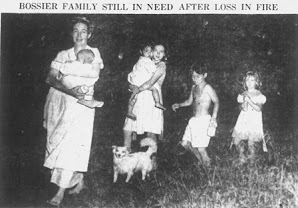
In the fall of 1949, fire swept through a group of 25 cabins in Bossier City called Shirley’s Tourist Courts. They were located at 1402 East Texas Street and arranged in a u-shape configuration. The blaze began in the pre-dawn hours, forcing one family of eight and their dog to flee for safety as they helplessly watched everything they owned go up in flames.

“A small boy, who resided nearby, said he looked out his window to see fire catch in two cabins simultaneously. ‘First, there were two explosions,’ he said, ‘and then fire started coming out of the window.’” The wind immediately carried the fire to other cabins. Of the 25 cabins, only five were untouched, while 13 cabins burned to the ground and seven were damaged. The total destruction was estimated at $38,000. The owner was out of town at the time of the fire.

Bossier Fire Commissioner Fred Jones,
Deputy Sheriff Maurice Miller, and
Police Officer James C. Cathey, Jr.
After Barksdale AFB and Bossier City firefighters extinguished the fire, the first inspection revealed apparent signs of arson. Bossier authorities found two one-gallon gasoline bottles with burning candles underneath them on gas burners in two of the cabins. In other cabins, gas jets were on, and they found heavy glass similar to the one-gallon jars found on top of the stove. Deputy State Fire Marshall Herman Jones said that the blaze “definitely looks like arson.”

The following week the State Fire Marshal Hugh W. Stewart announced that two Bossier City men were charged with aggravated arson of Shirley’s Tourist Courts. The accused were Robert Paul Hogg, owner, and J. L. Morris, a welder employed by Hogg. Morris had confessed to setting the fire. During the trial, “Morris testified that he was offered $1,000 by Hogg, a life-time job and lots of whiskey and pretty girls.”

The state’s star witness, Morris, pled guilty as charged, receiving a five-year suspended sentence, and was placed on probation. Hogg was convicted and sentenced to a prison term of eight years. At the time, he was on parole for a five-year federal sentence for embezzlement, for which he served one year in federal prison before being paroled. In violation of his parole, he was returned to Georgia to complete his federal prison sentence, and in 1952 he was moved to Angola to finish his time for the arson.

According to the testimony of an insurance agent, Hogg would have gained little from the insurance payout. Most of the money would have gone to pay off both mortgages. He had a first mortgage of $13,000 and a second mortgage held by the previous owner, T.R. Hester, of $18,400. With the insurance estimate of $38,000, Hogg would have made out with a little over $6,000.

If you’re wondering how much that would be in terms of today’s dollar, then he would have pocketed approximately $70,000 after paying off the two mortgages totaling about $386,000. Hester ended up having to sue Hogg and the insurance companies for the money due him on the second mortgage. The fire was the only major crime that year, according to the then newly elected Bossier City Police Chief Burgess E. McCranie.

Visit the Bossier Parish Libraries History Center to learn more about fires or crimes or anything about Bossier Parish history that interests you. We are next to the Central Library
branch at 2206 Beckett Street, Bossier City. Can’t come in, call 318-746-7717 or email history-center@bossierlibrary.org with your request. For fun facts, photos, and videos, be sure to follow us @BPLHistoryCenter on FB, @bplhistorycenter on Tiktok, and check out our blog http://bpl-hc.blogspot.com/.

By: Amy Robertson