Showing posts with label Cemeteries. Show all posts

Wednesday, May 17, 2023

Memorial Day Remembrances - Far Away yet Close at Heart

In honor of upcoming Memorial Day, I found a local history story that is an ocean away, in some of the most beautiful natural surroundings European countries have to offer, surrounded with flags of the United States. They are the American Cemeteries maintained by the American Battle Monuments Commission (ABMC), a government agency founded in 1923 that now manages 26 cemeteries and 35 monuments created after a variety of wars across four continents. The land is generously donated in gratitude to America, and is never taxed in these foreign countries. Forty percent of these cemeteries and monuments are in France.
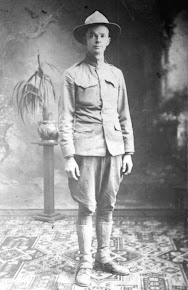
One of these cemeteries in France, Aisne-Marnes (Aisnes is pronounced Enne) near Belleau, France, northeast of Paris, is the final resting place of PFC. Henry Homer Dalrymple, who was born on July 21, 1892 in Bossier Parish. Homer, as he was known, was raised in the rural Midway/Linton community near Benton and died July 1, 1918, just shy of his 26th birthday in the Picardie region of France (now known as the Hauts-de-France). He was killed in action by a direct hit with a high explosive, where the French and the American Expeditionary forces were holding off the Germans at the Marne River, just ahead of the famous battle of Château Thierry.

Homer Dalrymple’s first burial on his Army burial record listed an American cemetery at the Bézu-le-Guéry, near the village of Château Thierry. There was an American field hospital located there. Its purpose so close to the front was primarily triage. Burial at a field hospital would have likely meant burial in a mass grave, or at least a temporary or hastily constructed one. Homer Dalrymple’s burial record shows that he was reinterred in the beautiful American Cemetery in Belleau France, now known as the Aisnes-Marne, on June 10, 1919.


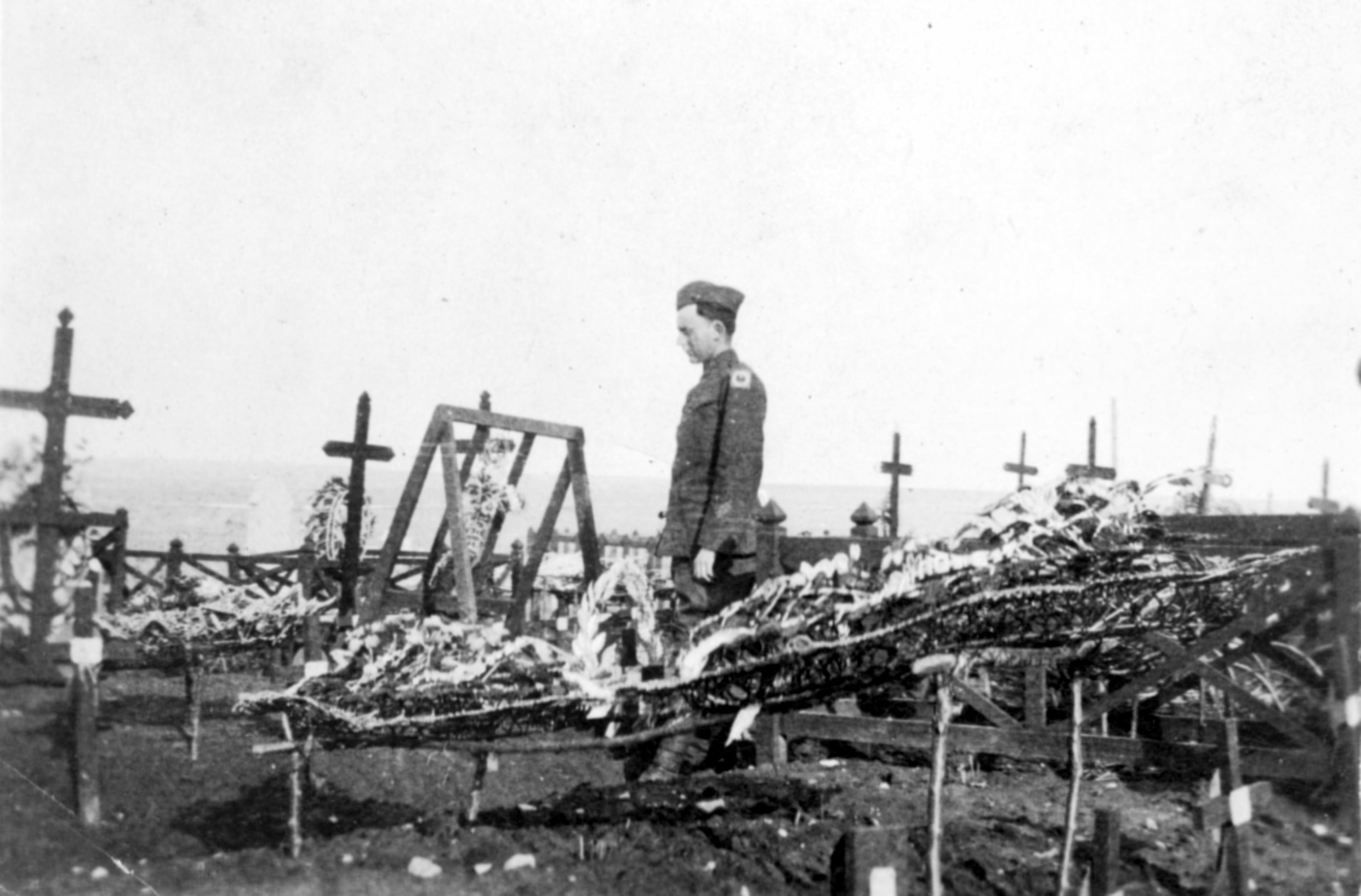
Another photo in our collection, this one of a Bossier WWI soldier who made it home and lived to an old age, was of Dan Rials (Arthur Daniel Rials), who was a member of Company B, 13th Engineer Corps of the US Army. This touching photo, though of a different location in France, may help to explain Homer Dalrymple’s reburial. The photo shows a young Dan Rials in uniform walking among tall wooden crosses and flower-covered yet spindly-looking makeshift funeral biers, platforms for coffins before they are lowered into the ground, identified on the photo as Fleury-sur-Aisne, France, circa 1919.


Fleury-sur-Aisne was a Red Cross “evacuation” hospital used following German advances into France. An online search for Fleury-sur-Aisne yields an even more somber photograph, a chaplain at a burial service there, praying over shrouded bodies in a mass grave of soldiers who had died at the hospital. It’s difficult to look at, but yields much information about death at the frontlines. It is likely, though, that those soldiers too would later have gotten their own cross, or Star of David if they were Jewish, at a permanent American cemetery, such as the beautiful Aisne -Marne mentioned above or the Meuse Argonne, also managed by the American Battle Monuments Commission, or sent back to the United States if their family so chose.


In fact, the American Battle Monuments Commission got its start at the end of WWI. The United States was granted plots of land by the Allies to bury their fallen. Six cemeteries were created in France, one in Belgium, and one in England, as perpetual, tax-exempt property of the U.S. government. Responsibility for their care and maintenance was placed in the hands of the ABMC in 1923.


Homer Dalrymple’s mother Lydia Dalrymple, did not request that her son’s body be returned home, but she did take advantage of the opportunity to go to France as a “Gold Star Mother” (a mother who lost one or more children in the war) to visit the grave of her son in the stunning, new American Cemetery at Aisne-Marne. The History Center has a photo of her, labeled as “Grandma Dalrymple”, by then looking quite elderly, beginning her trip on board a train in Dallas. This was possible because in the late 1920’s, the War Department of the United States compiled a list of mothers and widows of WWI soldiers killed and buried in Europe and offered to take them to their loved ones’ graves. Between 1930 and 1933, 6,000-plus women traveled on these “Gold Star Mother Pilgrimages”. The trips were entirely planned and paid for by the U.S. Army, a relatively rare act of public support for the private grief of families of the fallen.


If you would like to see these or other photos, such as those in our current Red Cross exhibit, visit us at the History Center, or ask us how to use our online catalog, which includes digitized images. We are located at 2206 Beckett St, Bossier City, LA and are open M-Th 9-8, Fri 9-6, and Sat 9-5. Our phone number is (318) 746-7717 and our email is history-center@bossierlibrary.org


For other fun facts, photos, and videos, be sure to follow us @BPLHistoryCenter on FB, @bplhistorycenter on TikTok,

Images: 

  • Dan Rials, 1919, in Fleury sur Aisne, France
  • Postcard photo of Homer Dalrymple 1892-1918 in World War I uniform. He was in the 48th Infantry Co. H. He was killed near Château Thierry and buried in France.
  • Burial register card for Henry Homer Dalrymple. US National Archives: Record Group 92, Office of the Quartermaster General, Card Register of Burials of Deceased American Soldiers 1917 – 1922
Article by Pam Carlise

Wednesday, October 5, 2022

“Sacred to the Memory: Bossier Parish and North Louisiana Historic Headstones”

 It’s now October and “spooky season” is upon us! Soon you’ll see lots of yards and houses decorated to scare. Many of these decorations will be in the form of fake headstones, maybe even clustered to look like a spooky cemetery. Truthfully, North Louisiana graveyards are fascinating places because of the wide range of symbols and imagery used on gravestones. Their historic value, I dare say, far outweighs their scare factor. 

Bossier Parish and many other areas of North Louisiana have very few surviving homes or artifacts from the 19th century. We do, however, have plenty of cemeteries. Historic cemeteries are valuable resources for researchers. Inscriptions give us information about people who lived long ago. Decorations on the tombstones can tell us a little about what life was like in the past. Many are  simply beautiful works of art.


Like other items, tombstones reflect the culture of the people who produce and choose them. 19th and early 20th century cemetery monuments in Bossier Parish contain symbols that would have been recognizable to most people of the time, even if the exact meanings might have varied from person to person. 


The majority of Bossier’s early settlers were Protestant and, as would be expected, most gravestone symbols reflect this heritage. Many are Biblical in origin.  A few Catholic and Jewish symbols have been found. Other gravestone symbols and shapes reflect the classical and historical revivals of the 19th century. A wide variety of symbols are found on these early stones. The meaning of some of these icons, or epitaphs, are obscure today. For example, some graves say “consort of” rather than “wife.” This wording appears to be the fashionable lingo of the time, and does not mean that the couple wasn’t married. 


Some symbolism we do recognize today are flower or tree-related. Rosebuds are usually found on children’s graves. The buds recognize a life cut short, not yet blossomed. Lilies represent purity and resurrection. The flowers are often shown drooping or plucked. Sometimes the hand of God is shown picking a flower from the earth. Willow trees are very common on mid-19th century tombstones and come in a wide range of styles. They symbolize mourning and grief. 


Life was uncertain, even for the very wealthy in the 19th century. An example is the grave of Sallie Pickett Cummings at the Cottage Grove cemetery. Sallie Cummings died in her late teens in 1854 during a cholera epidemic, a mere six months after her wedding to Robert Campbell Cummings. Legend says that Sallie was buried in a glass-topped coffin. Her grieving family and husband placed a magnificent marker on her grave. 


Most people in Bossier could not afford a monument like Sallie’s but some of their markers still tell us a great deal about their lives and beliefs. Tragically, in Sallie’s era, graves of Bossier’s enslaved people often were marked simply with wood, which succumbs quickly to the elements. 


Disease could destroy families. Many women died in childbirth and men then remarried in succession. Because of this, joint husband and wife gravestones, common today, are uncommon prior to the late 19th century. In a rare and touching early 20th century example of a husband-and-wife headstone, Mr. and Mrs. Eller’s from 1910, the epitaph reads, “In labor and in love allied, in death they sleep here, side by side. Resting in peace, the aged twain. Till Christ shall raise them up again.” Clasped hands were symbolic of marriage in the 19th century, or the parting at death. 


Life was hard for children and many died young from diseases that are harmless or unknown today. Children died from whooping cough, measles, smallpox and other sicknesses. In contrast to previous centuries, in the 19th century children were starting to be looked upon as innocent little beings as opposed to miniature (and sinful) adults. This change is reflected in the appearance of lambs on children’s graves. One particular such stone, for Cornelia Haughton in 1869, shows a mother with 3 children, standing on what look to be clouds. Also on the grave are three lambs under a willow tree. The poignant epitaph reads, “They sleep together, side by side, the mother and her three babes. Their bodies rest beneath the sod. Their spirits dwell with God.” 


Doves are found on both children’s and adult graves. The dove perhaps symbolizes innocence, peace or the soul. A headstone with a dove flying toward a star likely represents a soul (the dove) on its way to heaven (the star). One tiny grave with a dove on top says, “Tis a little grave, but oh! Have a care. Worldwide hopes are buried there. This epitaph was for “infant Nuckolls,” 1912. 


Many historic cemeteries are in fragile or hazardous condition, or are on private land. If you’d like to see a virtual tour in the comfort of your home of two of Bossier’s most historic cemeteries, visit our YouTube channel to see a tour of the Rocky Mount and Cottage Grove cemeteries in north Bossier Parish. Go to youtube.com and search “Bossier Parish Libraries” then select the “Bossier Virtual History Tour” playlist. 

https://www.youtube.com/watch?v=oBffCDsWgMo&ab_channel=BossierParishLibraries

https://www.youtube.com/watch?v=c1bIld7z9lg&ab_channel=BossierParishLibraries


Or, for a group at the History Center or elsewhere, you can request the History Center’s presentation, “Sacred to the Memory: Bossier Parish Headstones.” This program features close-up photographs of headstones and monuments in Bossier Parish’s rural, historic cemeteries and reveals and interprets the symbolism and local history that they represent. History Center staff is available to present this and other local history programs on request, as well as assist you in researching your ancestors with our resources on Bossier Parish cemeteries. Please contact us at (318) 746-7717, or visit bossierlibrary.org and visit the “History and Genealogy” resource page. Visit us at the History Center at 2206 Beckett Street, Bossier City, LA. We are open M-Th 9-8, Fri 9-6, and Sat 9-5. Our email is history-center@bossierlibrary.org

For other fun facts, photos, and videos, be sure to follow us @BPLHistoryCenter on FB, @bplhistorycenter on TikTok

Article by: Pam Carlisle