Showing posts with label World War I. Show all posts

Wednesday, May 21, 2025

Guy I. Gandy - Far Away yet Close at Heart

In honor of Memorial Day, here is the story of a local “doughboy” (American soldier in the Great War, later known as WWI) who is memorialized right in Bossier City, as a namesake of the Gandy-Brown VFW Post #4588, and in his final resting place in the country of France. Private Guy Ira Gandy is buried in the Meuse-Argonne American Cemetery in some of the most beautifully tended landscapes Europe has to offer.


The Meuse-Argonne is one of the American military cemeteries maintained by the American Battle Monuments Commission (ABMC), a government agency founded in 1923 that now manages 26 cemeteries and 35 monuments created after a variety of wars across four continents. The land is generously donated in gratitude to America, and is never taxed in these foreign countries. Forty percent of these cemeteries and monuments are in France, a nation that saw much of the carnage of the first World War on its own soil. 14,000 of the young Americans killed in France are buried in the Meuse-Argonne American Cemetery east of Paris in the Alsace-Lorraine region near the borders with Belgium, Luxembourg and Germany. It’s the largest American cemetery in Europe.


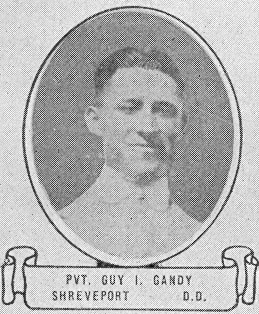
The white marble cross memorializing Pvt. Guy Ira Gandy in the Meuse-Argonne American Cemetery, is a long way from Homer, Louisiana where he was born in March, 1895. He was raised in rural Claiborne Parish, but became an orphan at the age of 9 when his father John Alexander Gandy passed away. His mother Leona passed away when Guy was only six. The 1910 census lists him as a young teenage orphan living with a family in Webster Parish. By June, 1917, when he registered for the WWI draft, he is listed as living in Bossier Parish, as a “dairy” and “truck” farmer working for the major Bossier landowner W.T. Colquitt of the West Bend Plantation. Records show his three older Gandy half-siblings were living in Bossier Parish, as well. In early December, 1917, he married Glennye McGraw in Shreveport. According to an article in the Shreveport Times, before being sent to a temporary military training facility in New Orleans, he took a job with the Cotton Belt railroad, but by August, 1918 he was already departing New York City for Europe on the Aquitania with the 306th supply and ammunition trains (truck convoys) of the 81st Infantry, known as “the Wildcats.”


The 81st went to the hotly contested region of Alsace-Lorraine that had been annexed by Germany in 1871 after the Franco-Prussian War, a strategic and symbolic “prize” that France wanted back with a vengeance. He had barely been overseas two months when Guy Gandy, like so many soldiers, succumbed to illness. He died on October 9, 1918, at the age of 23. For Gandy, pneumonia felled him. For so many others, it was the 1918 worldwide influenza epidemic (sometimes misleadingly referred to as the “Spanish flu”) that spread like wildfire through the packed training and field camps of young men worldwide. In fact, the official history, “The Medical Department of the United States Army in the World War,” Volume II: Administration, published in 1927, states that during the stay of the 81st Infantry Division in the St. Dié sector where Gandy died, battle casualties were very light, but the division suffered greatly from illness. During the period from September 20 to October23, 1918, division field hospitals admitted 1,049 influenza cases and 165 cases of pneumonia. (An uncorroborated article in the Planters Press newspaper of Bossier City on November 1, 1945, said that Gandy’s pneumonia was caused by being mortally wounded in the tiny St. Dié village of Chatillon Ser Seine on Oct 5th.)


On the same day as Gandy’s tragic death, October 9, 1918, the Shreveport Times announced that “Mr. and Mrs. Guy Gandy are proud parents of a son, who arrived Sunday, October 6. He will be called Guy, Jr., for his soldier father, who is now in France.“ The happy news of the arrival of baby Guy Martin Gandy was not clouded by the news of his father’s death until November 10, 1918, when the Times reported that Mrs. Gandy had received a cablegram informing her that her husband had died.


The first burial on Guy Ira Gandy’s Army record is the French Military Cemetery in Raon-L’Etape, Vosges, on October 10, 1918. An American field hospital of the 81st Infantry Division was located there, so it is possibly where Gandy died. Soon after, a temporary American military cemetery was established in Raon-L’Etape and Gandy was disinterred and reburied on 1/27/21. Initial burial at a field hospital would have likely meant burial in a mass grave, or at least a temporary or hastily constructed one. His final interment was at the carefully planned and maintained American Military Cemetery of Meuse-Argonne on October 17, 1921. Each time he was reburied, Glennye Gandy was notified.


Glennye Gandy’s brother Henry Ernest McGraw also fought in the Great War. He returned home and died in Shreveport in 1936 at the age of 40. Glennye married Dewitt Talmage Heard in 1925. (She passed away in 1942). Glennye Gandy Heard’s and Guy Ira Gandy’s son, Guy Martin Gandy, served in the Navy in WWII on a mine sweeper in the Pacific. He, too, returned home and lived to the age of 80.


If you have stories or photographs of people connected to Bossier Parish who served or lived through the sacrifices of WWI, please visit or contact us at the History Center. We are located at 7204 Hutchison Drive, Bossier City, LA and are open M-Th 9-8, Fri 9-6, and Sat 9-5. Our phone number is (318) 746-7717 and our email is history-center@bossierlibrary.org

For other local history facts, photos, and videos, be sure to follow us @BPLHistoryCenter on FB, @bplhistorycenter on TikTok, and check out our blog http://bpl-hc.blogspot.com/.

Images: 

  • Pvt. Guy I. Gandy  from SOLDIERS OF THE GREAT WAR (IN THREE VOLUMES), Memorial Edition, Copyright, 1920, SOLDIERS RECORD PUBLISHING ASSOCIATION
  • Meuse-Argonne American Military Cemetery courtesy of American Battle Monuments Commission, via Wikimedia Commons
  • 306th Supply Train delivering beef in Vosges, France, October 24, 1918. US Army Signal Corps photo via North Carolina Digital Collections
Article by: Pam Carlisle

Wednesday, May 17, 2023

Memorial Day Remembrances - Far Away yet Close at Heart

In honor of upcoming Memorial Day, I found a local history story that is an ocean away, in some of the most beautiful natural surroundings European countries have to offer, surrounded with flags of the United States. They are the American Cemeteries maintained by the American Battle Monuments Commission (ABMC), a government agency founded in 1923 that now manages 26 cemeteries and 35 monuments created after a variety of wars across four continents. The land is generously donated in gratitude to America, and is never taxed in these foreign countries. Forty percent of these cemeteries and monuments are in France.

One of these cemeteries in France, Aisne-Marnes (Aisnes is pronounced Enne) near Belleau, France, northeast of Paris, is the final resting place of PFC. Henry Homer Dalrymple, who was born on July 21, 1892 in Bossier Parish. Homer, as he was known, was raised in the rural Midway/Linton community near Benton and died July 1, 1918, just shy of his 26th birthday in the Picardie region of France (now known as the Hauts-de-France). He was killed in action by a direct hit with a high explosive, where the French and the American Expeditionary forces were holding off the Germans at the Marne River, just ahead of the famous battle of Château Thierry.

Homer Dalrymple’s first burial on his Army burial record listed an American cemetery at the Bézu-le-Guéry, near the village of Château Thierry. There was an American field hospital located there. Its purpose so close to the front was primarily triage. Burial at a field hospital would have likely meant burial in a mass grave, or at least a temporary or hastily constructed one. Homer Dalrymple’s burial record shows that he was reinterred in the beautiful American Cemetery in Belleau France, now known as the Aisnes-Marne, on June 10, 1919.


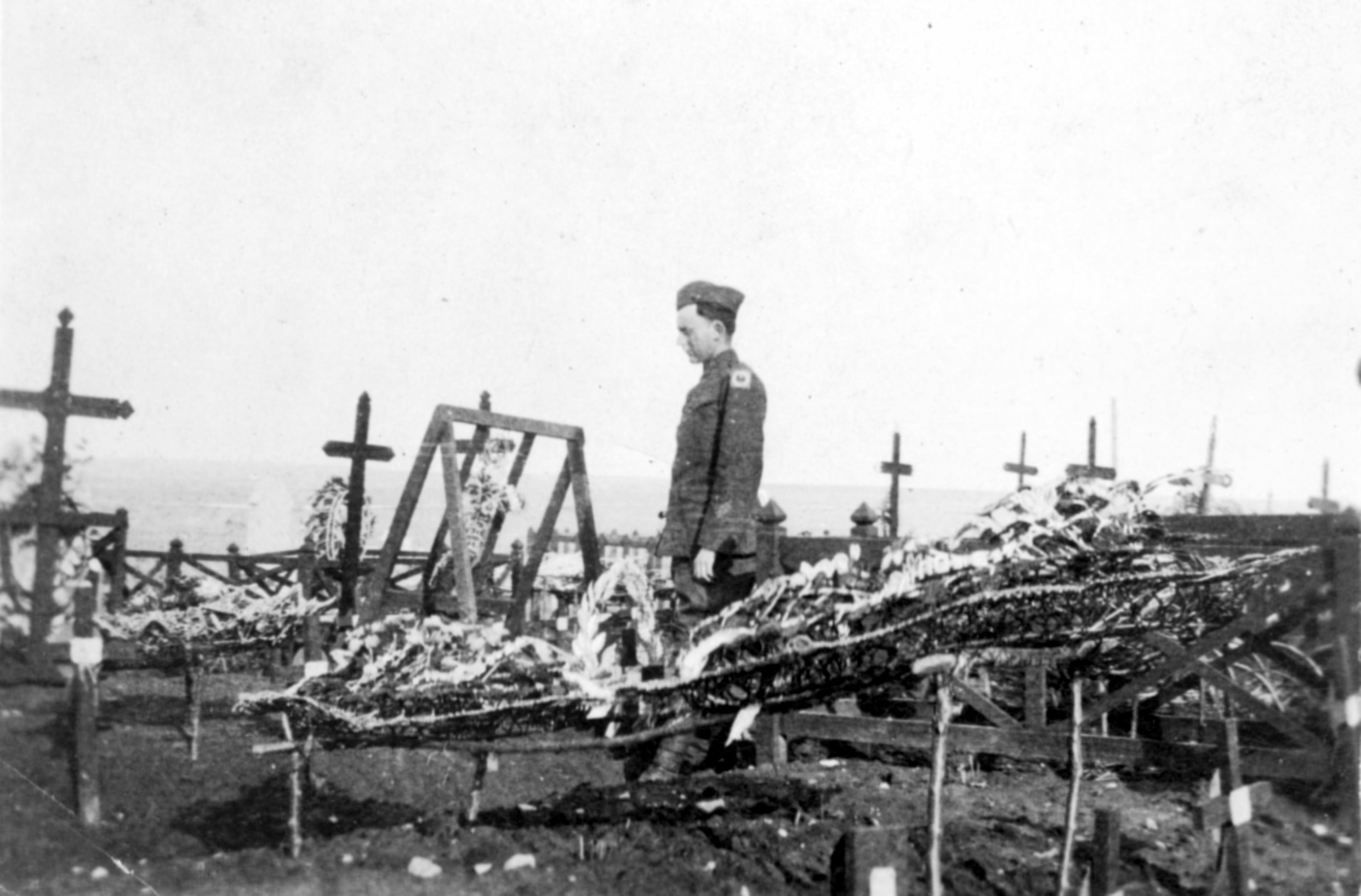
Another photo in our collection, this one of a Bossier WWI soldier who made it home and lived to an old age, was of Dan Rials (Arthur Daniel Rials), who was a member of Company B, 13th Engineer Corps of the US Army. This touching photo, though of a different location in France, may help to explain Homer Dalrymple’s reburial. The photo shows a young Dan Rials in uniform walking among tall wooden crosses and flower-covered yet spindly-looking makeshift funeral biers, platforms for coffins before they are lowered into the ground, identified on the photo as Fleury-sur-Aisne, France, circa 1919.


Fleury-sur-Aisne was a Red Cross “evacuation” hospital used following German advances into France. An online search for Fleury-sur-Aisne yields an even more somber photograph, a chaplain at a burial service there, praying over shrouded bodies in a mass grave of soldiers who had died at the hospital. It’s difficult to look at, but yields much information about death at the frontlines. It is likely, though, that those soldiers too would later have gotten their own cross, or Star of David if they were Jewish, at a permanent American cemetery, such as the beautiful Aisne -Marne mentioned above or the Meuse Argonne, also managed by the American Battle Monuments Commission, or sent back to the United States if their family so chose.


In fact, the American Battle Monuments Commission got its start at the end of WWI. The United States was granted plots of land by the Allies to bury their fallen. Six cemeteries were created in France, one in Belgium, and one in England, as perpetual, tax-exempt property of the U.S. government. Responsibility for their care and maintenance was placed in the hands of the ABMC in 1923.


Homer Dalrymple’s mother Lydia Dalrymple, did not request that her son’s body be returned home, but she did take advantage of the opportunity to go to France as a “Gold Star Mother” (a mother who lost one or more children in the war) to visit the grave of her son in the stunning, new American Cemetery at Aisne-Marne. The History Center has a photo of her, labeled as “Grandma Dalrymple”, by then looking quite elderly, beginning her trip on board a train in Dallas. This was possible because in the late 1920’s, the War Department of the United States compiled a list of mothers and widows of WWI soldiers killed and buried in Europe and offered to take them to their loved ones’ graves. Between 1930 and 1933, 6,000-plus women traveled on these “Gold Star Mother Pilgrimages”. The trips were entirely planned and paid for by the U.S. Army, a relatively rare act of public support for the private grief of families of the fallen.


If you would like to see these or other photos, such as those in our current Red Cross exhibit, visit us at the History Center, or ask us how to use our online catalog, which includes digitized images. We are located at 2206 Beckett St, Bossier City, LA and are open M-Th 9-8, Fri 9-6, and Sat 9-5. Our phone number is (318) 746-7717 and our email is history-center@bossierlibrary.org


For other fun facts, photos, and videos, be sure to follow us @BPLHistoryCenter on FB, @bplhistorycenter on TikTok,

Images: 

  • Dan Rials, 1919, in Fleury sur Aisne, France
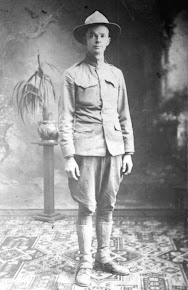
  • Postcard photo of Homer Dalrymple 1892-1918 in World War I uniform. He was in the 48th Infantry Co. H. He was killed near Château Thierry and buried in France.
  • Burial register card for Henry Homer Dalrymple. US National Archives: Record Group 92, Office of the Quartermaster General, Card Register of Burials of Deceased American Soldiers 1917 – 1922
Article by Pam Carlise

Wednesday, May 19, 2021

WWI and Local American Red Cross Societies

Book, "The Red Cross" by Clara Barton, 1898.
Mae Helverson Collection: 2015.010.001
This Friday marks the 140th anniversary of the American Red Cross, which was founded by Clara Barton and "a circle of her acquaintances." When World War I broke out in the summer of 1914, it experienced phenomenal growth as "the number of local chapters jumped from 107 in 1914 to 3,864 in 1918 and membership grew from 17,000 to over 20 million adult and 11 million Junior Red Cross members." Bossier Parish being the patriotic and charitable community that it is, established three Red Cross Societies during the spring of 1917.

It all began when a movement was started in April that year by the Shreveport Lion's Club during a luncheon at the Hotel Youree to establish a chapter of the National Red Cross in Shreveport. Immediately following this organization, Red Cross Societies began organizing throughout Bossier Parish. These societies served as auxiliaries to the Shreveport chapter. The first two societies were formed in Benton and Plain Dealing that May, then in Bossier City in July.

That June, the American Red Cross announced its first War Fund drive to raise 100 million dollars and reached this goal in one week. But that did not slow down the efforts of the local Red Cross Societies from increasing memberships and asking for donations. Including Drs. D. J. McAnn of Atkins and S. E. Prince of Curtis, who traveled together through the parish collecting subscriptions for the benefit of wounded soldiers and sailors, provided through the American Red Cross Society.

American Red Cross Poster, c 1918.
By Artist Wladyslaw 
T. Benda

Retrieved from Library of Congress,
<www.loc.gov/item/2002708897/>.

When fall came and the threat of winter just around the corner, an urgent request was made to the Red Cross headquarters by Maj. Grayson Murphy, head of the American Red Cross in France. The request was for the immediate shipment of one million five hundred thousand each of warm knitted woolen sweaters, mufflers, wristlets, and socks. The Shreveport chapter was tasked with supplying five thousand of each article listed. To meet this quota, they needed the cooperation of every woman in the six parishes under its jurisdiction. Naturally, the women of Bossier bought wool and got busy knitting.

The Caddo-Bossier Red Cross chapter published a statement at the end of 1918, giving an account of its total receipts and disbursements from the time of organization, in spring of 1917, through the end of Oct. 1918. The various receipts totaled to $115,186.73 and the disbursements totaled $80,323.47, that’s equivalent to $1,408,996 today. They also reported 13,410 knitted garments, 29,778 hospital garments, 14,544 refugee garments, and 155,783 surgical dressings made by local women and distributed to the soldiers and sailors.

For 104 years, the local chapter of the American Red Cross has been in operation. They "alleviated human suffering in the face of emergencies by mobilizing the power of volunteers and the generosity of donors. Its members offer aid and resources to others to prevent, prepare for and respond to emergencies through immediate assistance, education, outreach and training. Today, in addition to domestic disaster relief, the American Red Cross offers educational programs that promote health and safety, support and comfort for military members and their families, and provide international relief and development programs."

By: Amy Robertson

Wednesday, May 22, 2019

Fallen Heroes

The Civil War was the deadliest conflict in U.S. history and necessitated the establishment of the country’s first national cemeteries. General John A. Logan, leader of an organization for Northern Civil War veterans, called for a nationwide day of remembrance to take place on May 30, 1868. Logan called this day of remembrance Decoration Day where citizens were asked to decorate the graves of the fallen soldiers. Decoration Day eventually became known as Memorial Day and, while it originally honored only those lost during the Civil War, after World War I the holiday evolved to commemorate American military personnel who died in all wars. In 1968 Congress passed the Uniform Monday Holiday Act, which established Memorial Day as a federal holiday to be observed on the last Monday in May which went into effect in 1971.

Henry Homer Dalrymple in his WWI uniform
Johnette Parham collection: 2002.004.025.
With Memorial Day coming up this Monday, I want to tell you about one of Bossier Parish’s fallen heroes. Pvt. Henry Homer Dalrymple was born July 21, 1892, in Bossier Parish and was from the Midway community which is approximately 9 miles east of Benton. Pvt. Dalrymple lost his life serving in the first World War and is among the countless fallen remembered on Memorial Day.

Unfortunately, the first indication his family received about his death was when letters to Homer were returned to sender with the notation “return to writer: deceased.” The Dalrymple family quickly reached out to the War Department to confirm if it were true…had their beloved son and brother died? The War Department did not have any news of his death and informed the Dalrymple’s that an inquiry would be cabled to the commander abroad and they would advise the family as soon as possible.

Later they received a telegram from the War Department stating, “Deeply regret to inform you that Private Henry Homer Dalrymple, infantry, is officially reported as killed in action; date undetermined” (appearing in the October 24, 1918, publication of the Bossier Banner).

Then, the following letter was sent to the Bossier Banner and published on February 6, 1919:

"Germany, 12 December, 1918.
Mr. G. W. Dalrymple, Shreveport, La.
Dear Sir: I regret to inform you, in response to your inquiry of October 12th, that Henry H. Dalrymple was killed in action. He was always one of the best soldiers I had in the platoon, and was an acting sergeant when the accident occurred. He was killed by a direct hit with a high explosive, and his badly mutilated body was buried about a half kilometer from a village named Vaux, near Chateua [sic] Thiery [sic]. The date of the incident was July 1, 1918. Please accept my most sincere sympathy. Yours, Earl H. Brockman,Captain Infantry, U.S.A."

Pvt. Henry Homer Dalrymple was laid to rest in the Aisne-Marne American Cemetery and Memorial in Belleau, Department de l’Aisne, Picardie, France.

During World War I, mothers would display a gold star on service flags in their homes and on armbands to represent the loss of a son or daughter killed in war service. These women were known as Gold Star Mothers and became a federally chartered organization in 1928. The Gold Star Mothers lobbied Congress for a federally sponsored pilgrimage to Europe for mothers with sons buried overseas. President Calvin Coolidge signed the legislation, in March 1929, authorizing Gold Star Mothers and widows with next of kin buried overseas to travel to Europe with all expenses paid by Uncle Sam.

The Office of the Quartermaster General determined that 17,389 women were eligible to make the pilgrimage. Among these women was Homer’s mother Lydia Harriett Smith Dalrymple who made the pilgrimage sometime in the early 1930s.
Lydia Harriett Smith Dalrymple (left) on her Gold Star Mothers Pilgrimage
Also Harry Gray and Della Gray Sorrells. Johnette Parham Collection: 2002.004.055.
It is with a grateful and heavy heart that we remember all of the fallen heroes who, in service to our great country and with ardent patriotism, have valiantly paid the ultimate sacrifice on the altar of freedom, may they never be forgotten.

To learn more about Bossier Parish history, visit the Bossier Parish Libraries History Center at 2206 Beckett St., Bossier City, La.

By: Amy Robertson

Wednesday, October 10, 2018

"MILITARY DRAFT FOR FARMERS"


Richard Clarence Bradford WWI Draft Registration Card
Mr. & Mrs. Paul McKim Collection; 2002.035.108.009

In its September 26, 1918 issue The Bossier Banner discussed drafting farm laborers for military service.

“There was a meeting of farmers of Caddo, Bossier and other parishes last Thursday at the office of the Shreveport Chamber of Commerce.  The object was to discuss the labor situation, and to arrive at an understanding with reference to the drafting of farm laborers for military service.  Speeches were made by several members of the Parish Council of Defense and a number of farmers.”

“Judge J.C. Pugh seemed to think that all farmers should be exempted from the Army and finally said:”

“However I really do not believe that any man of the last draft will ever be able to smell gunpowder in this war, because the news we are now getting from over there indicates that our boys will have the Huns licked to a standstill before any more reinforcements reach them.”

“But Mr. W.H. Hughes, Jr., an extensive planter of Elm Grove, took a larger view of the situation, and spoke in a patriotic tone, as follows:”

“I intend to fill out my questionnaire and place myself as being eligible for Class I.  And I will do the same thing by every man who works on my plantation.  If I make out his questionnaire and believe him to be good soldier material.”

“Our country is at war and it is our duty to go, and to send every man available for military service. There are enough men who cannot fight to raise the crops, and I do not believe that my farm will produce any less by reason of the absence of those of us who go to the front and fight.  Those who are left will have to work harder, that’s all.”

“Mr. Hodges hit the point exactly.  Because a man has large farming interests there is no reason why he should be allowed to remain in the rear and accumulate a fortune while others are at the front defending his fortune.  He has more at stake, financially, than the poor man—and should be made to fight.”

Fifteen days later, on November 11, 1918, World War I ended and Judge Pugh was proved correct.

WWI Postcard from B. Herbert Britain to his family while on a ship returning to the U.S.A.
Mr. & Mrs. Paul McKim Collection; 2002.035.118.003

To find out more about how Bossier Parish participated in both World Wars pay a visit to Bossier Parish Libraries History Center.


By: Ann Middleton

Wednesday, September 5, 2018

"LETTERS FROM 'OVER THERE'"

Chicago Daily News War Postals series Circa 1918
Mr. & Mrs. Paul McKim collection: 2002.035.139.053
The August 22, 1918 issue of The Bossier Banner carried several letters from enlisted men to the folks back home.

“The following two letters were sent in by Postmaster John H. Allen, of Plain Dealing. The first is from his brother Dallas, now in training at Camp Martin, near New Orleans. The other is from John Baumgardner, a native of the Linton community, but who for some time prior to joining the colors, had employment in Plain Dealing. He is in France and should be addressed: Private John Baumgardner, Military Police, A.P.O., 707 A.M., E.F., France.”

“Dear Mr. and Mrs. J.H.A. and the Chillun: If you don’t mind and since I can’t get out a note. Feeling fine since mumps. Don’t do much. Keep radio practice up; lay round lots. Got a gun to keep cleaned and three pair of shoes to keep shined, four shirts to keep clean, four pair of trousers to keep pressed, two pair of leggings to keep spic and span, a mug to shave every day, a cot to keep in shape, a hat to keep brushed, drill three hours per day, school four hours per day, one hour for athletics, teeth to brush, buttons to sew on and eight hours to sleep. And I find time for writing now and then. See? Lots of time to rest. Yes—not.”

“How’s Plain Dealing and the oil boom? Dry up there? Rains every day here—every doggone one, I tell you. But, say, we have eats here.”

“Yes, we got the Dutchman’s goat. Every steam whistle in New Orleans blows one minute each day at eleven a.m. All business stops, and all pray for one minute—and intend to keep it up until the war is over. I am signing up a crowd to eat Thanksgiving dinner in Berlin, Christmas dinner back in New York, and get back to New Orleans for Mardi Gras next year. Want to go? Believe me, sauerkraut will be cheap as Arkansas land when the war is over. You can call it ‘liberty cabbage if you want, but the smell is still there.”

“Let me hear from you this year, please, and I’ll send your folks a pound of sugar for a Christmas present. Your brother, Dallas G. Allen.”

“Dear John, Thought you might want to hear from me since I am ‘over here.’ Am in a good camp somewhere in France. Am close enough to the front to hear the guns all the time. They sure roar at night too.”

“Would like to write you lots, only there is very little I can write. It is quite exciting when the Germans make an air raid over us.”

“This is an interesting place and I will have lots to tell you when I get back to that old place.”

“Say, if you can, mail me several copies of The Bossier Banner. I have not heard from anyone since I have been gone. Tell Maude to write every week and write yourself when you have time.”

“Sure will be glad when I get back to the good old U.S. America is the best place I have seen and especially Louisiana. Have been in England too. Like it better than France.”

“I am doing patrol duty and am on duty at night most of the time, so have to try to get some sleep.”

“Give my regards to Emmett and Mr. George. Your friend, John Baumgardner.”

Read more letters like these at the Bossier Parish Libraries History Center.

By: Ann Middleton

Tuesday, December 23, 2014

It's Not About Glitz and Glitter...

From our photo collection, in honor of the season and the 100-year anniversary of WWI: 


0000.014.036 Pearl Rials collection
World War I era Christmas tree, decorated with American Red Cross bags. Note on back of the photo says “D.A. Rials, Christmas tree, just make believe 1917, decorated with scraps of paper—no gifts”. 
From the History Center family to your family, may we all remember what is truly of value in this holiday season.