Showing posts with label Korean War. Show all posts

Wednesday, January 21, 2026

A Korean War-time History for National Blood Donor Month

Fifty-five years ago, on December 31, 1969, President Richard Nixon proclaimed the first National Blood Donor Month in January 1970 to honor voluntary blood donors and to encourage people to give blood.

World War II was the first war in which the banking and transporting of blood products to battlefields and military hospitals saved countless lives, when physician-scientist Dr. Charles Richard Drew developed new and practical methods to separate blood plasma, which, unlike whole blood, had a shelf life of two months. He also developed infrastructure like stateside community donation centers in store fronts, factory floors and “bloodmobiles,” and the know-how to ship blood products overseas and onto battlefields and field hospitals, no matter how remote.

World War II was also the time when the Shreveport Memorial Blood Bank (now LifeShare Blood Center) opened to serve Northwest Louisiana as one of the country’s first community blood banks, using their own blood banking machine, a dried plasma system. However, blood collected there was intended for homefront use by local hospitals, and was banked in case of a regional emergency.

The American Red Cross (ARC) collected blood for wartime military use at collection centers in major cities – not Shreveport or Bossier. The nearest centers during World War II were the blood banks in Dallas and Fort Worth, opening in 1945. By the time of the Korean War, the ARC’s collection for military use did expand to Northwest Louisiana and was temporarily located in 1951 at Barksdale Air Force Base. By early 1952, the ARC’s Ark-La-Tex blood collection efforts were anchored by a “Defense Blood Center” in the science building at Centenary College in Shreveport.


From this Defense Blood Center in Shreveport, a mobile blood donation unit operated within a 100-mile radius throughout the Ark-La-Tex. In fact, post blood-drive statistics often showed that the amount of blood collected was often inversely proportional to the size of the community where the blood mobile stopped, when smaller communities, like Daingerfield TX or Plain Dealing LA collected the most pints. Bossier City, however, was proud to be the recipient of this mobile unit’s very first trip, when it was stationed at Bossier High School on January 11, 1952. The visit was coordinated by V. V. Whittington, president of the Bossier Bank and Trust Company, who recruited the Bossier Bearkat football team to recruit as many fellow students, and teachers, as possible.

The February 1, 1953, Shreveport Times reported that the mobile unit of the blood center was also recruiting donations from the students and staff of Bossier City Colored High School, later known as Charlotte Mitchell High School. Principal Jack Strong pledged to be the first in line from the school. Although the American Red Cross had ended its policy to require segregating blood by race by 1950, it did not disallow the practice in states like Louisiana, where segregation was the norm in schools and elsewhere until as late as the early 1970’s.

For the Shreveport blood drives, many promotions were used to entice people to come to the donation center, such as using popular musicians through the Shreveport-based Louisiana Hayride radio show, or an appearance by the Wilson and Company six-horse hitch demonstration team of Clydesdales. Despite the papers’ reports of the enthusiasm generated for the early blood drives, especially at high schools and colleges like Centenary, as well as certain workplaces, the March 25, 1952, Shreveport Times reported that the amount of donations at both the center and through the blood mobile did not reach capacity. The donor recruitment chair for the region urged people to contact Shreveport’s Defense Blood Center to make an appointment by pointing out that the center had no blood to send to aid the victims of tornadoes that had ripped through six southern states the previous week. Though the Defense Blood Center’s priority was to provide blood to the military, the center’s secondary function was to have a stockpile of blood plasma available for use in “widespread civil emergencies.”

One exceptional drive was promoted in the December 21, 1952, Shreveport Times with an announcement that on December 29th, donors with Type O blood (the universal donor type) were asked to donate by the ARC southeast region headquarters in Atlanta in order to have their blood flown in refrigerated containers to Travis Air Force Base near San Franciso. The containers would then be transferred to a waiting Military Air Transport Service plane to take off immediately for Korea.

Normally, blood donations from Shreveport were separated for its plasma, which has a much longer shelf life than whole blood (2 months versus one week). Plasma is invaluable in many trauma situations, but some needs weren’t adequately met without whole blood. Normally, whole-blood donations were taken from donors on the west coast, eliminating some of the travel time for the perishable blood. However, at that moment, the need for whole blood by American troops in Korea was greater than what could be provided on the west coast alone.

In contrast, the Shreveport Times of August 6, 1953, reported that the need for blood had decreased following the Korean Armistice Agreement, which was signed July 27, 1953, and that Shreveport’s Defense Blood Center would close at the end of the month. The paper reported that a total of 36,454 pints of blood had been collected by the center from 30 parishes and counties since December of 1951.


If you have local Korean War, medical history or other family photos or stories to share (we will also scan and return originals if that is your preference), please visit or contact us at the History Center. We are located in the Bossier Central Library Complex at 7204 Hutchison Drive in Bossier City, LA. Please note the new hours for the History Center: M-Fri 9-6. Saturdays we are open by appointment. Our phone number is (318) 746-7717 and our email is history-center@bossierlibrary.org

For other local history facts, photos, and videos, be sure to follow us @BPLHistoryCenter on FB and @bplhistorycenter on TikTok.

Images: Centenary Conglomerate, February 20, 1952. Centenary College of Louisiana Archives and Special Collections

Article by: Pam Carlisle

Wednesday, June 25, 2025

Task Force Smith - A Reminder of the Forgotten War

The year was 1950, and the world was recovering from the most destructive conflict to have ever occurred. The reconstruction of the world was ongoing, with two major power blocs dominating the international order: the American led Western Bloc and the Soviet led Eastern Bloc. In late June, the news came to the world: the Soviet aligned Democratic People’s Republic of Korea has crossed the dividing line into the American aligned Republic of Korea. The first war of the post-World War II world had come; the Korean War had begun. Often referred to as the Forgotten War here in the United States due to its unfortunate timeline placement between WWII and Vietnam, the Korean War was mired with the political backdrop of the Cold War and the drawdown undertaken by the western powers in the wake of the end of WWII.


The first Americans deployed in the wake of the DPRK’s southward advance were members of the Japanese occupation forces, sent to garrison the Japanese Home Islands in the wake of Imperial Japan’s surrender at the end of World War II. While the wider United Nations intervention would not come until after the coming battle, the battle at Osan is considered the first engagement by the United Nations Command. While overall command was held by General Douglas MacArthur, Lieutenant Colonel Charles Smith was given operational command of the task force, made up of 1st Battalion, 21st Infantry Regiment, and Battery A of the 542nd Field Artillery, leading to the apt name of ‘Task Force Smith.’ Made up of portions of the 24th Infantry Division, the 540 men were instructed to halt or delay the advancing North Koreans for long enough to deploy further reinforcements. Just under two weeks after the beginning of the invasion, on July 5th, 1950, (and two days before the official formation of the United Nations Command) the American Task Force Smith would settle in at Osan, located south of the Republic of Korea’s captured capital in Seoul. The defensive position was accompanied by artillery and anti-tank weapons used by the American Army during the second World War, with the expectation being that nothing the North Koreans had would be able to resist the might of American arms. Task Force Smith, in the early hours of the morning, would be disabused of this notion rather quickly and violently. The Task Force was faced with thousands of advancing North Korean soldiers, including DPRK Soviet T-34s, with only an undermanned battalion and a single artillery battery to carry out their orders to delay.


According to the National Museum United States Army article from January 29th, 2025, “Task Force Smith and the Problem with ‘Readiness,’” the artillery employed by the US soldiers would ricochet off the T-34's armor. Likewise, the American anti-tank weapons were also unable to pierce the Soviet armor. Still, these soldiers would delay, spending themselves dearly to halt the advance. However, they were able to eventually disable six of the Soviet designed tanks, as well as fight the DPRK’s soldiers to a standstill for seven long, grueling hours. With the limited ammunition that could break the tank armor expended and the increasing number of North Korean infantry advancing, the heavy order to retreat was given. In the end, there would be over 150 casualties (missing, wounded, or dead).


Among the number of men who served with Task Force Smith and survived, there was a Bossier resident of special note. Corporal Joseph Rachal Jr., a resident of what was at the time Curtis, Louisiana, was among a selection of the men who served with Task Force Smith who were brought to the White House for honors on behalf of those that fought at Osan. This collection of eighteen men were met with President Truman in the White House Rose Garden, and according to the UC Santa Barbara American Presidency Project, said to them: “I congratulate you men on the job you did in that original task force. Had it not been for the fact that these two divisions to which you belong had caused the Communists to hesitate, we possibly would not have been able to hold our position with the Korean Republic.” It is because of Corporal Rachal and the men alongside him of Task Force Smith that gave the South Koreans and Americans time to dig in further down the road, with a better understanding of who and what they were facing in the times to come.


The legacy of Task Force Smith, and by extension the Korean War, has been a mixed one. Task Force Smith taught the U.S. Army a valuable reminder about the necessity of intelligence and the perils of overconfidence. The Korean War, meanwhile, is an example of the Cold War that was to come: two dominant world powers in a constant game of back-and-forth. Regardless of these facts, the men of Task Force Smith were not responsible for what brought them there. Their sacrifice bought time for the Republic of Korea and the United Nations Command to muster a response that would ultimately see the DPRK pushed back beyond the 38th parallel, and the current ongoing cessation of hostilities.


If you have any photos or other information relating to the history of Bossier City or Bossier Parish, the History Center may be interested in adding the materials to its research collection by donation or by scanning them and returning the originals. Call or visit us to learn more. We are open M-Th 9-8, Fri 9-6, and Sat 9-5. Our phone number is (318) 746-7717 and our email is history-center@bossierlibrary.org. We can also be found online at https://www.facebook.com/BPLHistoryCenter/ and http://bpl-hc.blogspot.com/

Images: 

  • Task Force Smith arrives in South Korea - (U.S. National Archives/July 2, 1950/NAID: 315834053)
  • Task Force Smith Monument at Osan - (U.S. Air Force photo/Master Sgt. Matt Summers/VIRN: 081009-F-9999S-0001)
Article by: Jonah Daigle

Wednesday, July 5, 2023

Bossier Parish Soldiers Gave All in Korean War

 On the evening of Sunday, July 26, 1953, President Dwight Eisenhower was nervous. The armistice ending the Korean War was due to be signed the following day, and according to White House Assistant Staff Secretary Arthur Minnich, Eisenhower feared “that there was the possibility that something would go wrong before the signing was complete.” Those fears proved unfounded, as the armistice was signed the following morning at 10 a.m., 70 years ago this month, ending the conflict which saw families across the nation burying loved ones killed in action, including three from Bossier Parish.


James E. Kelleher Jr. had been a resident of Benton since birth. Articles in The Bossier Banner and The Planters Press newspapers state that he was a graduate of Benton High School and entered the U.S. Army in 1948, training in California before being sent to Japan as part of the 5th Calvary Regiment, 1st Calvary Division. Rising through the ranks, he became a sergeant and, according to the American Battle Monuments Commission, was a recipient of the Purple Heart, Korean Service Medal and the National Defense Service Medal, among others. After being wounded on August 2, 1950, he wrote a letter to his mother saying she shouldn’t worry about him. “I am not in too bad a condition,” he stated. “I did get shot though, and it didn’t feel very good.” A copy of the letter is in the History Center archives. Kelleher returned to duty in late August, but was wounded again during fighting on November 28, 1950. After recuperating, he rejoined his division in mid-January 1951. Approximately a month later, he was killed in action. He was 20 years old.

“I am not in to [too] bad a condition,” he stated. “I did get shot though, and it didn’t feel very __ good.” 

Lionel King of Plain Dealing also served in the Army, the 9th Infantry Regiment, 2nd Infantry Division. Born in 1922, this African American soldier earned several medals while achieving the rank of master sergeant. Among the service decorations listed for him by the ABMC are the Purple Heart, Republic of Korea War Service Medal and the Republic of Korea Presidential Unit Citation. Although additional information about King’s time of service was difficult to find, online records of the National Archives show that he was killed in action February 14, 1951, during fighting in South Korea. According to The Planters Press, his family was notified approximately a month later. He was 28 years old.


Charles J. Steelman hailed from Plain Dealing as well, and like King and Kelleher, served in the Army. He was a private first class with the 17th Infantry Regiment, 7th Infantry Division, and his awards included the Purple Heart, National Defense Service Medal and Republic of Korea War Service Medal, according to the ABMC. Information about Steelman was also difficult to find, but National Archive records show he was killed in action in the South on February 19, 1951, aged 19.


Today, the Wall of Remembrance at the Korean War Veterans Memorial in Washington, D.C. commemorates these three men and the more than 36,000 other Americans who lost their lives fighting to defend South Korea. The names Kelleher, King and Steelman are inscribed there. At least two of the names can also be found here at home. Sgt. Kelleher was buried at Lay Cemetery in Benton, while Pfc. Steelman was laid to rest at Stevens Cemetery in Caddo Parish. The final resting place of MSgt. King was unable to be verified. Their sacrifice is stated simply but eloquently by the phrase attributed to Korean War veteran Howard Osterkamp, “All gave some; some gave all.”


If you have any letters, photos or other information relating to residents of Bossier Parish who’ve served in the military, the History Center may be interested in adding the material to its research collection. Call or visit us to learn more. We are open M-Th 9-8, Fri 9-6, and Sat 9-5. Our phone number is (318) 746-7717 and our email is history-center@bossierlibrary.org. We can also be found online at https://www.facebook.com/BPLHistoryCenter/


Image 1: Sergeant James E. Kelleher Jr. / photo courtesy of A Footstep In Time & Donna Hinton Warke

Image: 2 Cropped section of the letter written by James E. Kelleher, Jr. 

Image 3: Purple Heart Medal/ photo courtesy of Clipart-library.com

Image 4: Grave marker for Private First Class C J Steelman/ photo courtesy of Family Miner


Article by: Kevin Flowers

Wednesday, June 28, 2023

Bossier Parish Man Still Missing from Korean War

Seventy three years ago this month, President Harry Truman was taking a break from the stress of life in the White House by relaxing at his home in Independence, Missouri. The peace and quiet he enjoyed would not last. Word came on June 24th (June 25th in Korea) that North Korean troops were invading South Korea. Truman rushed back to Washington and committed U.S. forces as part of a United Nations effort to defend the South. The Korean War had begun. Approximately 36,500 U.S. service members would lose their lives in the brutal conflict. One member from Bossier Parish is still among the missing.


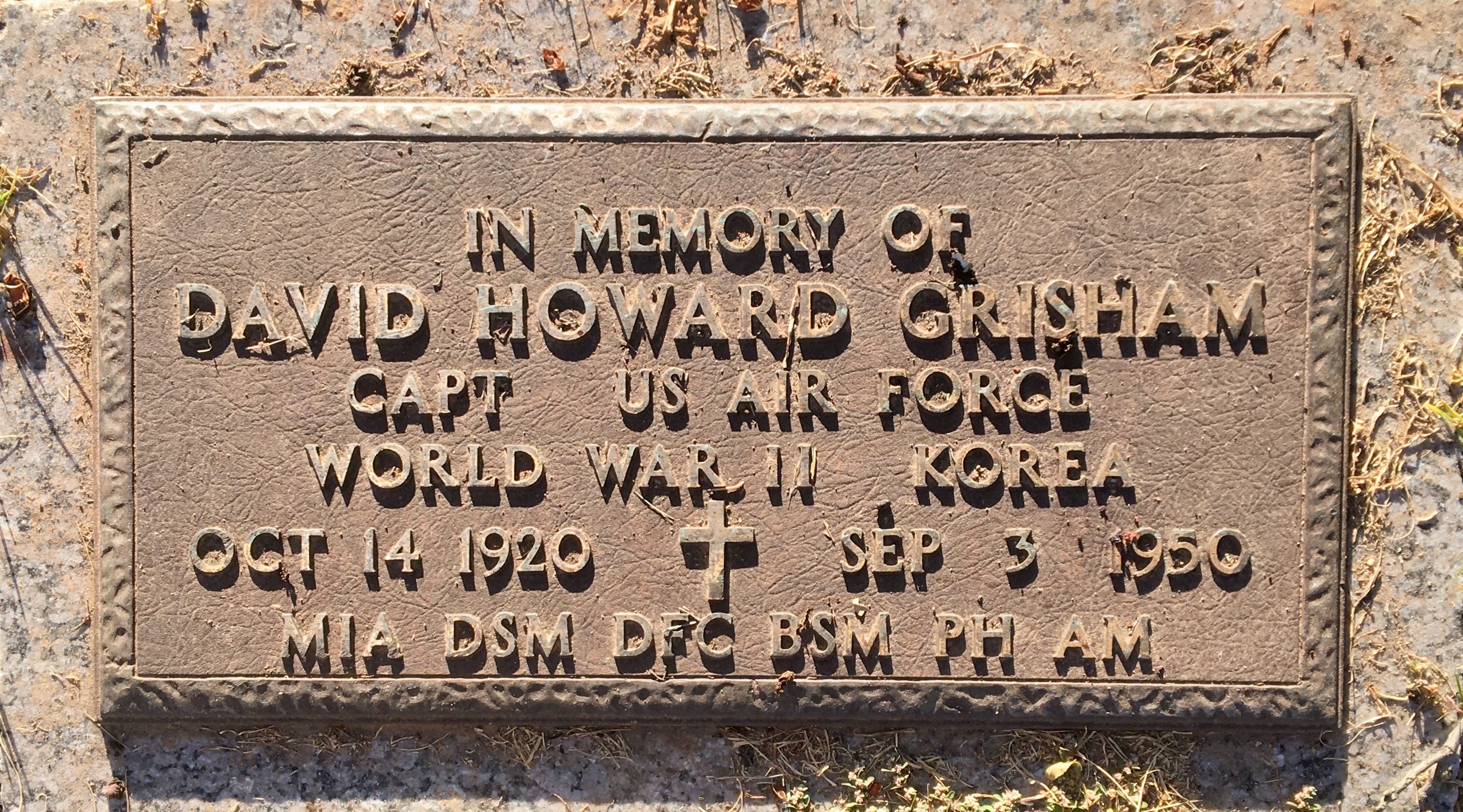
Captain David H. Grisham was a pilot and meteorologist. The 1938 Benton High School graduate first served his country in World War II, flying some 30 combat missions. According to the American Air Museum in Britain, it was during one such flight, with Grisham as co-pilot, that his plane – a B-24 Liberator – was repeatedly attacked by enemy aircraft while returning from a mission over Frankfurt, Germany. The plane lost all four of its superchargers, thus slowing its speed. Protective cloud cover was scarce. Taking evasive action, the Liberator descended to 75 feet. Enemy fighters fell back. Although damaged, the B-24 was able to reach a Royal Air Force station near Kent in England and make a wheels-up landing. This would not be Grisham’s last encounter with danger.


In Korea, weather played a key role in the planning and execution of combat operations, but forecasting the weather could be difficult. Grisham was up to the challenge. As part of the U.S. Air Force’s 20th Weather Squadron, he served as staff weather officer for the 18th Fighter Bomber Group and often flew reconnaissance missions, gathering data vital to troop movements. It was on his 46th recon flight that something went wrong. The Defense POW/MIA Accounting Agency details what happened. Grisham, as number two pilot in a flight of two, departed Ashiya Air Base in Japan in the early morning hours of September 3, 1950, flying a single-seat F-51 Mustang. Grisham and the lead pilot agreed to rendezvous over Pusan, Korea if they became separated. Shortly after takeoff, they had to climb through heavy overcast. The lead pilot exited the clouds, but did not see Grisham’s plane. He tried reaching Grisham by radio with no success. Grisham never arrived at the rendezvous point. Efforts by the Emergency Rescue Squadron failed to find any trace of him. Grisham was missing in action, one-month shy of his 30th birthday. Though the weather had been bad, the operations officer at the time of the flight states in a letter published in the Bossier Banner newspaper in November 1950, “We were ordered to proceed because the ground forces were in dire need of close support.”


Grisham was presumed dead on December 31, 1953, five months after the war ended with the signing of an armistice. His remains were never recovered. His name is inscribed, along with the names of all those who lost their lives fighting to defend South Korea, on the Wall of Remembrance at the Korean War Veterans Memorial in Washington, D.C. He is also listed on the Courts of the Missing at the National Memorial Cemetery of the Pacific in Hawaii and is memorialized with a plaque at Hill Crest Cemetery in Haughton.


If you have any letters, photos or other information relating to residents of Bossier Parish who’ve served in the military, the History Center may be interested in adding the material to its research collection. Call or visit us to learn more. We are open M-Th 9-8, Fri 9-6, and Sat 9-5. Our phone number is (318) 746-7717 and our email is history-center@bossierlibrary.org. We can also be found online at https://www.facebook.com/BPLHistoryCenter/


Images: 

Image 1: Captain David H. Grisham, Defense POW/MIA Accounting Agency

Image 2: Grisham's B-24 Liberator, B-24 Best Web

Image 3: Memorial plaque at Hill Crest Cemetery in Haughton, photo by Sandra Clarkston


Article by: Kevin Flowers