Showing posts with label POW/MIA. Show all posts

Wednesday, May 14, 2025

History Center Uncovers Story Behind Flea Market Find for Vietnam Veteran

Sharing stories from history is part of why I so enjoy being a staff member of the History Center. Researching and writing about people and events from the past is interesting to me. One recent opportunity to research military history reminded me that sometimes the most extraordinary stories can come from the most unlikely places.


In 1970, a student-led organization called Voices in Vital America introduced POW/MIA bracelets to ensure that service members who were prisoners of war or missing in action in Vietnam not be forgotten. Each bracelet, made of nickel or copper, contained the service member’s name and date of capture or disappearance and would be worn until he returned home. It was just such a bracelet that I had the chance to investigate early last month after taking a phone call at the History Center from a gentleman in Florida.


Retired Marine Kermit McNeal was seeking answers to questions he had about a POW/MIA bracelet that he bought approximately two years prior while visiting a flea market. He wanted to know if the person named on the bracelet – Arthur Black - had survived the war, and if Black or his family would like to have the bracelet. Unfortunately, Mr. McNeal’s efforts to learn about the bracelet had been futile. “No one wanted to help me,” he said. After receiving no assistance from some other history organizations, he found the Bossier Parish History Center online and reached out.


His reasons for buying the bracelet were both noble and personal. As a Vietnam veteran, he thought it “undignified” to leave the bracelet behind. “I simply couldn’t walk away and leave it there,” he told me. But an incident on the home-front during the war also played a role in his decision. During his time of service, someone attempted to swindle money from his mother by claiming that he had been captured, and saying they could affect his release for a fee. Thankfully, the ruse didn’t succeed. “I was never captured, but just hadn’t written home in a while,” he said. “This bracelet represented someone who had been captured or was missing.”


The History Center is privileged to have a POW/MIA bracelet in its archive collection. It bears the name William Butler, an Air Force pilot who spent nearly 6 years as a prisoner after being shot down over North Vietnam in 1967. In a column published a year ago, History Center Public Historian Pam Carlisle shared how his bracelet impacted the lives of a Bossier City couple by creating an opportunity to learn his story. Similarly, the bracelet purchased by Mr. McNeal would open an avenue for him to learn Arthur Black’s story.


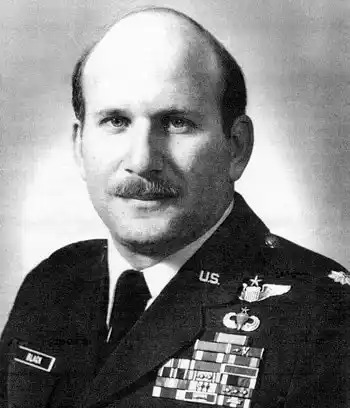
As I began researching Mr. Black and the date of September 20, 1965 shown on his bracelet, I was surprised by the amount of information available. He served as an Air Force pararescueman, sometimes called a PJ (for parajumper). His job was extremely dangerous. The National Museum of the United States Air Force describes it this way: “The PJ's unique mission in Vietnam was to ride into a combat zone aboard a slow, vulnerable helicopter, and descend into jungles, swamps, mountains and forests on a cable and winch. On the ground, they stabilized and helped hoist the injured to safety, often under fire.”


According to the museum’s website, pararescueman wore flight crew helmets and armored “flak” jackets for protection and carried weapons such as .38-caliber pistols, M-16 rifles and survival knives. Basic medical kits were used to tend the wounded. The website states that because of the heroic work done by Black and other PJs in Vietnam, more than 4,000 lives were saved.


It was while attempting to recover a pilot whose plane had gone down that Black’s helicopter crashed after being fired upon by enemy troops. He and three others aboard were immediately captured, beginning nearly eight years of beatings, torture and other abuse. In a recent interview with the Times of San Diego newspaper, he talked about how the ordeal caused him to review his life. “I thought about the past, all the things that I had done good and bad. I considered … what my parents were going through. And I figure they were having a harder time than me.”


After 2,703 days in captivity, Mr. Black came home. Released in 1973, he received a presidential commission to second lieutenant and continued his Air Force career by becoming a pilot himself and retired with the rank of major in 1987. He resides in Carlsbad, California, and thanks to the assistance of Carlsbad Mayor Keith Blackburn, I was able to contact Mr. Black and share with him how Kermit McNeal had discovered his bracelet. Honored to learn of this and grateful that McNeal hadn’t left it behind, Black said he was welcome to keep it.


That a flea market find could lead to uncovering such stories amazed me. That it offered the chance to interact with these two veterans was a privilege. Mr. McNeal thanked me for my efforts, saying he was certainly happy to hear that Black survived the war, and said the bracelet would remain on display in his home. Opportunities like this make working at the History Center so appealing. I may never look at flea markets the same way again.


If you have any information or items relating to the history of Bossier Parish, the History Center may be interested in adding the materials to its research collection by donation or by scanning them and returning the originals. Call or visit us to learn more. We are open M-Th 9-8, Fri 9-6, and Sat 9-5. Our phone number is (318) 746-7717 and our email is history-center@bossierlibrary.org. We can also be found online at https://www.facebook.com/BPLHistoryCenter/ and http://bpl-hc.blogspot.com/


Images: 

  • Arthur Black/photo courtesy U.S. Air Force
  • William Butler's POW/MIA bracelet/History Center collection
  • Arthur Black as a pararescueman/photo courtesy Arthur Black
Article by: Kevin Flowers

Wednesday, June 28, 2023

Bossier Parish Man Still Missing from Korean War

Seventy three years ago this month, President Harry Truman was taking a break from the stress of life in the White House by relaxing at his home in Independence, Missouri. The peace and quiet he enjoyed would not last. Word came on June 24th (June 25th in Korea) that North Korean troops were invading South Korea. Truman rushed back to Washington and committed U.S. forces as part of a United Nations effort to defend the South. The Korean War had begun. Approximately 36,500 U.S. service members would lose their lives in the brutal conflict. One member from Bossier Parish is still among the missing.


Captain David H. Grisham was a pilot and meteorologist. The 1938 Benton High School graduate first served his country in World War II, flying some 30 combat missions. According to the American Air Museum in Britain, it was during one such flight, with Grisham as co-pilot, that his plane – a B-24 Liberator – was repeatedly attacked by enemy aircraft while returning from a mission over Frankfurt, Germany. The plane lost all four of its superchargers, thus slowing its speed. Protective cloud cover was scarce. Taking evasive action, the Liberator descended to 75 feet. Enemy fighters fell back. Although damaged, the B-24 was able to reach a Royal Air Force station near Kent in England and make a wheels-up landing. This would not be Grisham’s last encounter with danger.


In Korea, weather played a key role in the planning and execution of combat operations, but forecasting the weather could be difficult. Grisham was up to the challenge. As part of the U.S. Air Force’s 20th Weather Squadron, he served as staff weather officer for the 18th Fighter Bomber Group and often flew reconnaissance missions, gathering data vital to troop movements. It was on his 46th recon flight that something went wrong. The Defense POW/MIA Accounting Agency details what happened. Grisham, as number two pilot in a flight of two, departed Ashiya Air Base in Japan in the early morning hours of September 3, 1950, flying a single-seat F-51 Mustang. Grisham and the lead pilot agreed to rendezvous over Pusan, Korea if they became separated. Shortly after takeoff, they had to climb through heavy overcast. The lead pilot exited the clouds, but did not see Grisham’s plane. He tried reaching Grisham by radio with no success. Grisham never arrived at the rendezvous point. Efforts by the Emergency Rescue Squadron failed to find any trace of him. Grisham was missing in action, one-month shy of his 30th birthday. Though the weather had been bad, the operations officer at the time of the flight states in a letter published in the Bossier Banner newspaper in November 1950, “We were ordered to proceed because the ground forces were in dire need of close support.”


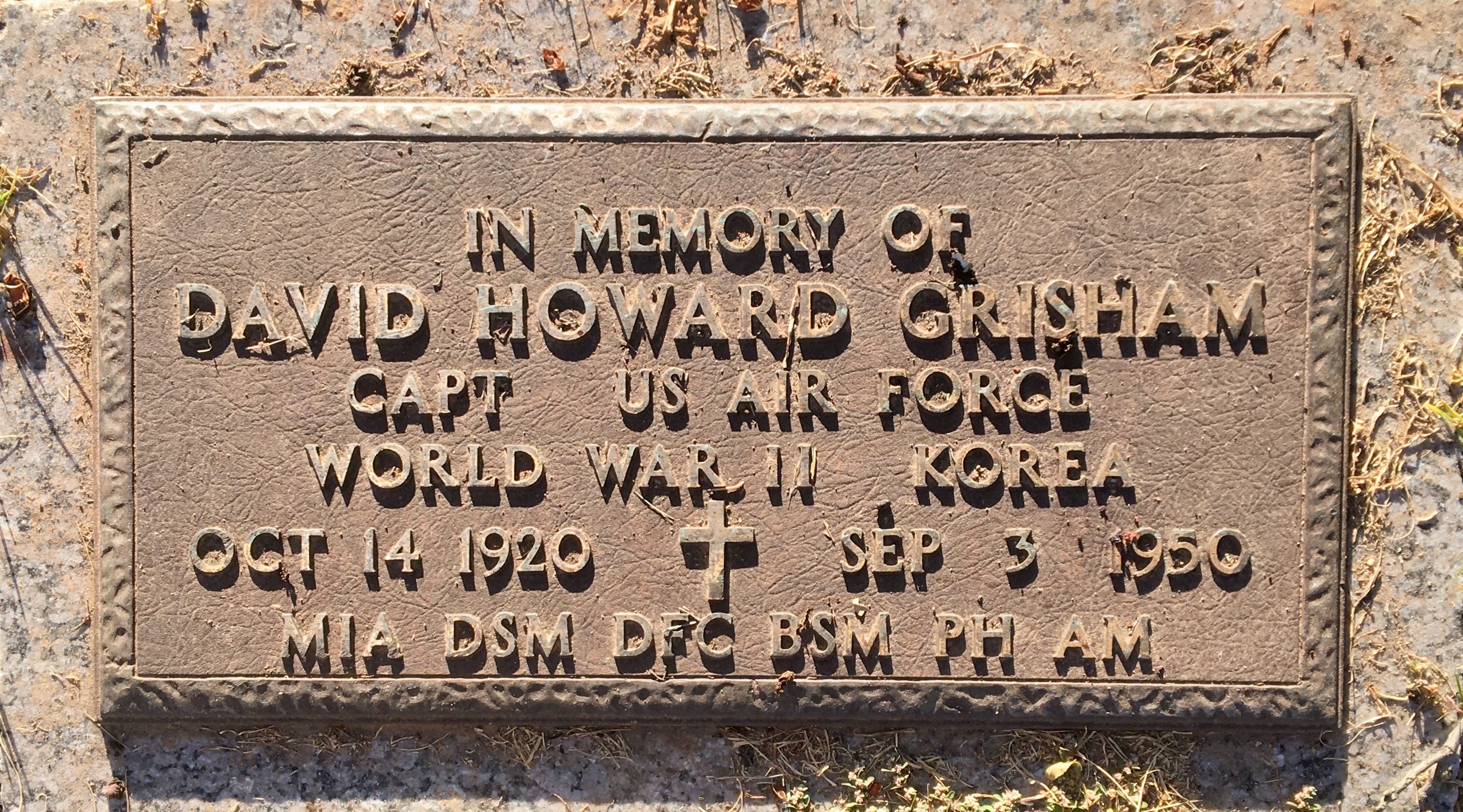
Grisham was presumed dead on December 31, 1953, five months after the war ended with the signing of an armistice. His remains were never recovered. His name is inscribed, along with the names of all those who lost their lives fighting to defend South Korea, on the Wall of Remembrance at the Korean War Veterans Memorial in Washington, D.C. He is also listed on the Courts of the Missing at the National Memorial Cemetery of the Pacific in Hawaii and is memorialized with a plaque at Hill Crest Cemetery in Haughton.


If you have any letters, photos or other information relating to residents of Bossier Parish who’ve served in the military, the History Center may be interested in adding the material to its research collection. Call or visit us to learn more. We are open M-Th 9-8, Fri 9-6, and Sat 9-5. Our phone number is (318) 746-7717 and our email is history-center@bossierlibrary.org. We can also be found online at https://www.facebook.com/BPLHistoryCenter/


Images: 

Image 1: Captain David H. Grisham, Defense POW/MIA Accounting Agency

Image 2: Grisham's B-24 Liberator, B-24 Best Web

Image 3: Memorial plaque at Hill Crest Cemetery in Haughton, photo by Sandra Clarkston


Article by: Kevin Flowers


Wednesday, September 22, 2021

Bossier Native Survives WWII Prison Camp, Part 2

As you will recall from last week's column, Pittman requested to be assigned to a combat crew rather than play football for the Army here in the states. The following is a summary of his experience in combat and as a POW.

Jan. 16, 1945, was a day that he would never forget. It was his crew's 13th mission, and Berlin was their primary target. According to Pittman, "it was nearly impossible for bombers to get in and out without casualties. It was actually impossible at that time because they had the whole city surrounded with anti-aircraft." His crew took the lead in the mission, and before they knew it, they took on heavy German "flak" (anti-aircraft fire).

B-24 Liberator Through flak and over the destruction created by preceding waves of bombers, these 15th Air Force B-24s leave Ploesti, Rumania, after one of the long series of attacks against the No. 1 oil target in Europe. (U.S. Air Force photo)[1]

The aircraft was going down, and the crew had to bail out of the plane. Fellow crew member Moose Meyers, the tail gunner, was bleeding profusely and appeared to be mortally wounded. Pittman pulled him out and asked him if he could bail out. When Moose said yes, he helped him to the escape hatch and watched as his parachute opened. All of the crew members bailed out, and by the end of the day, they had all been captured by German soldiers, becoming prisoners of war.

After being captured, they took him to the Gestapo Chief, where he was interrogated and beaten. Next, they forced Pittman to remove all of his clothing. They allowed him only to wear his thin gabardine flight suit, which offered no protection from the bitter cold. They put him in a dungeon where most of his crew members were. From there, they went to a jail where he was shown kindness by the jailer, who saw how cold he was, seating him near a radiator for warmth and giving him a cup of hot soup and a blanket.

The following day the Burgermeister (which roughly translates to mayor) and other dignitaries came to the jail to look over the prisoners. The same jailer that showed Pittman kindness went into his cell and kicked him while his back was turned, lifting him off the floor. After the dignitaries left, he apologized for his actions; the jailer said it was because "he had to put on a front" while the dignitaries were there.

Next, the prisoners boarded a train which took them to the Central Interrogation Center for all of Germany in Frankfurt. According to Pittman, it was really rough there. They were professional interrogators with the facilities needed to torture men for information. Pittman was put on another train and taken to Wetzler, a small POW camp about 20 or 30 miles north of Frankfurt. Over the next few days, most of the members of his crew arrived there as well.

Pittman described this camp as a permanent POW camp that did not feed the prisoners; they were all literally starving to death there. A few weeks later, they were moved to a large POW camp in Nuremberg, where conditions were even worse. Many of the men there were sick, and some were dying. These sick, malnourished men were taken to a new location, this time on foot. Unbeknownst to them, General Patton was nearby on the Rhine River.

They marched for about two weeks, during which they stole food from local farmers, taking anything they could get their hands on. During this time, Patton began sending a plane over every morning and dropping leaflets providing reports of the war to the prisoners. In his messages, he urged the men to "stick together and don't try to escape," that they were right behind them and would come and get them just any time.

Source: Robert D. Reeves - Peoria to Munich - A Prisoner of War
http://www.moosburg.org/info/stalag/ree7eng.html

Their march brought them to an overcrowded POW camp in Moosburg. It contained thousands of prisoners, many having to sleep outside. One afternoon a rumor began to circulate that Patton and his men were just across a small ravine and would come to get them the next morning. Sure enough, Pittman woke to the sound of a gun. Being outside, he quickly saw that the front gate had been pushed in by a big tank and drove right up to the barbed wired compound he was in, and General Patton jumped out of it. A few days later, the war ended.

General Patton on liberation day at Camp Stalag VII A, 29 Apr 1945
Before returning to the states, the men were brought to Camp Lucky Strike in France, where they were disinfected, bathed, given haircuts and clean clothes. For some, this was their first bath since being captured. Pittman fondly remembers being allowed to bathe in the Danube during their march to camp Moosburg—his first bath since arriving in Germany. From there, the liberated prisoners were either placed on a ship or plane to return home.

View of Camp Lucky Strike - Saint-Valery, France. 1945.
Source: State Archives of Florida, Florida Memory.
<https://www.floridamemory.com/items/show/136556>.

Pittman tells his audience that "during our captivity—it was the roughest part of my life! The combat was bad, the flying combat was very nerve-wracking, everybody was tense, and you were literally scared! But to me, staying there in that prison camp and being tortured with hunger, I think, was probably the worst experience I had. We were threatened several times with our lives, but that didn't bother us too much. It was just the dream of food, and it was wanting food and not being able to get it that was a nightmare! You would go to sleep, and you'd dream about food. When you'd wake up, and you were talking, all you would talk about was food!"

Pittman lost 50 pounds during his imprisonment, but other survivors who had been there longer being reduced to skin and bones. Some would consider being shot down on the 13th mission bad luck, but Pittman felt it was good luck because he lived to tell about it.

To read the full transcript of Pittman's story and the discussion that followed after his talk, visit the Bossier Parish Libraries History Center at 2206 Beckett Street, Bossier City. Donations are a large part of our collection and are vital in helping us preserve Bossier Parish's history. Visit, call, or email the Bossier Parish Library History Center for help with your research. We are at 2206 Beckett Street, Bossier City, 318-746-7717, history-center@bossierlibrary.org.

By: Amy Robertson

Wednesday, September 15, 2021

Bossier Native Survives WWII Prison Camp, Part 1

This Friday is National POW/MIA Recognition Day, first established in 1979 through a proclamation signed by President Jimmy Carter. Since then, each subsequent president has issued an annual proclamation commemorating the third Friday in September as National POW/MIA Recognition Day. Today, more than 81,600 Americans remain missing from WWII, the Korean War, the Vietnam War, the Cold War, and the Gulf Wars/other conflicts. Approximately 72,000 missing Americans are from WWII alone, 976 of which are Louisianans.

Among those unaccounted for include those buried with honors as unknowns, officially buried at sea, and missing in action, including prisoners of war. Not all POWs became unaccounted for; many were liberated and came home. This week we remember Robert Milton Pittman, Sr., a Plain Dealing native who survived being a POW in Germany during WWII.

Pittman graduated from Plain Dealing High School in 1940 as a track runner and football player. His skill on the gridiron won him a scholarship to Tulane University, where he continued his education. At the end of 1941, the United States entered World War II after Japan staged a surprise attack on American military installations in the Pacific with the most devastating strike at Pearl Harbor. Pittman registered for the draft in 1942 and was accepted, along with 45 other Bossierites, by the Bossier City Draft Board No. 1 in May of 1943 for Army Air Force Services.

Robert Milton Pittman
After going through basic training and several technical schools, he reported to Omaha, Nebraska, for assignment to a combat crew. But once they saw that he played football for Tulane, they signed him up to play football for the Second Air Force that fall. Pittman did not want to stay and play football for the base team; he wanted to join a combat crew. He put in a request for assignment on a combat crew, and it was granted. His assignment was to a B-24 Liberator Bomber crew of the 712th Squadron of the 448th Bomb Group.

On Apr. 5, 1945, The "Bossier Tribune" announced, "Plain Dealing Man German POW."

"S/Sgt. R. Milton Pittman, radioman-gunner on a B-24, reported missing in action over Germany since Jan. 16, is a prisoner of the German government, his parents, Mr. and Mrs. S.D. Pittman of Plain Dealing, have been advised by the war department.

"In a card received a few days after the report from the war department, Sergeant Pittman told his parents he is in perfect health and is grateful for the Red Cross clothing distributed in the camp.

"The young flier, who has been overseas since August, 1944, has a brother, Sgt. Perry Pittman, stationed in Thomasville, Ga. His brother-in-law, S/Sgt. Cecil R. Roberts, is a marine stationed in the Pacific area."

Then, on June 7, 1945, "The Bossier Banner-Progress" announced, "Sgt. Milton Pittman Is Reported at Home Now" [Miller's Bluff Correspondent].

"Sgt. Milton Pittman arrived home Monday morning from overseas. He had been a war prisoner of the Germans since the 16th of last January. He was liberated on the 29th of April by our armed forces, and arrived in the States last Tuesday, May 29th.

"Milton was a radio man-gunner on one of the planes that bombed Berlin so often last winter. We're all quite glad he is back home and in good health. All are rejoicing with his parents, Mr. and Mrs. S.D. Pittman, of the Wardview community."

Another interesting report appeared in "The Shreveport Journal" on June 28, 1945.

"Lieut. John J. Doles, Jr., is with the 14th armored division that liberated the big prisoner of war camp at Moosburg, Germany. He did not know that his school mate, Milton Pittman, whom he had liberated many times in football games, was one of the prisoners. Lieutenant Doles has what it takes to make a good soldier. In his last letter to his parents, Mr. and Mrs. J.J. Doles, he asked them not to worry about him, that he is all right and is in no danger now. We are all proud of you, Lieutenant Doles."

These reports in the local papers let us know that he was captured by the enemy, held prisoner and that he wanted his folks to know that he was in good health. We also know that he was liberated and came home. These articles are all his community saw and learned about his ordeal until he shared his story.

Often, survivors of war don't like talking about their experiences; it's something that most want to and try to forget. Those who share their stories allow the listeners to understand better what it was like for them and others serving in the military during wartime. Pittman shared his story with the Plain Dealing Phi Delta Club in 1980. The Bossier Parish Libraries History Center is grateful to have been donated the transcript of that talk and the discussion afterward. Come back next week to read a summary of his account of what it was like to be a POW in Germany during WWII.

By: Amy Robertson