Showing posts with label World War II. Show all posts

Wednesday, May 27, 2026

Ben Kuroki: All-American War Hero (Part 1)

May is Asian American and Pacific Islander Heritage Month and a perfect time to remember Ben Kuroki, an Army Air Corps gunner from the “Mighty Eighth” Air Force during World War II who couldn’t wait to fight for his country, but who first had to, as he stated, “fight like hell” for the chance.


Ben Kuroki in almost every way possible represented the classic All-American young man of the 1940s. Growing up on his parents’ potato farm outside of Hershey, Nebraska, population 500, he was a high school basketball star and vice president of his graduating class. At the age of 24, two days after the bombing of Pearl Harbor by Japan, he and one of his brothers headed to their nearest military recruiting office in North Platte, Nebraska. But as Nisei, the sons of immigrants from Japan, their credentials as Americans were considered suspect. After they heard nothing from the recruiter for two weeks, they acted on a radio call they heard for volunteers for the army's air corps. With Ben having high hopes of becoming a pilot and younger brother Fred of becoming a navigator, they drove 150 miles to Grand Island, Nebraska and signed up. That recruiter was perhaps more interested in the $2 fee he got for each man he signed up than what they looked like.


The brothers were “in,” but not accepted. Kuroki remembered that they experienced hatred from fellow recruits, NCOs, and officers and described themselves as the loneliest men in the Army. They were frequently on Kitchen Patrol (KP) or tasked with menial chores like cleaning the latrines and digging ditches. Kuroki completed basic training in Texas and was sent to Fort Logan, Colorado for clerical training, not the fighting action the young man dreamed of. Fred was transferred to the Corps of Engineers.


Upon completion of the Army's administrative course, Kuroki was sent to Barksdale Field in Shreveport, Louisiana where a new air group was being formed to fly Consolidated B-24 heavy Liberator bombers. Kuroki was assigned as a clerk-typist to the 409th Bomber Squadron of the 93rd Bombardment Group. In an oral history interview he recalled:


When we went to Barksdale Field, Louisiana, I saw those big B-24s flying in, and I said, laughing, “Oh, my god.” I was so da** excited. But you know, I wouldn’t go near that plane. The first thing they’d say, if something happened, they’d say I was the one that was doing sabotage or something, and I didn’t want to risk it.


In fact, Kuroki was so frightened of something happening to get him kicked out of the Air Corps that he spent his earned leave time on base. Recalling the prejudice he encountered, he said, “I didn't even go into town because I couldn't enjoy a minute of it when I did.” In a speech to business leaders following his wartime experience, Kuroki remembered about his time in Barksdale:


Of the 40 clerks sent to Barksdale, I was the last one assigned. I spent about a month at Barksdale, most of it on K. P. You've all heard the Air Forces motto, "Keep 'Em Flying." Well, my motto was Keep 'Em Peeling"; they called me "Keep 'Em Peeling" Kuroki in those days. The most discouraging thing about that was the fact that I had no assurance that I ever would be assigned.


What kept him going, he said, were letters from his sister reminding him that Americans were in shock from Pearl Harbor and many were “unable to distinguish between Japanese and Americans of Japanese descent.”

“I still was without a friend in the Army, though, and that made it bad. There was only one boy who was kind to me at all,” who would take him his mail when he couldn’t get out of the kitchen in time to get it.


A few days before Kuroki and his squadron were to leave Barksdale, their commanding officer told Kuroki he was to be transferred and wasn't going with them to Fort Myers to prepare for overseas deployment. Kuroki considered that about the worst news he’d ever heard, and he asked the officer why. He only answered that he had nothing to do with it. But the officer started asking him questions, like how he liked the Army, and so forth. Kuroki was frank about his experiences and his hopes. His words must have had some effect, because the day before the group left, the officer again called for him and told him to pack his bags because he was going with them.


At Fort Myers, Kuroki did clerical work for about three months and gradually began to win over some of the soldiers. The young man who used to get his mail for him at Barksdale became an inseparable friend after they were in a truck accident at Fort Myers and Kuroki was able to help him. But when the group finished training and was ready to go overseas, Kuroki was again told he would not be going with them, and was given orders transferring him out of his squadron. This time it felt even worse, because for three months at Fort Myers, he had been counting on going overseas. He went to see the squadron adjutant and begged him, with tears streaming down his face, to take him along. When the adjutant got the approval, Kuroki recalled, “I was about the happiest guy in the world just then.”


In England, Kuroki was an orderly, typing up flight orders and keeping track of squadron records. As the Eighth's first B-24 squadron, its planes flew cross-channel bombing missions. Kuroki spent as much time as possible on the flight line to help out in any way he could and learned to skillfully operate the .50-caliber machine guns of the B-24. He passed a two-week gunnery course and never gave up requesting flight status. Part II of this story will detail exactly how his persistence paid off.


While our History Center exhibit and research areas are closed for installation of new exhibits, you can still explore our History Center resources online at www.bossierlibrary.org and choose “History and Genealogy” under Resources. Or you can attend our History Center programs in the Central complex meeting room. Beginning June 2nd at 6PM, and for the following 3 Tuesday evenings, we are bringing back R & R with History: Read & React: 1 Book; 4 Evenings. In honor of America’s 250th, this session’s book is Valiant Ambition: George Washington, Benedict Arnold, and the Fate of the American Revolution by Nathaniel Philbrook. The discussions will be led by Benton High School history teacher, Rusty Beckham, whose programs receive rave reviews from BPLHC patrons! To get a copy of the book and register, stop by the Central Library circulation desk, at 7204 Hutchison Drive, Bossier City, LA. You can contact us with questions at (318) 746-7717 or email history-center@bossierlibrary.org


Images: 

  • Ben Kuroki/photo colorized by Johnny Sirlande
  • Ben Kuroki welcomed into VFW in Omaha, NE, 1944/photo courtesy National Archives4
Article by: Pam Carlisle

Wednesday, August 20, 2025

On the 80th Anniversary of the Atomic Bombing of Japan: A Story of Survivor Shoji Tabuchi

Shoji Tabuchi, who made Bossier City home for a decade in the 1970’s, was a young classically-trained violinist in Japan who set himself a goal to be a country music star in America when as a college student he heard Howdy Forrester, fiddler for Roy Acuff, on tour in Japan. Ultimately becoming the fiddler for Bossier’s homegrown country music star David Houston, who wowed audiences in his own right, and then in his own show and theatre in Branson, MO, Shoji attained that goal and then some. If you visited Branson, Missouri, the entertainment tourism-based city in the Ozarks, or know anyone who did from roughly 1980 – 2020, you’ve very likely heard of this showman who revered the country classics, yet added enough flash to his performances to make them Las Vegas-worthy. A less well-known aspect of Shoji’s story may be his status as a survivor of the atomic bomb dropped in Hiroshima.


Over eighty years ago, in May, 1945, Nazi Germany surrendered to the Allied Forces. The event, which became known as V-E Day (Victory in Europe) marked the end of WWII in Europe. But for the rest of that summer, World War II escalated in the Pacific. June 1945’s Battle of Okinawa was one of the bloodiest Americans had seen. Then, on August 6, 1945, the American B-29 Superfortress bomber aircraft called the “Enola Gay” dropped the first atomic bomb over Hiroshima. A few days later the B-29 named “Bockscar” dropped a second atomic bomb over Nagasaki.


Combined, the bombings in Hiroshima and Nagasaki claimed approximately 200,000 lives in Japan. In between the two bombings, the Soviet Union declared war on Japan, further pushing an end to the war. On August 15th (August 14th in the Western Hemisphere) President Harry S. Truman announced that Emperor Hirohito had accepted the terms of unconditional surrender. In England, August 14th became known as V-J Day (Victory in Japan). In the United States, Truman announced V-J Day would be celebrated Sept. 2nd 1945, when the agreement was formally signed on the deck of the USS Missouri in Tokyo Bay.


Shoji Tabuchi was born in Daishoji, Japan in April, 1944. Effects of the atomic bomb could be felt for miles out from its “ground zero,” such as from heat or the blast itself, which damaged buildings. Following the bombing of Hiroshima in August 1946, though the family was not in Hiroshima itself or within the lethal radius for radiation, Shoji was evacuated riding on his mother’s back, while she pushed his baby brother in a carriage. Journalist Bob Greene related this story of Shoji’s evacuation in “Duty: A Father, His Son, and the Man Who Won the War,” published in 2000. (“Duty,” about Greene’s father and Colonel Paul W. Tibbets, Jr., who commanded the Enola Gay, is available as an e-book with your Bossier Parish Library card through the library’s Hoopla platform.)


Greene accompanied the Enola Gay crew members, General Paul Tibbets (pilot), Colonel Thomas Ferebee, (bombardier) and Major Theodore "Dutch" Van Kirk (navigator) on a Memorial Day reunion trip to Branson in the 1990’s. Their topmost desire while in Branson was to see Shoji Tabuchi in his theatre. Shoji Tabuchi Theatre staff ushered their party, which included spouses, to a section of special seats and asked for the three crew members to sit together. Ferebee, knowing Shoji’s heritage and their own famous connection to the Enola Gay joked, “Why, so they can shoot us?”


Shoji Tabuchi actually had one of his famous theatrical moments planned. He paused his performance to ask the three men to stand and be recognized by the audience. Theatre staff approached the men and their wives with flowers and gifts. After the show, the party was invited to Shoji’s lounge area. Shoji at first made small talk, but then he told his story of clinging to his mother’s neck as they made their way to the mountainside to escape the heat and effects of the nuclear blast at Hiroshima. He especially wanted the three men to hear the sentiment he attributed to his father, that “all would have died” if the bomb hadn’t been dropped. Believing the devastation of the atomic bombings of Hiroshima and Nagasaki hastened the end of the war, Shoji expressed that the Enola Gay’s crew members spared the lives of “men, women, children” all over Japan, like himself.


The Branson fiddler and showrunner Shoji Tabuchi passed away at age 79 on August 11, 2023. His funeral and burial were in Oak Grove, LA (West Carroll Parish), the hometown of his wife Dorothy and daughter Christina.


If you have stories or photographs of people connected to Bossier Parish, please visit or contact us at the History Center. You might also want to visit the History Center if you would like to read about Shoji Tabuchi’s early experience in the American music business and in Bossier City in Tillman Frank’s book, “I was there when it Happened.” If you are interested in the History of World War II, please come to our monthly World War Tuesday coffee and discussion series. The next one is September 9th at 10:30 am. We are located at 7204 Hutchison Drive, Bossier City, LA and are open M-Th 9-8, Fri 9-6, and Sat 9-5. Our phone number is (318) 746-7717 and our email is history-center@bossierlibrary.org

For other local history facts, photos, and videos, be sure to follow us @BPLHistoryCenter on FB, @bplhistorycenter on TikTok, and check out our blog http://bpl-hc.blogspot.com/.

Images: 

  • Shoji Tabuchi in the Bossier Press, June 29, 1972.
  • Colonel Paul Tibbets, pilot of the Enola Gay waving from its cockpit. USAF photo courtesy of the National Archives and Records Administration. 
  • Enola Gay bombardier Thomas Ferebee. Photo Taken by Ted H. Lambert, who served in the USAAF (20th AF) on Tinian during WWII. Licensed under <http://creativecommons.org/licenses/by-sa/3.0/>, via Wikimedia Commons
Article by: Pam Carlisle 

Wednesday, August 13, 2025

“Invasion” Force Hits Bossier’s East Bank During World War II

The Bossier side of the Red River was the scene of a unique event 80 years ago. Soldiers dashed out of boats amid billowing smoke screens and hurried towards the east bank. Planes fired on enemy positions, as the clatter of machine guns echoed along the river, and medics tended the wounded. No, war hadn’t come to Bossier City. The fighting was simulated, meant to give spectators a glimpse of America’s fighting forces in action and encourage the support of those forces by the purchase of war bonds.


War bond drives, or war loan drives as they were also called, were a critical aspect of U.S. policy during the Second World War. They helped raise funds that the government used to buy equipment and supplies for the war effort, and they helped foster a sense of patriotism among citizenry by providing a means to contribute to that effort. There were eight such drives between November 1942 and December 1945. The mock invasion held in Bossier City on Sunday afternoon, June 10, 1945, was part of number seven.


In the days leading up to the event, local newspaper stories heightened interest by telling of the military machinery and maneuvers that would be on display and the guests who would attend, including Louisiana Governor Jimmie Davis and movie star of that era, Robert Young. Personnel would be present to sell bonds. In an article on June 9, Barksdale’s Bark, the newspaper of Barksdale Field – as the base was then called - depicted the upcoming event. “One hundred Barksdale GIs, armed with rifles and machine guns, will be disgorged from nine Higgins boats tomorrow, and behind a smoke screen, will plunge into an inferno of explosions, … belching flame throwers, roaring dive bombers and wheezing bazooka shells to secure a beachhead,” the paper stated. According to the article, Barksdale supplied the troops who would go ashore and much of the equipment to be used, including jeeps, walkie-talkies and blank ammunition. The Higgins boats, named for Andrew Higgins, founder of the New Orleans company that built them, were brought by truck from Texas.

The “Red River Bond Invasion Show,” as the event was referred to in some local newspapers, got underway before a crowd estimated to number between 25,000 and 30,000 spectators that had gathered along both sides of the river and on the Texas Street bridge. Prior to the start of the invasion, Young addressed those assembled and “placed decided emphasis on the need to buy war bonds,” according to an article the following day in The Shreveport Journal. Navy Lieutenant Joe McMeel, survivor of a bombing attack on the aircraft carrier USS Franklin just four months earlier, spoke as well and reminded the crowd that although victory had been secured in Europe, the war in the Pacific continued.


After the guest speakers, the invasion commenced. The Shreveport Journal article of June 11 described the scene: “As the men advanced to establish their beachhead, smoke bombs … were set off, providing continuous protection to the men landing on the shore and to those moving upward on the beach. Even as the men advanced, the … P51s (fighter aircraft) continued to come over, providing a cover for them and blasting an opening … to aid the men in their move forward.” This must have been quite a sight to see on Red River! Once the objective of planting a flag in enemy territory was achieved, the invasion ended.

Persons who purchased bonds at the event and in the days just prior to the event were allowed rides on the Higgins boats. Young, who years later would achieve fame on tv in shows like “Father Knows Best” and “Marcus Welby M.D.,” signed autographs for those who bought bonds of $1000 or more. The June 11 article in the Shreveport Journal states that approximately $21,000 in bonds were sold during the afternoon’s show. That amount combined with money from bond sales across the country during the seven weeks of the Seventh War Loan Drive helped achieve a final total of more than $26 billion. Yes, billion.

For one Sunday afternoon in the summer of 1945, Bossier’s east bank became a stage, offering a more forgiving glimpse into the brutal beach landings at places such as Normandy, Iwo Jima and Okinawa. For a moment, the crowd had a visual reminder that freedom isn’t free.


If you have any photos or other information relating to the history of Bossier City or Bossier Parish, the History Center may be interested in adding the materials to its research collection by donation or by scanning them and returning the originals. Call or visit us to learn more. We are open M-Th 9-8, Fri 9-6, and Sat 9-5. Our phone number is (318) 746-7717 and our email is history-center@bossierlibrary.org. We can also be found online at https://www.facebook.com/BPLHistoryCenter/ and http://bpl-hc.blogspot.com/


Images: 

  • 7th War Loan poster/Wikimedia Commons
  • The Planters Press headline, June 7, 1945/Newspapers.com
  • Boat landings on Bossier's east bank/Barksdale's Bark, June 16, 1945

Article by: Kevin Flowers

Wednesday, June 25, 2025

Task Force Smith - A Reminder of the Forgotten War

The year was 1950, and the world was recovering from the most destructive conflict to have ever occurred. The reconstruction of the world was ongoing, with two major power blocs dominating the international order: the American led Western Bloc and the Soviet led Eastern Bloc. In late June, the news came to the world: the Soviet aligned Democratic People’s Republic of Korea has crossed the dividing line into the American aligned Republic of Korea. The first war of the post-World War II world had come; the Korean War had begun. Often referred to as the Forgotten War here in the United States due to its unfortunate timeline placement between WWII and Vietnam, the Korean War was mired with the political backdrop of the Cold War and the drawdown undertaken by the western powers in the wake of the end of WWII.


The first Americans deployed in the wake of the DPRK’s southward advance were members of the Japanese occupation forces, sent to garrison the Japanese Home Islands in the wake of Imperial Japan’s surrender at the end of World War II. While the wider United Nations intervention would not come until after the coming battle, the battle at Osan is considered the first engagement by the United Nations Command. While overall command was held by General Douglas MacArthur, Lieutenant Colonel Charles Smith was given operational command of the task force, made up of 1st Battalion, 21st Infantry Regiment, and Battery A of the 542nd Field Artillery, leading to the apt name of ‘Task Force Smith.’ Made up of portions of the 24th Infantry Division, the 540 men were instructed to halt or delay the advancing North Koreans for long enough to deploy further reinforcements. Just under two weeks after the beginning of the invasion, on July 5th, 1950, (and two days before the official formation of the United Nations Command) the American Task Force Smith would settle in at Osan, located south of the Republic of Korea’s captured capital in Seoul. The defensive position was accompanied by artillery and anti-tank weapons used by the American Army during the second World War, with the expectation being that nothing the North Koreans had would be able to resist the might of American arms. Task Force Smith, in the early hours of the morning, would be disabused of this notion rather quickly and violently. The Task Force was faced with thousands of advancing North Korean soldiers, including DPRK Soviet T-34s, with only an undermanned battalion and a single artillery battery to carry out their orders to delay.


According to the National Museum United States Army article from January 29th, 2025, “Task Force Smith and the Problem with ‘Readiness,’” the artillery employed by the US soldiers would ricochet off the T-34's armor. Likewise, the American anti-tank weapons were also unable to pierce the Soviet armor. Still, these soldiers would delay, spending themselves dearly to halt the advance. However, they were able to eventually disable six of the Soviet designed tanks, as well as fight the DPRK’s soldiers to a standstill for seven long, grueling hours. With the limited ammunition that could break the tank armor expended and the increasing number of North Korean infantry advancing, the heavy order to retreat was given. In the end, there would be over 150 casualties (missing, wounded, or dead).


Among the number of men who served with Task Force Smith and survived, there was a Bossier resident of special note. Corporal Joseph Rachal Jr., a resident of what was at the time Curtis, Louisiana, was among a selection of the men who served with Task Force Smith who were brought to the White House for honors on behalf of those that fought at Osan. This collection of eighteen men were met with President Truman in the White House Rose Garden, and according to the UC Santa Barbara American Presidency Project, said to them: “I congratulate you men on the job you did in that original task force. Had it not been for the fact that these two divisions to which you belong had caused the Communists to hesitate, we possibly would not have been able to hold our position with the Korean Republic.” It is because of Corporal Rachal and the men alongside him of Task Force Smith that gave the South Koreans and Americans time to dig in further down the road, with a better understanding of who and what they were facing in the times to come.


The legacy of Task Force Smith, and by extension the Korean War, has been a mixed one. Task Force Smith taught the U.S. Army a valuable reminder about the necessity of intelligence and the perils of overconfidence. The Korean War, meanwhile, is an example of the Cold War that was to come: two dominant world powers in a constant game of back-and-forth. Regardless of these facts, the men of Task Force Smith were not responsible for what brought them there. Their sacrifice bought time for the Republic of Korea and the United Nations Command to muster a response that would ultimately see the DPRK pushed back beyond the 38th parallel, and the current ongoing cessation of hostilities.


If you have any photos or other information relating to the history of Bossier City or Bossier Parish, the History Center may be interested in adding the materials to its research collection by donation or by scanning them and returning the originals. Call or visit us to learn more. We are open M-Th 9-8, Fri 9-6, and Sat 9-5. Our phone number is (318) 746-7717 and our email is history-center@bossierlibrary.org. We can also be found online at https://www.facebook.com/BPLHistoryCenter/ and http://bpl-hc.blogspot.com/

Images: 

  • Task Force Smith arrives in South Korea - (U.S. National Archives/July 2, 1950/NAID: 315834053)
  • Task Force Smith Monument at Osan - (U.S. Air Force photo/Master Sgt. Matt Summers/VIRN: 081009-F-9999S-0001)
Article by: Jonah Daigle

Wednesday, May 7, 2025

“Photobombing” in Europe: The John D. Collins Jr. Collection

Did you know…tomorrow (May 8, 2025) is the 80th anniversary of World War II’s Victory in Europe (VE) Day?! Memorial Day approaches on May 26th. This is the perfect month to highlight an exceptional collection in the History Center’s archives, the photographs from the World War II-era scrapbooks of Colonel John Duty Collins Jr. The photographs preserved in this collection are special because they contain images of subjects that range from delightfully quotidian to emotionally charged.

John Duty Collins Jr. flew combat missions in Europe during World War II as a B-17 pilot and Operations Officer of the 305th Bomb Group, 8th Air Force of the Army Air Corps. He was stationed at the heavy bomber airfield near Chelveston, England, for 2 1/2 years (April, 1942-Oct, 1945). During his time in Chelveston, he accumulated photographs which chronicled the daily life of the airmen, including time spent in the briefing room, preparing for and returning from missions.

Mixed among Collins’ humorous photos that show the soldiers in high jinks and high spirits, such as the crew known as “the Cocktail Kids” grinning in front of their plane, the “Dry Martini,” which was named for its pilot Allen V. Martini, are somber reminders of the cost of war. The photos of burial services in 1944 at a newly-opened American battlefield cemetery, the American Military Cemetery in Margraten, Holland (now known as the Netherlands American Cemetery) are hauntingly beautiful. American flag-draped coffins are visible along with row upon row of white wooden crosses or stars of David, with lines of soldiers paying their respects.

On V-E day, May 8, 1945, when Germany unconditionally surrendered to the Allies, John Duty Collins took a photographer with him to fly over European cities and capture on film the way they looked on that day in history. The group’s B-17’s were known as low-time bombers, able to perform low-altitude operations, and the aerial yet close-up views of parades and processions in European town squares make that capability astonishingly apparent.


The 305th Bombardment Group stayed at Chelveston until July 1945, when it relocated to Army Air Field A-92, St . Trond, Belgium, as a part of the “Casey Jones Project,” the name given to the US Army Air Corps’ “post-hostilities” aerial mapping project for Iceland, Europe, and North Africa from June 1945 to December 1946. The 305th (also known as the “Can-Do”) Bomb Group was specially chosen to be part of this mission, along with the 306th Bomb Group, because of its reputation for grit and innovation. In 1943 and 1944, it had earned Distinguished Unit Citations in Paris and Halberstadt. Under Colonel Curtis LeMay the 305th Bomb Group had introduced flying formations and bombing procedures that became standard operating procedures for the Eighth Air Force. The 305th also had more B-17s, with their proven low-altitude capabilities, assigned to them than any other bomb group.


The 305th stayed in St. Trond until December 1945, when it moved to Lechfeld, Germany, its last move until it was inactivated in December 1946. The photos John Duty Collins had taken or collected during this time, both from the air as part of the mapping project and on the ground documenting the group’s post-war life in Europe, add to the remarkable collection. The photos highlight both the architectural treasures of Europe that steadfastly remained, as well as the tremendous losses in the heaps of rubble that comprised formerly grand cities.


John Duty Collins, Jr. served 33 years as a career officer in the Air Force, retiring in 1973 after service in the Pentagon. He passed away in Arlington, VA in 2003.


If you are interested in World War topics, please attend one of our monthly World War Tuesdays coffee and conversation programs at the Bossier Central Library Complex every second Tuesday of the month at 10:30 AM. The program on Tuesday, May 13th will feature slides of photos from the Col. John Duty Collins, Jr. Collection and more information about the history of the 305th Bomb Group of the 8th Air Force and its birds eye view of VE Day and its aftermath.


The Bossier Parish Central Library and History Center is located at 7204 Hutchison Drive (formerly called 850 City Hall Drive) just across Beckett Street from the old Central Library and History Center in Bossier City, LA. Our hours are M-Th 9-8, Fri 9-6, and Sat 9-5. Our phone number is (318) 746-7717 and our email is history-center@bossierlibrary.org  For other local history facts, photos, and videos, be sure to follow us @BPLHistoryCenter on FB, @bplhistorycenter on TikTok, and check out our blog http://bpl-hc.blogspot.com/.

Images: 

  • Two unidentified soldiers smiling while boating for recreation. They are likely from the 305th Bomb Group, 8th Air Force of the Army Air Corps, which was stationed at the heavy bomber airfield near Chelveston, England during WWII. Photo from the John Duty Collins Collection at the Bossier Parish Libraries History Center
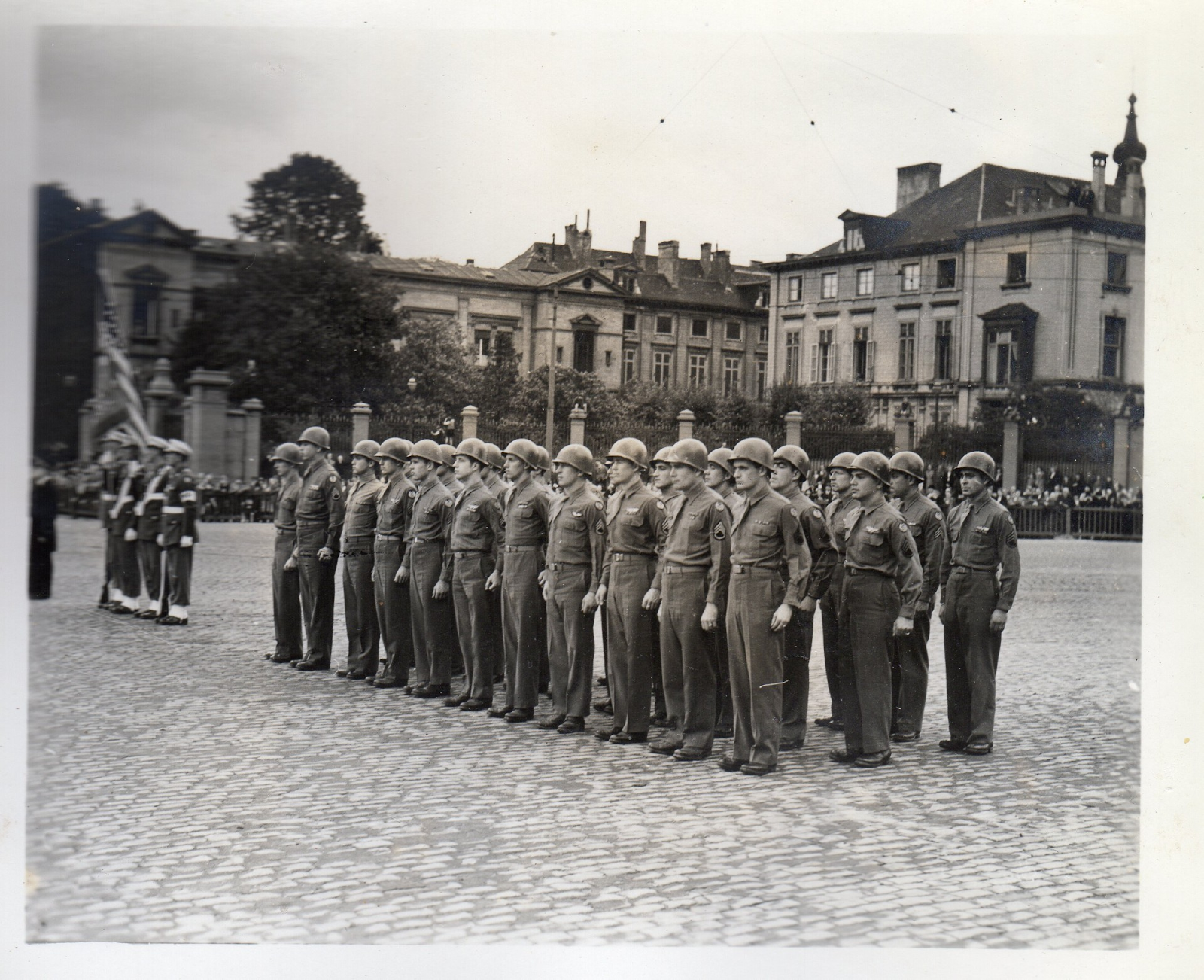
  • American military standing at attention. Photo is believed to have been taken just after VE-Day in France in 1945. Photo from the John Duty Collins Collection at the Bossier Parish Libraries History Center
  • Photo of funeral services for American military personnel in the American Military Cemetery, Margraten Holland. C. 1944.  Photo from the John Duty Collins Collection at the Bossier Parish Libraries History Center
Article by: Pam Carlisle 

Wednesday, March 26, 2025

World War II Greece and a Benton Pilot

In a recent letter to the editor in the March 12th edition of the Bossier Press-Tribune, mention was made of a local young man who gave his life defending the Free World: 1st Lieutenant Harvey M. Bigby, a World War II pilot with the U.S. Army Air Corps, 15th Airforce. Lieutenant Bigby, with another seventy-nine men, would be involved in an air accident over the south of Greece while undertaking a bombing mission. Now you may be asking yourself why these American pilots were in Greece in the first place, and the answer is more complex than you may first believe.


The Second World War came to Greece during 1940, after the Italians invaded from Albania, according the to the United States Holocaust Memorial Museum. Having conquered and occupied Albania, a Balkan country to the north of Greece and to the east of the “heel” of Italy, the Italian dictator Mussolini began a protracted invasion campaign, starting on October 28th, 1940. The Greek army would stem the tide against the Fascist invasion for a time, thanks both to the tenacity of the Greek army and the significant shortcomings of the Italian Army. However, with the planned invasion of the Soviet Union on the horizon, the German military would invade both Yugoslavia and Greece on April 6, 1941, to secure their Southeastern flank and assist their Italian allies. Though the British deployed an Expeditionary Force, and the Greek Army put up an admirable resistance, the German army would overrun the country by April 26th. Greece would be divided between Italy, Germany, and Bulgaria, and the country would be subjected to a brutal occupation for nearly three long years. However, just because the nation was occupied did not mean it was forgotten, and the Allies, along with Greek resistance fighters, would fight a bloody fight against the occupiers. Enter the U.S Army Air Corps, and Harvey M. Bigby.


Harvey M. Bigby registered for the draft on July 1st, 1941, just a few months before the American entry into the Second World War. By February of 1942, he volunteered for the U.S. Army Air Corps and spent the next year in training and pilot school, graduating as a 2nd Lieutenant on February 16th, 1943. Harvey was stationed stateside over the next several months, until finally the moment came: deployment overseas, bound for the European Theatre. Assigned to the 97th Bomb Group, 342nd Bomb Squadron, 15th Air Force, Bigby was made co-pilot to a B-17 Bomber Flying Fortress, nicknamed “Webfoot.” The B-17s were tasked with striking strategic targets behind the front lines, from military bases and concentrations to production facilities. The USAAC strategy was to flood the skies, so to speak, and Bigby’s mission was no different. On January 11th, 1944, he, along with many others, were tasked with striking a German port facility based in a small town just south of Athens. Alas, tragedy struck on the mission’s approach. While flying over the Greek region of Peloponnese, two of the bombers in the mission were lost in the clouds, leading to a terrible collision costing dozens of lives.


Initially, Lieutenant Bigby and the other men were labeled as missing, though the Army Air Corps suspected the planes had crashed into one another, based on the Missing Air Crew Report filed in the wake of the accident. By February 3rd, the Bigby family was informed of Harvey’s Missing-In-Action status, and from there, no substantial news would come for nearly half a year. Indeed, it wasn’t until the June 1st edition of the BPT that it was reported that 1st Lieutenant Harvey M. Bigby was Killed-In-Action during his January 11th bombing mission.


Lieutenant Bigby and his comrades gave their lives in the defense of the Free World, and the defeat of the Nazi German menace. The German occupation of Greece would end in late 1944 due to fears of the advancing Red Army and the Romanians changing allegiance to the Allies. As for the Lieutenant’s body, he was initially buried overseas, before being reinterred at the Jefferson Barracks National Cemetery in Missouri on January 13th, 1950. While the Lieutenant was but one of many Americans who gave their lives, his memory yet lives on.


If you have any photos or other information relating to the history of Bossier City or Bossier Parish, the History Center may be interested in adding the materials to its research collection by donation or by scanning them and returning the originals. Call or visit us to learn more. We are open M-Th 9-8, Fri 9-6, and Sat 9-5. Our phone number is (318) 746-7717 and our email is history-center@bossierlibrary.org. We can also be found online at https://www.facebook.com/BPLHistoryCenter/ and http://bpl-hc.blogspot.com/


Images: 

  • 15th US Army Airforce Patch. (Photo courtesy of Wikipedia)
  • Harvey M. Bigby's memorial. (Photo courtesy of Dept. Veteran's Affairs)
Article by: Jonah Daigle

Wednesday, December 4, 2024

80 Years Hence: The Railsplitters in the Battle of the Bulge

It was six months since the start of the Normandy Invasion on June 6, 1944, and four months since the Liberation of Paris. The advance had not slowed, with the German Army ceding more ground as the year progressed. Then came December, with winter setting-in for France, and an exhausted Allied army unprepared for the coming storm. Having marshalled its remaining available strength at the behest of Hitler’s mania, Germany launched their last-ditch gamble through the Ardennes Forest on December 16. Their hope was to cut the Allied Offensive in two. What instead occurred is considered one of the bloodiest and largest battles in American history, sealing defeat for the German Reich in the west. This battle bears many names, but the most popular is that of the Battle of the Bulge.


The Allied armies under S.H.A.E.F. (Supreme Headquarters Allied Expeditionary Force) were of two minds when it came to the war as of late 1944. The primary strategic objective, crossing the Rhine and advancing into Germany, had not been met; however, the Allied armies had still made great gains over the past several months. They did this by constantly hammering against the German lines and pushing them further back into France and the Low Countries (Belgium, Luxembourg, and the Netherlands). According to a Center for Military History journal written for the 50th anniversary of the Battle of the Bulge (“The Ardennes: Battle of the Bulge”) by the time of the German all-out assault of the Allied lines, the First Army was exhausted after near continuous fighting over the past month-and-a-half.


Likewise, the 84th Infantry as a part of the United States Ninth Army VIII Corps, had been attacking portions of the network of defensive fortifications built by the Germans just before World War II, known as the Siegfried Line. Indeed, they were still engaged at the beginning of the Ardennes Offensive, and only began shifting south on December 20, four days after the initial German assault. Within the 84th Infantry, otherwise known as the Railsplitters, several local men from Bossier Parish and the vicinity served: Sandy J. Spataro, W. C. Holland, Willis M. Evans, Woodrow Harrison, Emmett E. Cope, Benjamin W. Napper, James D. McLendon, Willie J. Gann, Clyde L. Hamiter, Claude S. Ballard, and Rayford H. Odom. These men, some 5000 miles from home, fought on the frontlines of the entire Ardennes campaign, serving under Major General Alexander Bolling.


The 84th Infantry became involved in some of the heaviest fighting in the European Theatre, and the desperate fight against the German offensive was no different. The division had been reassigned to the U.S. First Army and ordered to secure the Belgian town of Marche. They arrived just before the German advance and defended the town against two Panzer Divisions. The American Infantry bitterly resisted, holding out against the tide of incoming German steel. This defense of Marche, it should be kept in mind, was concurrent with the desperate fighting at the Belgian city of Bastogne to the South, as well as the German drive west towards the coastal city of Antwerp in the north.


After December 26, ten days after the start of the German push, the Railsplitters were able to leave the defensive posturing and return the favor to the German war machine. Working with the 2nd Armored Division, the Railsplitters were given the crucial instruction to begin the drive south, with the intention of closing the Bulge. On January 5, 1945, the advance began, taking ground and prisoners, only to slow as the weather turned against them. With heavy snow in a highly forested region, the advance shifted from the infantry supporting the armor, to the inverse. By January 10, the 84th had managed to advance to Laroche, Belgium, and according to the unit history, the fate of the Bulge was all but settled. However, this did not mean the fighting ended or became any easier. It would take another two weeks before the Railsplitter’s participation in the wider Battle of the Bulge came to an end.


When discussing battles and campaigns of this scale, it is easy to lose sight of the very human cost. The 84th Infantry was one singular division in a sea of Armor and Infantry, tasked with an area only slightly larger than Bossier City. While the 11 local men that entered the Ardennes with the Railsplitters survived, many more did not. The final death toll for the Battle of the Bulge saw approximately 19,000 dead for America alone. With this 80th anniversary, remember not just the great triumph, but also the great cost it took to achieve it.


If you have any photos or other information relating to the history of Bossier City or Bossier Parish, the History Center may be interested in adding the materials to its research collection by donation or by scanning them and returning the originals. Call or visit us to learn more. We are open M-Th 9-8, Fri 9-6, and Sat 9-5. Our phone number is (318) 746-7717 and our email is history-center@bossierlibrary.org. We can also be found online at https://www.facebook.com/BPLHistoryCenter/ and http://bpl-hc.blogspot.com/


Images: 

  • Photo 1: 84th Infantry Howitzer at the Battle of the Bulge / Courtesy of " The 84th Infantry Division In The Battle Of Germany, November 1944-May 1945"
  • Photo 2: 84th Infantry Division Insignia / Courtesy of Wikipedia
  • Photo 3: 84th Infantry at the Battle of the Bulge / Courtesy of "The 84th Infantry Division In The Battle Of Germany, November 1944-May 1945"
Article by: Jonah Daigle

Wednesday, November 27, 2024

Thanksgiving, 1944

Imagine it’s Thanksgiving, eighty years ago. It’s 1944 and World War II had been widely predicted from authoritative sources to be over by Thanksgiving, certainly in Europe. Instead, American troops were in a full-scale attack on the German western bulwark, the Siegfried Line. The Battle of Hürtgen Forest, actually a series of battles fought from September 19 to December 16, 1944, the second longest battle the U.S. Army had ever fought, was being conducted largely on foot due to challenging weather and a terrain of dense forests and muddy ridges. Making sure these and other troops got a real Thanksgiving turkey dinner was a goal to which the Army made a serious commitment. It was a morale boost the troops desperately needed and deserved, and civilians did their part in making it happen.


The Bossier newspaper the Planters Press reported that the government began as early as July 17, 1944 purchasing turkeys for the armed forces. The planning for the effort had begun in June. On Sept 21, 1944, the Planters Press reported that the US Army is trying to see to it that “every soldier eats turkey on Thanksgiving Day” and that the biggest turkey crop in years assured plenty for everyone, soldier and civilian alike.


However, the federal Farm War News column that appeared in papers across the country, including the Bossier Banner, relayed the news to the American public that though the turkey crop was an excellent one that year, the federal War Food Administration, which was responsible for the production and distribution of food to meet war and civilian needs, that there were enough turkeys to only fully meet the military demand. Turkeys were still under embargo for civilians, not yet available for them to purchase. The embargo was running later than the previous year, the Farm War News reported, because the military requirements were much larger and because, like most facilities, there was a labor shortage in the processing plants.


Civilians were facing a similar shortage with another traditional Thanksgiving must-have, cranberries. The Planters Press reported in the end of September, 1944, that servicemen and women were expected to have more cranberries available for their holiday dinners than they had in 1943, but less would be available to civilians.


The good Thanksgiving dinner news, for at least some fortunate diners on the home front, was that Shreveport-Bossier District officials of the Office of Price Administration announced a cap on holiday dinner prices at restaurants. Anyone who got their Thanksgiving Day meal in a restaurant could not be charged more than the holiday meals of the previous year.


Given the usual boxed, ready-to-eat K-ration fare of the soldiers in the field, it’s likely that few civilians would have begrudged the restricted sale of the turkeys and cranberries. The most poignant deprivation at Thanksgiving dinners on the home front, of course, was evidenced by empty seats at family dinner tables, especially after having been buoyed by the summer’s announcements that the war should be over by Thanksgiving. Even stateside relatives often could not get together for the holidays, with train seats needed for troops, and rubber and gas shortages minimizing car travel.


President Roosevelt, in his Proclamation 2629 announcing the official date of Thanksgiving 1944 as November 23rd, delivered a speech to remind the war-weary nation of reasons and ways to continue to be thankful: 

In this year of liberation, which has seen so many millions freed from tyrannical rule, it is fitting that we give thanks with special fervor to our Heavenly Father for the mercies we have received individually and as a nation and for the blessings He has restored, through the victories of our arms and those of our allies, to His children in other lands.

For the preservation of our way of life from the threat of destruction; for the unity of spirit which has kept our Nation strong; for our abiding faith in freedom; and for the promise of an enduring peace, we should lift up our hearts in thanksgiving….


From the staff of the Bossier Parish Libraries History Center, we wish you a happy Thanksgiving and time spent with family or friends. We are located at 7204 Hutchison Drive (formerly called 850 City Hall Drive) just across Beckett Street from the old Central Library and History Center) in Bossier City, LA. For the week of Thanksgiving, all Bossier Parish Libraries locations will be closed Thursday, November 28 through Saturday, November 30. Normal operating hours for Bossier Central Library and History Center are M-Th 9-8, Fri 9-6, and Sat 9-5. Our phone number is (318) 746-7717 and our email is history-center@bossierlibrary.org


For other local history facts, photos, and videos, be sure to follow us @BPLHistoryCenter on FB, @bplhistorycenter on TikTok, and check out our blog http://bpl-hc.blogspot.com/.


Images: 

  • A corporal (Leo Kaller) celebrating Thanksgiving on the Siegfried Line in November, 1944. United States Army photo via Wikimedia Commons.
  • Cartoon about train seat shortage from the Bossier Banner Progress, November 16, 1944.


Article by: Pam Carlisle. 

Wednesday, November 6, 2024

Daisy “Dell” Sutherlin Jones: Delta Wings and Haughton Roots

November is Aviation History Month, and here in the History Center, we’re always looking for stories from World War II. But if “aviation history” and World War II invokes images of fighter planes, bombers and their pilots, here is another image to add: Domestic planes being used in the war effort, with women as part of their crews.


In 1943, Daisy Dell Sutherlin (later Jones), a young woman from Haughton, became an early “stewardess,” now known as flight attendant, for the North Louisiana-grown Delta Airlines. It was a brand-new career opening up for women in an industry just on the cusp of major growth. And for Daisy Dell, it was a starting point for big-city life and careers.


Delta, as Huff Daland Dusters, began in 1925 as a crop-dusting service, first in Macon, Georgia, then Monroe, Louisiana. It was bought by C.E. Woolman, who changed its name in 1928 to Delta Air Service for the Mississippi River Delta region it served. In 1929, Delta operated its first passenger flight from Dallas, Texas, to Jackson, Mississippi, with stops in Shreveport and Monroe. By 1940, it added Douglas DC-2 and DC-3 propellor planes that could hold 14 and 21 passengers respectively, and added Delta’s first flight attendants, then known as stewardesses. In 1941, the HQ moved from Monroe to Atlanta.


Delta’s addition of stewardesses to its flight crews came 10 years after the Boeing Air Transport company pioneered this position in 1930. A nurse from Iowa, Ellen Church, wanted to become an airline pilot but realized that wasn’t a career path open for a woman. So, she approached Boeing with the idea of placing nurses aboard airliners. She convinced the powers that be that the presence of women nurses would help relieve the traveling public’s fear of this new way to travel, flying.


Thus, women nurses as stewardesses replaced non-medical male stewards, and at Delta in 1940, flight attendants were required to be single women (never married) between 21 and 26 years old who were registered nurses. They also had to pass particular height, weight and appearance standards, and for over another decade, they had to be white. In 1952, Ruth Carol Taylor was the first African-American flight attendant in the United States, with Mohawk Airlines.


Fortunately for Dell Sutherlin Jones, who after her Haughton High School graduation, attended the two-year business secretary course at Louisiana Polytechnic Institute (Now Louisiana Tech), the registered nurse requirement was dropped during World War II due to the military’s demand for nurses. She left her job as a bookkeeper in Shreveport to head to Georgia to become a stewardess, and was on the job and in the air by January 1944, when the airline was still flying for the Air Transport Command, carrying materials and personnel for military purposes across domestic routes. The Air Transport Command, which was formed in June 1942, controlled most of the airliners (commercial passenger and cargo planes) that were drafted for the war effort, like Delta’s DC-3’s.


By the middle of 1944, the ASC was able to return planes to the airline that had been used for training. A July 7, 1944, article in the Shreveport Times, when Delta airlines came to Shreveport to recruit young women to be stewardesses, said, “The recent return to Delta by the government of three DC-3 planes has made possible the openings and M.E. Beard, local traffic manager for the line, said he was anxious that Shreveport be represented among the stewardess(es) who serve the line.” Miss Daisy Mae Sutherlin was named as the area’s current representative.


A jumbo-sized postcard featuring a Delta DC-3 in flight that Daisy Dell sent from Atlanta to her little sister Elyane in Haughton in November 1944, chastised “Layne” in fun about why she hasn’t written , since by then she’d have started elementary school, and she must be able to write a little. Daisy Dell inquired, “do you make any A’s?” She signed the letter, “Dell,” though local papers continued to call her the name she was known for from childhood, Daisy Mae.


Elayne, in an interview with her and her childhood friend, Dell Steadman, remembered they were practically giddy over Dell and her glamourous career, an image promoted by the airline and their fashionable summer and winter wool suits and matching jaunty hats. It was a special event when Dell’s flight stopped in Shreveport, where it was reported in the Bossier Banner-Progress on June 8, 1944, how Elayne and her mother and aunt drove to Shreveport to spend a few hours with “Miss Daisy Sutherlin, who is an airplane hostess on the Delta Line.”


Daisy was even featured in a magazine, pictured in her crisp uniform smiling between two pilots with the DC-3 towering behind them. Though the magazine was “Outdoors Georgia,” and the article promoted an appreciation of Georgia’s landscape and natural resources from the air, the writer emphasized the absolute comforts of air travel and stewardess Daisy Dell Sutherlin of Shreveport’s role in that. Though Daisy Dell had admitted to the article’s writer that she could count her trips thus far on one hand and had only recently completed her training, “she went about her business like a veteran. She tilted the easy chairs for passengers, answered a million questions, and served orange juice, delicious coffee and sweet buns in a tray. Just like breakfast in bed,” and enthused that when Daisy puts a pillow beneath your head, “you're at peace in a troubled world.”


When Dell left stewardess life, she studied at Johns Hopkins, and enjoyed big city life, working in Chicago and in 1951, New York City. The Planters Press Bossier City newspaper reported on Sept 11, 1952, that Dell, who by then worked for the pharmaceutical company Squibb in New York, “is flying here by plane on the 19th to visit with her family.” This visit was perhaps explained when news of her marriage license, filed along with Wesley J. A. Jones of Gary, Indiana, appeared in the Shreveport Journal on September 24th. Wesley Jones had been an aerial instructor in the Navy Air Corps. After their wedding later that month in Haughton, the couple first moved to Stamford, CT and continued to travel widely.


If you have World War II homefront family photos or stories to share (we will scan and return originals if that is your preference), please visit or contact us at the History Center. Also, don’t forget about our World War II’s Day coffee and discussion group on the second Tuesday of each month from 10:30 – noon. The next meeting is on November 12, with Rev. Sig Kunz speaking on his childhood experiences during World War II in Eastern Europe. The History Center (and World War Tuesday) is now located in the new Central Library building at 850 City Hall Drive, Bossier City, LA, across Beckett Street from the original History Center and the “old” Central Library. We are open M-Th 9-8, Fri 9-6, and Sat 9-5. Our phone number is (318) 746-7717 and our email is history-center@bossierlibrary.org


For other fun facts, photos, and videos, be sure to follow us @BPLHistoryCenter on FB, @bplhistorycenter on TikTok, and check out our blog http://bpl-hc.blogspot.com/.


Images: 

  • Photo of Dell Sutherlin, Delta flight attendant, between two pilots, with a Delta Douglas DC-3 plane behind them. From “Outdoors Georgia,” January, 1944.
  • Front of a Delta Airlines DC-3 jumbo postcard C. 1940. Courtesy of the Delta Flight Museum. Gift of Cara Finger in honor of Dell Jones and Elayne Cornett.
  • Back of postcard of Delta Airlines DC-3 jumbo postcard, from Dell Sutherlin to Elayne Sutherlin, November, 1944. Courtesy of the Delta Flight Museum. Gift of Cara Finger in honor of Dell Jones and Elayne Cornett.
  • Elayne Sutherlin (Cornett) and her mother, Lucille McAnn Sutherlin C.1950. History Center photo courtesy of Elayne Cornett.
Article by: Pam Carlisle 

Wednesday, August 21, 2024

Motobu, Continued: A Marine’s Best Friend and Sgt. James F. Brown

 Last week’s article featured the story of a shell-shocked and abandoned Japanese war dog named Motobu, for the north Okinawa peninsula where he was found, who was rescued by some US Marines of the 2d Battalion, 6th Marine Division, including a young man from Bossier City, Sgt. James Francis “Frank” Brown, Jr. It would be, I’d hoped, a “feel-good” story of a rescued German Shepherd and “his” Marines. But as I did more research, I learned that Motobu’s Marine Reservist Frank Brown, who attended Bossier High School and served as a volunteer Bossier City firefighter, had been killed on May 20, 1945, when he was shot in the hills of Okinawa, which were pitted with caves and passages hiding Japanese fighters. Here is more of Frank Brown and Motobu’s story.


Toward the end of the year of 23-year-old Frank Brown’s death, Bossier City got its own VFW Post. In the Post’s October, 1945 meeting, an inaugural class of candidates was accepted and initiated and a name was chosen for the new Post, Gandy-Brown. The Planters Press newspaper of Bossier City reported on Nov 1, 1945, that two young veterans were chosen as the post’s namesakes. The first was an army private in WWI, Mr. Guy Ira Gandy, who died of pneumonia after being wounded in France in 1918. The second young man was James Francis Brown Jr., described by the Press as “a Bossier City boy who was widely known throughout Bossier for his winning smile and charming personality. He was employed by the City of Bossier water department and a fireman of Bossier City…known to almost everyone as Frank.” Frank’s grandmother Mrs. Sarah Reichler of Bossier City, who raised Frank after his mother died when he was young boy, and was his “next-of-kin,” was named “Post Mother.”


Two years later on November 10, 1947, a silver star medal for Frank was presented to her, along with the permanent citation and letter, at the National Guard armory in Shreveport. The gala occasion was the Birthday Dinner held by the local Marine Reserve Unit for the USMC’s 172nd Anniversary. The medal was presented posthumously to Sgt. James F Brown Jr., Marine Corps Reserve on behalf of the president of the United States for “service as set forth in the following citation”:


…When his platoon became pinned down by heavy Japanese machine-gun fire from the flank, Sergeant Brown boldly led fifteen men across two hundred yards of open terrain to attack and destroy the hostile emplacement. Upon reaching the reverse slope of an adjacent hill and repulsing a vicious enemy, counter-attacking under the cover of shattering mortar barrages, he valiantly proceeded alone to the crest of the ridge to hurl hand grenades at the enemy forces below and disrupt their attempts to reorganize for counter action. Inspired by his heroic actions, the remainder of his unit joined him at his hazardous post and, fighting with unquenchable spirit, repulsed numerous Japanese onslaughts until reinforcements arrived. Although killed shortly before his besieged forces were relieved, Sergeant Brown, by his daring initiative and unswerving devotion to duty, had materially contributed to his platoon's success… He gallantly gave his life for his country.


More than a year after that occasion, as next-of-kin, Mrs. Reichler had a solemn decision to make. The U.S. Army and Marines buried those killed in action in Okinawa in temporary cemeteries on the island that were organized at division-level. In December, 1945, the War Department began efforts to identify and return the remains of American war dead from battlefields worldwide for reverenced burial in US cemeteries. Working through 1948, the Army recovered 10,243 sets of remains from six cemeteries on Okinawa. The remains went to Saipan in the Northern Mariana Islands for further processing and final disposition. The next of kin were given a choice to have their loved ones returned home or to remain permanently resting overseas.


Mrs. Reichler chose to bring her grandson Frank home. The Shreveport Times ran a story on Feb. 23, 1949, with the headline , “Pacific War Dead Arrive for Reburial – Eight from Shreveport, Bossier City on Ship.” Among those eight was Sgt. James Francis Brown, Jr. The Times reported that the eight from Shreveport and Bossier were “among the 5,806 war dead who have been returned to the United States for reburial from the Pacific area aboard the Amy transport Dalton Victory.” Army officials stated that each next of kin had been notified prior to the vessel’s arrival and would be notified again after the remains arrived at the regional distribution centers for the American Graves Registration Service. From there, as reported in the March 17, 1949, Planters Press, Sgt. Brown’s body would travel with a military escort via the Texas and Pacific railroad to arrive in Shreveport at 11:10 am on March 18.


Frank’s body was taken to Wellman’s funeral home in Shreveport for a chapel service conducted by Rev. T.E. Davis of the First Presbyterian Church of Bossier City. Honorary pallbearers were all city employees, members of the local VFW and the American Legion. He was buried in Shreveport’s Forest Park Cemetery.


As for the dog, Motobu, his fate is unknown. There are scant, yet loving, tributes of him to be found on the world wide web. One is the digitized photo, from May 1945, of Motobu flanked by 1st Lieutenant Merrill F. McLane and Corporal Howard Lee Cox, both looking at him with admiration. This official USMC photo is preserved in the Photograph Collection of the Marine Corps Archives & Special Collections. The other tributes are two short YouTube videos of interviews with Corporal Cox, created in 2012 when he was 87 years old, which feature stories of Motobu and how he helped their unit, and saved Cox’s life many times over.


If you have World War II family photos or stories to share, please visit or contact us at the History Center. We will scan them and return the originals if that is your preference. And don’t forget about our World War Tuesday coffee and discussion group on a variety of World War II topics held the second Tuesday of each month from 10:30 – noon. The History Center (and World War Tuesday) is now located in the new Central Library building at 850 City Hall Drive, Bossier City, LA, across Beckett Street from the original History Center and the “old” Central Library. We are open M-Th 9-8, Fri 9-6, and Sat 9-5. Our phone number is (318) 746-7717 and our email is history-center@bossierlibrary.org


For other fun facts, photos, and videos, be sure to follow us @BPLHistoryCenter on FB, @bplhistorycenter on TikTok, and check out our blog http://bpl-hc.blogspot.com/.


Images: 

  • Portraits of Sgt. James F. Brown and his grandmother, Mrs. Sarah E. Reichler, from The Planters Press, Bossier City, Louisiana, Thu, Apr 04, 1946.   
  • 6th Marine Division Cemetery dedication, Okinawa, Japan, 4 July 1945. USMC photograph from the John C. McQueen Collection (COLL/64) at the Archives Branch, Marine Corps History Division
  • Motobu and Marines. From left to right: Marine 1st Lieutenant Merrill F. McLane (6th Marine Division), Japanese war dog 'Motobu', Corporal Howard Lee Cox (6th Marine Division). United States Marine Corps - Photograph Collection (COLL/3948) of the Marine Corps Archives & Special Collections).
Article by: Pam Carlisle

Wednesday, August 14, 2024

Motobu, A Marine’s Best Friend and Sgt. James F. Brown

 After writing the stories of the horrific Texas City disaster of 1947, it seemed time to venture into lighter, feel-good territory. After finding a story of a shell-shocked and abandoned Japanese war dog, named Motobu for the north Okinawa peninsula where he was found, who was rescued by some US Marines, including a young man from Bossier City, I thought I’d come across the perfect feel-good topic. And, it was just in time for the 79th anniversary of “Victory Over Japan,” commemorating the August 14, 1945 announcement that Japan had surrendered unconditionally to the Allies, effectively ending World War II. As I did more research, the story of the young Marine reservist from Bossier City, Sgt. James F. Brown, who helped rescue the starving German Shepherd that became a critical and beloved member of his unit, takes a tragic turn. But thanks to Motobu, one can still imagine some brave Marines having moments of joy amidst the horrors of the Battle of Okinawa (March 26, 1945 – Sep 7, 1945) in the Ryukyu islands extending off of Japan.


James Francis Brown, Jr. (born 1921), known as Frank, attended Bossier High School in the 1930’s, when it encompassed all grades. According to the 1940 US Census, Frank completed school through the seventh grade, then left to work. It was around that same time that his mother Jane passed away. His father, Frank Sr., worked in the logging and timber industry and James lived with his siblings and stepsiblings with his grandmother, Sarah Reichler, in Bossier City. Before leaving for the service, Frank worked for the city water department and volunteered as a firefighter in Bossier City, where he was apparently was well-known and well-liked.


Shortly after the US entered World War II, Frank Brown, Jr. enlisted in the Marines on February 10th, 1942. He worked his way up through the ranks to Sergeant. He became a part of the new Sixth Marine Division (of Company F, Second Battalion, Fourth Marines) which formed in September, 1944. His division was part of a Fleet Marine Force, which was tactically equivalent to an infantry division and performed offensive amphibious or expeditionary warfare.


The Sixth Marine Division in Okinawa initially had a deceptively easy advance onto the island until they encountered the Kunigami Detachment, which was assigned to defend the Motobu Peninsula and le Shima (now known as Iejima). Fighting at Motobu was fierce and unrelenting. It took several before the peninsula was secured. 207 Marines were killed and 757 were wounded.


The Japanese war dog (both the Japanese Imperial Army and the US Marines used dogs as sentries, messengers, scouts among other important tasks) that was later named Motobu by his US Marine rescuers, was found shortly after the battle. The German Shepherd was suffering from severe shell shock (what is now called PTSD), lying nearly unconscious under a rock and unable to stand or make his way to a nearby stream to drink. In a Marine Corps photo of Motobu post-rescue, the dog is alertly looking right at the camera, tongue out, sporting a beautiful, healthy coat and a handsome pose. He is flanked by two Marines, 1st Lieutenant Merrill F. McLane and Corporal Howard Lee Cox, who are looking at Motobu with looks of respect and even adoration. Motobu fell on good times, but even fiercer battles were yet to come.


Sadly, unbeknownst to the readers of the Motobu story in the Shreveport and Bossier newspapers, James F. Brown was killed in action, even as they were reading of his part in the rescue of Motobu. (Note that there was a “Delayed” annotation in the article’s byline.) Brown was killed on May 20, 1945, when he was shot in the hills of Okinawa that were pitted with caves and passages hiding the Japanese fighters who resisted surrender at any cost.


The Shreveport Journal on Saturday, June 2nd, wrote, “Little did the public realize that Brown was dead when they read in Wednesday’s (May 30, 1945) Journal of his rescue of a shell-shocked dog”. In fact, Frank Brown’s grandmother in Bossier City, Sarah E. Reichler, who was listed as his next of kin, had received notice of Frank’s death on Sunday, May 27th, just three days before the Shreveport Journal story was published. The Planters Press ran the Motobu story even later, on June 7th. The Journal also reported that Brown had not had a furlough since joining the service, so his family members had not seen him for about three years.


Read next week’s article to learn more about Frank Brown’s heroic actions, Motobu’s contributions to the 6th Marines, and how both Brown and his grandmother were shown appreciation by the local community for their sacrifices.


If you have World War II family photos or stories to share (we will also scan and return originals if that is your preference) please visit or contact us at the History Center. Also, don’t forget about our World War II’s Day (Tuesday) coffee and discussion group on the second Tuesday of each month from 10:30 – noon. The History Center (and World War Tuesday) is now located in the new Central Library building at 850 City Hall Drive, Bossier City, LA, across Beckett Street from the original History Center and the “old” Central Library. We are open M-Th 9-8, Fri 9-6, and Sat 9-5. Our phone number is (318) 746-7717 and our email is history-center@bossierlibrary.org


For other fun facts, photos, and videos, be sure to follow us @BPLHistoryCenter on FB, @bplhistorycenter on TikTok, and check out our blog http://bpl-hc.blogspot.com/.


Images: 

  • Sgt. James F. Brown from The Planters Press newspaper of Bossier City, Louisiana, Thu, Apr 04, 1946.   

  • Motobu and Marines. From left to right: Marine 1st Lieutenant Merrill F. McLane (6th Marine Division), Japanese war dog 'Motobu', Corporal Howard Lee Cox (6th Marine Division). United States Marine Corps - Photograph Collection (COLL/3948) of the Marine Corps Archives & Special Collections).  
Article by: Pam Carlisle

Wednesday, July 10, 2024

Dear Mr. President, 1942

Two weeks ago, we featured kids, the fifth graders of Mrs. Bonvillion’s class at Bossier Grammar School, who were making a difference during World War II. They collected the waste fats and tin cans that were needed to make munitions for the armed services. The children posed for a photo in 1944, a copy of which is in our History Center collections, showing them holding a banner that said, “We Brought the GREASE to Write the PEACE.” Here’s another story from our collections of a Bossier City youngster doing her part, and making her voice known, for the war effort.


Ten years ago, we received a donation of some newspaper clippings from Billie Jackson Lynn of Bedford, Texas. Ms. Lynn lived in Bossier City as a girl, graduating from Bossier High School in 1950. Her mother saved two clippings about a letter Billie wrote to President Franklin Roosevelt in 1942. Billie had four uncles and a cousin serving their country during World War II, all but one in the Army Air Forces. Two were prisoners of war, captured after the Philippine fighting. Worried about them, Billy decided to appeal to President Roosevelt to do his best to get them back safe and sound to their homes in Shreveport. He referred her letter to the War Department, which, in turn, referred it to General Ulio, adjutant general.


Here is his reply: "Dear Billy, Your letter of September 12, 1942, addressed to the President, concerning your loved ones who are now serving their country, has been transmitted to the War Department for reply. Your comments have been noted with interest and you may be assured that the War Department is always glad to receive the opinions of our young women and future citizens. Very truly yours, J.A. Ulio, Major General, The Adjutant General."


The newspaper noted the status of the soldiers in Billie’s family: “Billy's [sic] uncles are: Staff Sergeant H.F. Leeman, now a prisoner of war in Japan, formerly with the Army Air Forces; Private Charles H. Haynes, in the Air Forces in England; Private Homer W. Haynes, last heard from in Fort Lewis, Wash., with the Air Forces; and Corporal Clyde A. Jackson, in San Diego, with an anti-aircraft unit of the coast artillery. Her cousin: Private First Class James H. Markham, of the Air Forces, a prisoner of war [in Japan].


All are from Shreveport, and Billy hopes they all get back safely, after the job is finished. If she, the President, and General Ulio can affect it, they will. Meanwhile, she is an earnest collector of scrap metals, which will free her uncles and cousin.”


Both SSgt. Leeman and PFC Markham had been stationed at Barksdale Field and were reassigned to Savannah Army Air Base in Georgia in early 1941. They then went on to the Philippines where they were captured by the Japanese and taken prisoner. The men survived the Bataan Death March and were held in separate prison camps in Japan. They were finally released after the war and returned to the US.


Her newspaper photo shows Billie holding the letter she received along with a bomb, which her uncle had been fashioning into an ashtray before he was called into service. Billie donated the bomb to a scrap metal campaign. Ms. Lynn remembers that “in those days, we were all patriotic.”

Newspaper clippings are commonly saved and passed down as family mementos, but newspaper is acidic by nature. This acid causes the paper to turn yellow and break – things you don’t want to happen to your family keepsakes! Since the information in the clipping is the real treasure and not the newspaper itself, be sure to make copies of fragile clippings. Use an acid-free, lignin-free paper for the copies. Much of the standard copy paper today is acid-free and can be purchased at any office supply store. By making copies, you ensure all of the important information is preserved for future generations. We made photocopies and scans of Billie’s articles so that we can easily preserve and share the story of her presidential correspondence.


To learn more about life during World War II, join us for World War Tuesdays on the second Tuesday of the month from 10:30 – noon. The next meeting is August 13, 2024 – in our new location! The History Center is now within the new Bossier Parish Libraries Central Complex Library at 850 City Hall Drive, Bossier City, LA (across Beckett Street from the original History Center and the “old” Central Library). We are open M-Th 9-8, Fri 9-6, and Sat 9-5. Our phone number is (318) 746-7717 and our email is history-center@bossierlibrary.org


For other fun facts, photos, and videos, be sure to follow us @BPLHistoryCenter on FB, @bplhistorycenter on TikTok, and check out our blog http://bpl-hc.blogspot.com/.


Images: 

  • Billie Jackson (Lynn) in 1942, holding a letter she received from General Ulio, US Adjutant General, and a bomb that had been fashioned into an ash tray, which she was donating to a scrap metal campaign.
  • Brigadier General J.A. Ulio, 1940. Photo by Harris & Ewing, courtesy of the Library of Congress
Article by: Marisa Richardson

Wednesday, July 3, 2024

Frenchmen Turn to Barksdale for Help Fighting Hitler

 Eighty-four years ago this month, France officially surrendered to the Germans following the Nazi invasion of the country in1940. But while flags emblazoned with the Nazi swastika flew over Paris, there were those who vowed that Hitler’s forces would not long remain on French soil. And Barksdale Air Force Base helped keep that promise.


Beginning in May 1944, young Frenchmen began arriving at Barksdale, called Barksdale Field at the time, to train as pilots, gunners, navigators, and bombardiers. They carried with them the hopes of a nation desperate to oust the invaders. In the coming weeks and months, others arrived. They were part of a larger contingent of French cadets, eventually totaling approximately 4,000, that came from areas outside occupied France for training at airfields across the United States. The goal: to equip them with the skills necessary to help reclaim their homeland. They would be known as the Free French air force and, according to a September 2019 article in the magazine France-Amerique, the men were quite surprised by life in the U.S. “They couldn’t believe their eyes,” the article states. “After the hardships of war, they discovered an affluent America filled with Coca-Cola, hamburgers, drive-in theaters, and boogie-woogie music.”

The Frenchmen who came to Barksdale received a warm welcome. The Shreveport Times of May 7, 1944, contains a story of the first arrivals being feted with a party at the home of Centenary College language professor, Dr. E.L. Ford. Although, according to the story, some of the men spoke no English, that didn’t prove a hinderance. “Once at the Ford home, … where a number of persons who spoke French were present and also a group of girls from the French club at Centenary, the men … in bits of French and English strongly expressed their delight at being here,” the story states. “They like ‘cokes’… and are in awe of our food.” I wasn’t able to find specific information about how the language barrier was overcome during their training at the airfield.


As the parties and welcoming faded into memory and the men’s training began, a seriousness took hold, reminding them that they had a job to do and a country to save. An article in Smithsonian Magazine from March 2004, describes the scolding that one cadet training in Alabama received after a poor flight performance. “The exasperated instructor marched him over to another officer on the flightline and told him to give the student hell—in French.”


Unfortunately, some of the cadets at Barksdale paid the ultimate price during flight training. From September 1944 through February 1945, thirteen Frenchmen were killed in plane crashes here. Newspaper accounts of the time detailed the tragedies. A witness to one of the crashes was a city editor with The Shreveport Journal. “There was a dull thud as it struck the ground, an explosion, a burst of flame … and then great billows of smoke rose skyward,” he said. And the hazards of training were not limited to the air. Another young cadet died after accidently stepping into a spinning propeller.


The B-26 Marauder, a twin-engined bomber, was the aircraft in which the men were given instruction. According to the National Air and Space Museum, it included some new features, but could be difficult to learn due to higher speeds needed during take-offs and landings. The museum states that one of the plane’s early nicknames was the “Widow Maker.” Despite these challenges, the B-26 proved to be invaluable. The museum says of it, “Like the M1 Garand combat rifle, the Sherman tank, and the LST, the Marauder was an important weapon in the war against the Axis powers.”


As reports came over the radio of the liberation of Paris in August 1944, the Frenchmen were, of course, thrilled. Barksdale’s Bark, the official newspaper of the airfield, stated in an article from August 26 that year that the men “ … marked the stirring events in their native France by marching together on the parade grounds.” A photo shows them carrying both the American flag and the French tri-color flag, a fitting tribute to Barksdale’s role in providing the skills necessary to help France rise again.


Thanks to my History Center coworker Jonah Daigle for supplying the idea for this article. His contribution is very much appreciated.


If you have any photos or other information relating to the history of Bossier Parish, the History Center may be interested in adding the materials to its research collection by donation or by scanning them and returning the originals. Call or visit us to learn more. We are open M-Th 9-8, Fri 9-6, and Sat 9-5. Our phone number is (318) 746-7717 and our email is history-center@bossierlibrary.org. We can also be found online at https://www.facebook.com/BPLHistoryCenter/

Images: 

  • French fliers attend party welcoming them to Barksdale Field/courtesy The Shreveport Times, May 7, 1944
  • French fliers march on parade grounds at Barksdale to mark the liberation of Paris/courtesy Barksdale's Bark, August 26, 1944

Article by: Kevin Flowers