Showing posts with label Plantation. Show all posts

Wednesday, May 29, 2024

Time Stands Still for Old South Bossier Home

 Along Highway 71 in south Bossier stands a home that seems somewhat out of place. Part of no neighborhood, it’s located in a field not far from Walker Place Park and the Brookshires Grocery Arena with majestic, white columns and a brick façade. I’ve long been curious about the home’s history, and apparently others have too, as evidenced by a recent email to the History Center asking about the place.

Newspaper accounts state that the two-story colonial dates to the World War II era. An article in The Shreveport Times from August 4, 1998, describing renovation efforts at the house, states “Construction workers last week began refurbishing the 3,000 square-foot home, which was built in the early 1940s …” An ad in a 1945 edition of The Shreveport Journal lists the place for sale. “Upstairs there are three exceptionally large bedrooms with two baths complete,” according to the ad. “Downstairs there is the kitchen with many built-in features, a large dining room, breakfast room, living room that is huge and comfortable.” Included were a three-car garage, and on the home’s east side, a large porch. The showplace was called Rainbow Manor, the name coming from the land on which the home stood, Rainbow Plantation. Also included were stables and three large barns.


According to an article written by Bossier Parish Historian Clif Cardin in the Bossier Press Tribune on October 26, 2000, this property was called Chalk Level Plantation in the 1800s, and later Red Chute Plantation before being renamed Rainbow. One of the earliest accounts I found of the plantation being referred to as Rainbow was a story in The Shreveport Journal from July 6, 1915 discussing the sub-division of the 1,000-acre property for farming. “The plantation will be divided into 20-acre tracts, each fenced and provided with a house and barn,” the article states. “The buyers will be supplied with horses and wagons, implements and seed and feed for the first year.” This venture fell through.


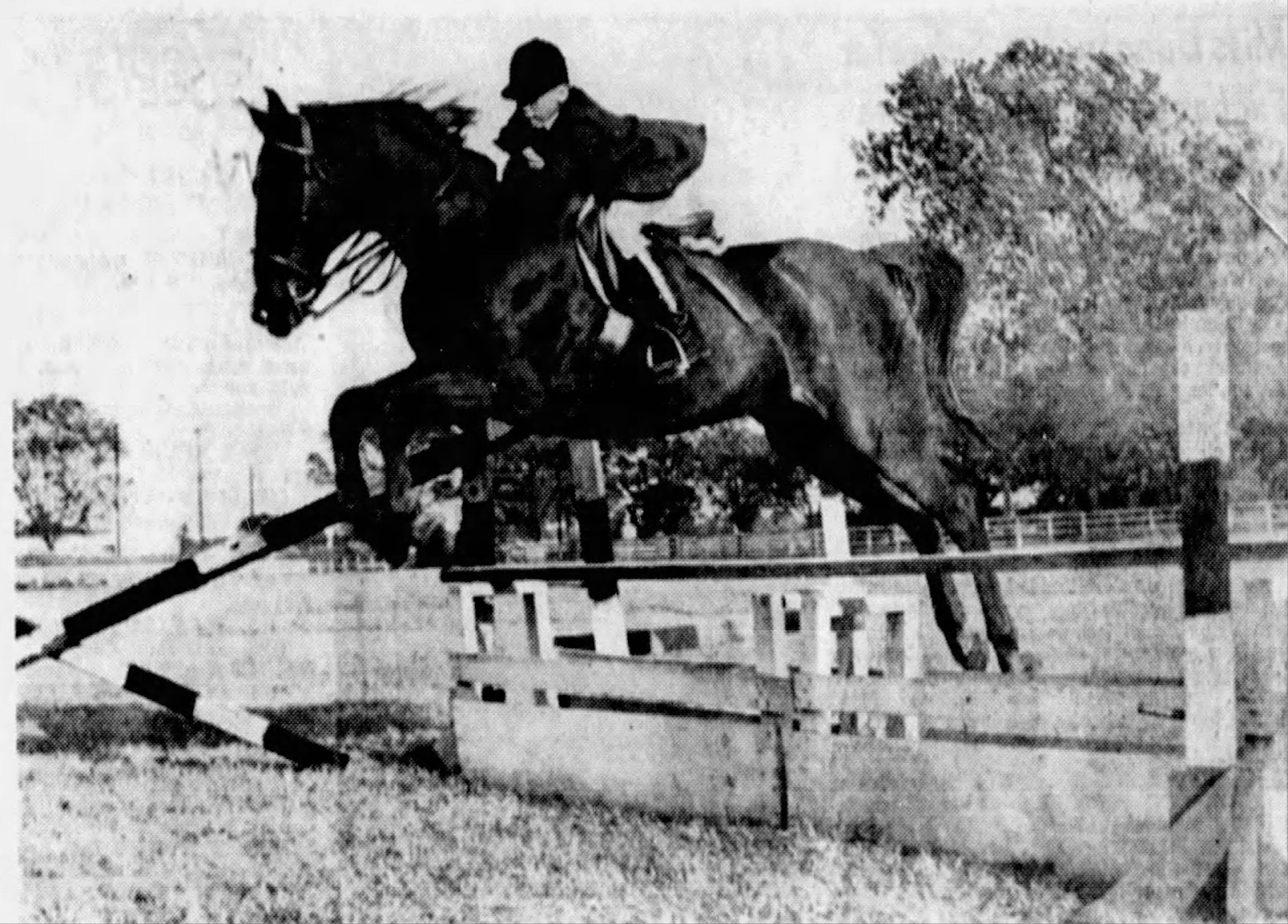
In 1946, planter and cattle breeder John Walker, Jr. bought the home and the surrounding land, which, by then, encompassed 360 acres. At least part of that acreage was later used for equestrian training, as evidenced by a pictorial in the December 6, 1963 issue of The Shreveport Journal showing young people on horseback at the property jumping over obstacles. An accompanying article states, “Learning to jump and teaching their horses to jump is of particular interest among the youngsters.”

By the mid-1970s, suburban growth was envisioned for this area of south Bossier. The Shreveport Journal reported in an article on January 17, 1974, “Plans for … development of a major residential-commercial project in Bossier City … were revealed today by the Don Coleman Construction Company, Inc. The development will be on land formerly called the Rainbow Plantation.” According to the article, the home was to remain on site.


Although those plans didn’t come to full fruition, the home did remain and was occupied by a Walker family member until February 1996. Two years later, the city owned the home and began refurbishing efforts, intending to turn the vacant house into an arts and information center, complete with state-of-the art conference facilities, but results of a lawsuit, brought by the U. L. Coleman Company over traffic access to the Teague Parkway, forced the city to abandon the idea and relinquish ownership. The home was used for office space during construction of the nearby arena, and the Bossier-Shreveport Battle Wings football team briefly used the home for office space in the early 2000s. Since then, it has apparently stood mostly empty and silent. While the tides of change move swiftly around it, for the home, time seems to stand still.


If you have any photos or other information relating to the history of Bossier Parish, the History Center may be interested in adding the materials to its research collection by donation or by scanning them and returning the originals. Call or visit us to learn more. We are open M-Th 9-8, Fri 9-6, and Sat 9-5. Our phone number is (318) 746-7717 and our email is history-center@bossierlibrary.org. We can also be found online at https://www.facebook.com/BPLHistoryCenter/


Images: 

  • Home shown in sales ad/The Shreveport Journal, Oct. 5, 1945
  • Tommy Skiffington making a jump on his horse Rusty/The Shreveport Journal, Dec. 6, 1963
Article by: Kevin Flowers

Wednesday, March 4, 2020

History in the Name: Bossier Parish Cities and Towns

The Parish of Bossier is a medley of communities that includes two cities, three towns, two census-designated places, as well as several unincorporated communities. Names for these communities were inspired by the area’s physical features, given in memory of an early settler, or after an individual that made significant contributions to the development of that area.
Bossier City is the highest populated municipality in the parish, and like many other communities, it has had more than one name. The first European settlers of the Bossier City area were James and Mary Cane, who had a plantation called Elysian Grove, which was about 600 acres in size. The plantation’s port or ferry landing was known as Canes Landing, and sometime after the Cane’s opened a store near the landing, the area became known as Cane City.

Near the end of the nineteenth century, a small village was laid out by Mary Cane’s granddaughter and her husband, changing the name to Bossier City. Bossier was later incorporated as a village in 1907 by Gov. Blanchard. Bossier City was named in memory of Pierre Evariste John Baptiste Bossier, the same U.S. Congressman that Bossier Parish was named after. In 1843, he was elected to represent Louisiana’s 4th District in the Twenty-Eighth Congress, the same year that Bossier Parish was created.
General Pierre Evariste Jean Baptiste Bossier C. 1820-30.
Clifton Cardin collection:1997.065.001
Shreveport is the second city that resides in Bossier Parish, but only small portions of it. It is easy to assume that the Red River perfectly divides Caddo and Bossier Parishes, and at one time, this was true. However, over time through natural and artificial causes, the course of the river has changed. The boundaries of the two parishes were designated based on how the “Old River” ran; however, the river has moved east over the years. Making it so that areas of Shreveport seem to be in Bossier and areas of Bossier seem to be in Shreveport.

The Shreveport downtown airport, Wright Island, Shreveport Aquarium, El Dorado Casino, and the Charles and Marie Hamel Memorial Park are all in Shreveport, Bossier Parish, Louisiana. Boomtown Casino is in Bossier City, Caddo Parish, as well as most of Cane’s Landing, and a portion of the eastern bank of the river south of Jimmie Davis Bridge. Therefore, parts of Shreveport are in Bossier Parish, making Shreveport the other city within the parish.

Shreveport was named in honor of Captain Henry Miller Shreve, who not only made the Red River navigable in 1838, but he also made contributions to the settlement of the region. Shreveport was first called Shreve Town after the real estate brokerage firm, Shreve Town Company, in which Captain Shreve was an owner.
Captain Henry Miller Shreve by artist George
D'Almaine Source: https://commons.wikimedia.org
There are two accounts of how the town of Benton received its name. In one account, it is said that it was initially called Ben’s Town after a merchant by the name of Benjamin Looney, who was reported as being the first merchant in the area. The other account is that the town of Benton was named in honor of Thomas Hart Benton, a United States Senator from Missouri. He played a critical role in developing the west by building roads west of the Mississippi, including the road from Arkansas into Shreveport, which passed through Lewisville, Plain Dealing, and Benton operating as a stagecoach line for many years.
Daguerreotype of United States Senator Thomas Hart Benton, C. 1850.
Image courtesy of the Harvard University Library.
Source: 
Harvard University Library, Weissman Preservation Center
found on  https://commons.wikimedia.org
The town of Haughton, which is expected to qualify to become a city after the 2020 U.S.
Census, started as Lawrenceville. When the VS&P railroad came through in 1884, the name was changed to Haughton on Sept. 1 of that year—named after one of the original settlers, William Haughton. The Lawrence’s and Haughton’s once owned all of the lands that make up Haughton today.
William Purvis Haughton
Source: http://bebossier.com/2018/03/history-of-haughton/
Before the Civil War, there was the Plain Dealing Plantation that was operated by George Gilmer. When the Shreveport and Arkansas Railroad, commonly known as the Cotton Belt Railroad, was announced to be coming through the area in 1888, S.J. Zeigler a businessman and the husband of a Gilmer descendant that owned the Plain Dealing property, selected the property to establish a village. It was briefly known as Guernshein after a prominent railroad company stockholder, but it was soon renamed to Plain Dealing after the plantation. It was chartered in 1890 and became incorporated as a town in 1928.

George Oglethorpe Gilmer owner
of Plain Dealing Plantation
Source: ancestry.com
To learn more about these and other communities in Bossier Parish, visit the Bossier Parish Libraries History Center at 2206 Beckett Street, Bossier City.

By: Amy Robertson

Wednesday, January 29, 2020

Rainbow Plantation Purchased for Italian Colonization

During the first world war, an organization by the name of Louisiana Colonization, Construction, Oil and Gas company purchased the Rainbow Plantation in the summer of 1915. Robert R. Emery was the vice president of the organization, and he secured the $40,000 purchase of the 1,000-acre property from the current owners at that time, George P. Murray and John E. Murray. The Rainbow Plantation, which was located four miles below Shreveport in South Bossier, was purchased for colonization purposes.

According to an article published in The Shreveport Journal on July 6, 1915, “The Louisiana Colonization, Construction, Oil and Gas company stock is largely owned by Italians, and the company proposes to put Italian farmers, truck gardeners and fruit growers on the land it has purchased. It is capitalized at $200,000. The officers and directors of the company are as follows: Joseph R. Tucker of Shreveport, president; Joseph Di Carlo of New Orleans, first vice president; Robert R. Emery of Shreveport, second vice president; D. Zagone, Shreveport, treasurer; A. Tingali, secretary. The directors are: J. W. Peyton, Joseph Sunseri, Frank De Fatta, Phillip Tucker, Joseph P. Glorioso, John Cordaro, Sam Ginnoni, and V. L. Campisi of Shreveport, and Joseph H. Tingali of Detroit. Messrs. Barnett & Keeney are the attorneys.

“The plantation will be divided into 20-acre tracts, each fenced and provided with a house and barn. The buyers will be supplied with horses and wagons, implements, and seed and feed for the first year.

“These tracts will be sold to Italian farmers only, and they will be given every convenience for comfortable and sanitary living. Graveled roads will be built, deep well water piped to the houses which also will be provided with gas for fuel and, eventually, with electricity.

“A school house and a church will be built this summer. The company is now erecting a building for store purposes. An experimental farm of sixty acres has been reserved and will be one of the first tracts to be put into cultivation. On it will be started everything that can be successfully grown in this climate for the instruction of farmers who come from other sections of the country, and, as its name implies, experiments will be made with profitable products unknown now to this section.

“Arrangements have been made to place twelve families on the land just as soon as possession can be had, which probably will be early in November. Permission has been secured, however, to proceed with the erection of the necessary houses at once.

“One of the farmers who will settle on the land has bought sixty acres, and will plant an up-to-date vineyard with the best varieties of Mediterranean grapes, the so-called California types. He will instal [sic] a heating plant and piping system with which to warm the ground and the air about the vines when necessary to defeat frost.

“Every building in the colony will be painted white, and the owners have already dubbed it ‘The White City.’”

In another article published in The Shreveport Times, July 7, 1915, it was reported that, “It is the belief of the company’s officers that, following the close of the war in Europe, Italian immigration to this country will be enormous, and they intend to take advantage of this circumstance to select the best of the immigrants for their colonies. They expect to buy a great deal more land in this section and treat it in the manner they are handling Rainbow Plantation.”

The reason the Italian Americans wanted to colonize during that time is most likely because they were often shunned by the dominant white culture in Louisiana, including Bossier Parish. By forming their colony, they would have a stronger sense of community, allowing them to support one another and create opportunities to improve their socio-economic status.

To learn more about the history of Rainbow Plantation and local communities in Bossier Parish, visit the Bossier Parish Libraries History Center at 2206 Beckett Street, Bossier City.

By: Amy Robertson

Wednesday, July 10, 2019

The Panic of 1873 and the Palmetto Plantation Lottery

John C. Vance with sisters Mary E. "Mollie" (red dress)  and Laura Elizabeth "Nina" (white dress).
Dale Jennings Collection: 1999.127.082
Industrial capitalism brought about the Panic of 1873, the first global depression which reached the United States in the fall of that year. The tipping point in the United States came when Jay Cooke and Company went bankrupt. They were the federal agent for the government financing of railroad construction. Railroad construction was the nation’s largest non-agricultural employer during that time. When Jay Cooke and Company closed their doors on September 18, 1873, it created a domino effect where many other banking firms and industries also became bankrupt. The New York Stock Exchange closed for ten days, credit dried up, and foreclosures were common. Railroads went bankrupt, factories closed, and countless other businesses failed, causing the unemployment rate to rise to an alarming 14 percent.


During the first year of this crippling economic depression, John C. Vance held the ownership of the Palmetto Plantation in north Bossier Parish, which had been in the Vance family since 1850. It was first owned by John Vance’s Father Allen Vance, a wealthy planter from Abbeville District, South Carolina. When Allen died in 1865, he left his estate to his wife and children with instructions not to sell the plantation until after his youngest daughter, Laura Elizabeth a.k.a. Nina reached the age of eighteen.

John Vance renamed the plantation “Palmetto,” after the official nickname of his home state South Carolina, “Palmetto State.” However, the name was not changed legally and remained as “Allen Vance Plantation” in legal documents. The plantation was divided into river land and hill land by the Flat River Bayou, which traversed the plantation.

Starting on April 15, 1873, a long-running notice could be found in The Shreveport Times that John Vance was looking to change the business he was in and wanted to sell the plantation. Seeing how the nation’s economics were in dire straits and citizens had lost their trust in the banking system, and with credit not being a feasible option John opted to conduct a lottery in hopes to sell the plantation for cash during this financially depressed period.

John described the plantation in the following way: “...The place is situated in the Red River bottom, 2-1/2 miles from Benton, 11 miles above Shreveport, one mile from the river, and the survey of the Camden and Shreveport railroad just made, runs through these lands one-half mile from the ginhouse and dwelling, where a depot will probably be located. The place is also on the line of the contemplated Oklahoma railroad, and adjoining and surrounded by lands of J. B. Pickett, W. C. Vance, Dr. S. W. Vance, Mrs. M. G. O’Neill, John M. Arnold, and W. R. Prather. All the lands offered are first-class Red River bottom, entirely free from overflow, and the plantation has upon it plenty of labor. The ginhouse is a large and fine one, with an excellent set of running gear in perfect order. Every other house on the place has been built since 1866. There are 19 cabins, with brick chimneys, built in different places on the plantation to suit the new system of labor. A three acre garden and orchard paled in, and a considerable amount of ditching done last year. The dwelling is a fine, large two-story house, with six rooms, exclusive of the kitchen, store rooms, bath rooms, etc., just completed at a cost of $6000. This is one of the best improved places in this country. I have spent $10,000, improyements [sic] alone, since 1866...”

Included in the notice were testimonies of John’s honesty and integrity from his neighbors, the Bossier Parish Clerk of Court, and the Recorder. He listed the names of individuals that would assume responsibility for all funds received through the lottery to guarantee that if all 300 tickets are not sold, the money will be refunded to those that did by a ticket. Other individuals agreed to act as
commissioners to superintend the drawing of the tickets and prizes to ensure the public that it would be “honestly and impartially done.” B. M. Johnson banking house in Shreveport acted as treasurer of the lottery funds holding them in an account to be redistributed in the event all tickets were not sold.

Each ticket was sold for $100 with the first prize, obviously being, the plantation of 700 acres. The second through the seventh prizes were 20 and 40-acre tracts of land, and there were 93 cash prizes of $100 each. The odds of winning the plantation or one of the other prizes was one out of three.

According to public records, the Palmetto Plantation remained in the Vance family until 1890; leaving us to assume that John Vance’s lottery scheme failed and that those that bought a ticket were refunded their money.

To learn more about the Vance family or Palmetto Plantation, visit the Bossier Parish Libraries History Center at 2206 Beckett Street, Bossier City.

By: Amy Robertson