Along Highway 71 in south Bossier stands a home that seems somewhat out of place. Part of no neighborhood, it’s located in a field not far from Walker Place Park and the Brookshires Grocery Arena with majestic, white columns and a brick façade. I’ve long been curious about the home’s history, and apparently others have too, as evidenced by a recent email to the History Center asking about the place.

Newspaper accounts state that the two-story colonial dates to the World War II era. An article in The Shreveport Times from August 4, 1998, describing renovation efforts at the house, states “Construction workers last week began refurbishing the 3,000 square-foot home, which was built in the early 1940s …” An ad in a 1945 edition of The Shreveport Journal lists the place for sale. “Upstairs there are three exceptionally large bedrooms with two baths complete,” according to the ad. “Downstairs there is the kitchen with many built-in features, a large dining room, breakfast room, living room that is huge and comfortable.” Included were a three-car garage, and on the home’s east side, a large porch. The showplace was called Rainbow Manor, the name coming from the land on which the home stood, Rainbow Plantation. Also included were stables and three large barns.
According to an article written by Bossier Parish Historian Clif Cardin in the Bossier Press Tribune on October 26, 2000, this property was called Chalk Level Plantation in the 1800s, and later Red Chute Plantation before being renamed Rainbow. One of the earliest accounts I found of the plantation being referred to as Rainbow was a story in The Shreveport Journal from July 6, 1915 discussing the sub-division of the 1,000-acre property for farming. “The plantation will be divided into 20-acre tracts, each fenced and provided with a house and barn,” the article states. “The buyers will be supplied with horses and wagons, implements and seed and feed for the first year.” This venture fell through.
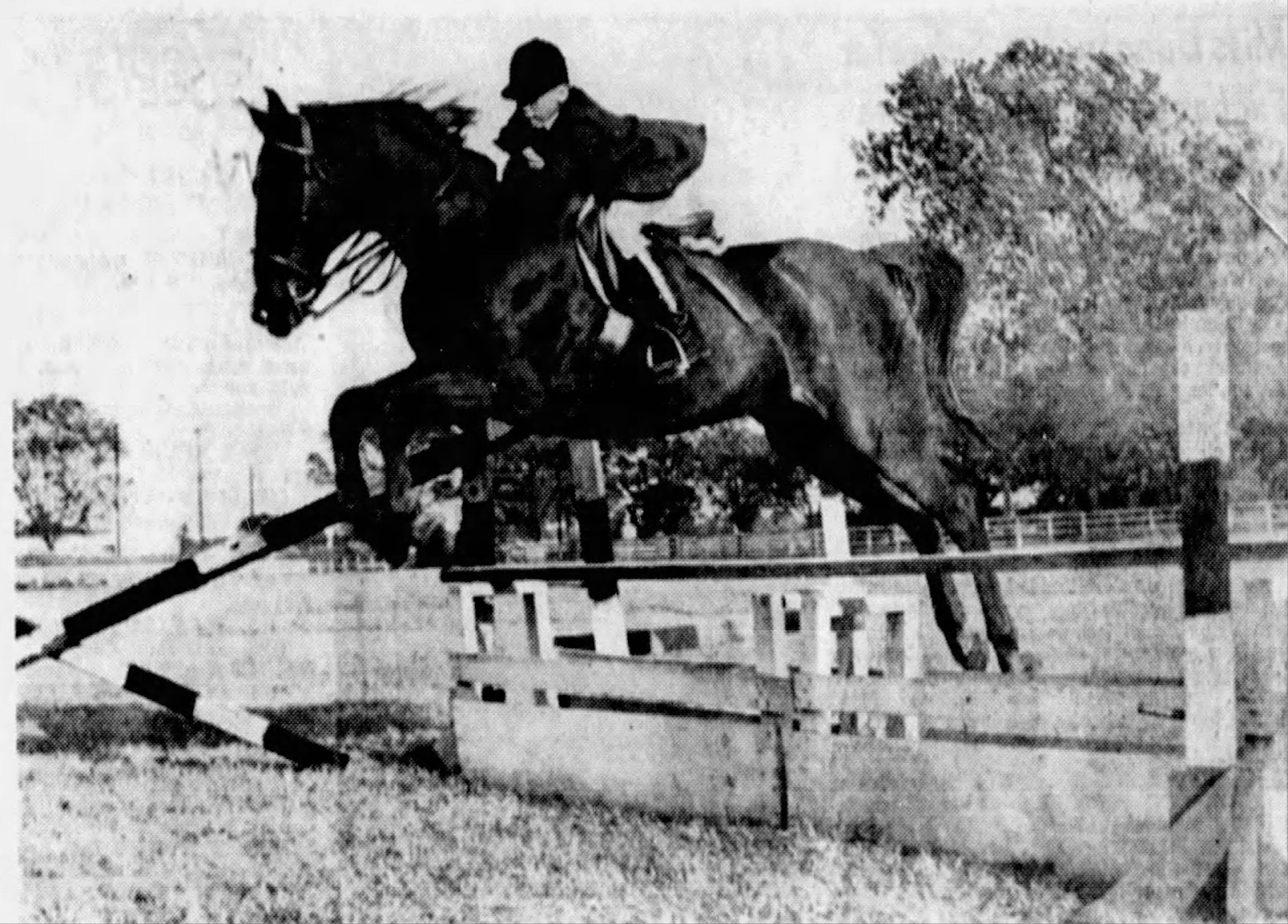
In 1946, planter and cattle breeder John Walker, Jr. bought the home and the surrounding land, which, by then, encompassed 360 acres. At least part of that acreage was later used for equestrian training, as evidenced by a pictorial in the December 6, 1963 issue of The Shreveport Journal showing young people on horseback at the property jumping over obstacles. An accompanying article states, “Learning to jump and teaching their horses to jump is of particular interest among the youngsters.”
By the mid-1970s, suburban growth was envisioned for this area of south Bossier. The Shreveport Journal reported in an article on January 17, 1974, “Plans for … development of a major residential-commercial project in Bossier City … were revealed today by the Don Coleman Construction Company, Inc. The development will be on land formerly called the Rainbow Plantation.” According to the article, the home was to remain on site.
Although those plans didn’t come to full fruition, the home did remain and was occupied by a Walker family member until February 1996. Two years later, the city owned the home and began refurbishing efforts, intending to turn the vacant house into an arts and information center, complete with state-of-the art conference facilities, but results of a lawsuit, brought by the U. L. Coleman Company over traffic access to the Teague Parkway, forced the city to abandon the idea and relinquish ownership. The home was used for office space during construction of the nearby arena, and the Bossier-Shreveport Battle Wings football team briefly used the home for office space in the early 2000s. Since then, it has apparently stood mostly empty and silent. While the tides of change move swiftly around it, for the home, time seems to stand still.
If you have any photos or other information relating to the history of Bossier Parish, the History Center may be interested in adding the materials to its research collection by donation or by scanning them and returning the originals. Call or visit us to learn more. We are open M-Th 9-8, Fri 9-6, and Sat 9-5. Our phone number is (318) 746-7717 and our email is history-center@bossierlibrary.org. We can also be found online at https://www.facebook.com/BPLHistoryCenter/
Images:
- Home shown in sales ad/The Shreveport Journal, Oct. 5, 1945
- Tommy Skiffington making a jump on his horse Rusty/The Shreveport Journal, Dec. 6, 1963


