Showing posts with label WWI. Show all posts

Wednesday, September 29, 2021

Bossier City's First VFW Post


The announcement came a few days after the Second World War ended. The first local chapter of the "Gold Stripe" veteran's fraternity, the Veterans of Foreign Wars, would be chartered in Bossier City. A representative from the VFW national headquarters, Jack Dillard, came to assist the local committee in rounding up the necessary quota of members required to obtain a charter.

In an interview, Dillard mentioned that "As there are now a great many Bossier veterans of both World War I and II who have had overseas military service the prospects for a large list of charter members are very good." The all-veteran committee included Hoffman L. Fuller, Raymond C. Sergeant, and Harry L. Clark.

Commander Morris G. Vascoe
1st Commander of the Gandy-Brown
VFW Post, Bossier City
Their first meeting was at the Bossier City Municipal building on Sep. 12, 1945. They elected Morris G. Vascoe as commander; Harry L. Clark, vice commander; Norman W. Culbertson, junior vice commander; Hoffman L. Fuller, judge advocate; Arte J. Mangum, chaplain, Paul Spears, Charlie Ford, and James G. Glasgow, trustees. At the first meeting, they had 27 charter members. The hopes were to reach a membership between 200-400 members for the Bossier City Chapter.

Commander Vascoe made the following statement in an article he wrote concerning the need for veteran welfare services. "Predicting that public interest in the welfare of the veterans will virtually disappear in the post war area, and that the rehabilitation of returning veterans will become primarily a responsibility for established veteran organizations, representatives of the new Bossier City Post of the Veterans of Foreign Wars of the United States, states that these worries had promoted the idea of organizing this local V.F.W. unit."

The following month, the post was named. In a report appearing in "The Planter Press," written by Post Commander Vascoe explains, "The name of a comrade of the first World War and World War 2, who paid the supreme sacrifice, were elected."

The comrade of World War I was Guy Ira Gandy, a resident of Bossier City for several years before he went into active service in the Army. He served in France as a Private in Co. "3" 306 Infantry, 81st Division Supply and Ammunition train, and died of pneumonia after being mortally wounded at a little town of Chatillion Ser Seine in France Oct. 5, 1918.

"The second name was submitted for a Bossier City boy who is widely known throughout Bossier for his winning smile and charming personality. He was employed by the City of Bossier water dept., and a fireman of Bossier City before his entry into active service. His name was James Francis Brown, known to almost everyone as Frank."

Brown enlisted in the Marine Corps on Feb. 10, 1942, and worked his way up through the ranks and became a Sergeant. He served with the famed "Fourth Marine Raider Battalion," a member of Company "F" 2nd Batallion. Brown was killed in action on May 20, 1945, in the battle of Okinawa in the South Pacific. Sarah Richlar, Brown's Grandmother, was chosen as "Post Mother."

When the Gandy-Brown VFW Post No. 4588 was officially chartered, 69 veterans from World Wars I and II were listed on the official charter roster. The Post's membership doubled over the next two years. Today, it is still a vital part of our community for our veterans and their families.

Each year on this day, Sep. 29th, National VFW Day is celebrated at Posts and in communities around the world. We can celebrate National VFW Day by remembering our troops, donating to veteran-support organizations, and promoting groups that help with post-military careers and medical treatment. 

To learn more about the history of VFW Posts in Bossier Parish, visit the Bossier Parish Libraries History Center at 2206 Beckett Street, Bossier City. Can't come in, call 318-746-7717 or email history-center@bossierlibrary.org with your request. Follow us @BPLHistoryCenter on FB, @bplhistorycenter on Tiktok, and check out our blog, http://bpl-hc.blogspot.com/.

Wednesday, October 14, 2020

1918 State Fair Canceled

Ferris Wheel at Louisiana State Fair in Shreveport
c 1910s.  Beulah Findley Colelction: 1997.054.064.
Recently the Louisiana State Fair announced that the 114th annual fair for this fall is canceled, but it is has been rescheduled for next spring. This means there will be two fairs in 2021, the 114th in the spring and the 115th in the fall. This year is only the second time in the history of this annual festival to be canceled.

The last cancellation was of the 13th annual fair in 1918 during the Spanish flu (H1N1) pandemic. W.R. Hirsch, regretfully, made the official announcement based on the following telegram from state health officer Dr. Oscar Dowling:

“Supplementing wire. After conference with Corput, public health service, concluded best postpone under existing conditions.” Dr. Corput was the federal health official, stationed at New Orleans, in charge of the influenza fight in this territory.

According to Hirsch, “In my opinion, which is based on the records in our headquarters, the 1918 fair would have been record-breaking, both in attractions, including the mammoth lot of exhibits, and also in attendance. We had promise of exhibits filling every exhibit building and barn, with indications that tents would have been necessary to accommodate a big overflow.”

Advertisement for the 13th annual Louisiana State Fair, 1918.

Before the cancellation, Hirsch had announced, “A dozen aviators, all in the aerial service of Uncle Sam, and most of them home boys, will fly over Shreveport during the seven days of the State Fair.” That year, Oct. 31st was designated as General Pershing Day and Soldiers’ and Sailors’ Day. Special arrangements were made to have as many of the aviators fly on that day as possible. All military, including allied nations and confederate veterans, were to receive free entry into the fair.

With WWI going on, there was a lot of focus on the war and the military. Plans included a 9,000 square foot United States government war exhibit, which included a gas mask used at that time to protect American soldiers from German gases. We were one of four southern fairs scheduled to receive this exhibit. The mask was made in a factory on Long Island, where 27,000 masks were manufactured daily.

“The fireworks spectacle, ‘World’s War,’ reproducing scenes from the world war, would have been another great attraction.” There was also promise of a great war exhibit by the Canadian government.

“We are the only State Fair announcing that Herbert C. Hoover, national food administrator, would be present and deliver an address to its visitors. We are also the only State Fair with promise of an address by a member of the congressional party that recently returned from a visit to the battle fronts of western Europe, Congressman J.B. Aswell having accepted our invitation to deliver an address on his experience on that thrilling trip to the war zones.”

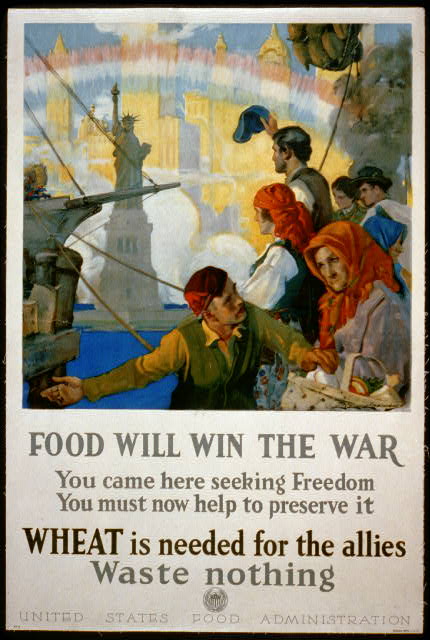
All culinary articles were to be hooverized products, the premiums offered were to encourage economy in cooking, and with assigned space for an exhibit of food conservation work. The word hooverize originated in 1917 and, by definition, means “to be sparing in the use of something especially food,” which Herbert C. Hoover promoted. He was the head of the U.S. Food Administration during WWI, and he encouraged citizens to eat less and save food for soldiers. Common slogans were “save the food, win the war,” and “food will win the war.”

Chambers, C. E. (1917) Food will win the war - You came here seeking freedom, now you must help to preserve it -Wheat is needed for the allies - waste nothing / C. E. Chambers. United States, 1917. [New York: Rusling Wood, Litho] [Photograph] Retrieved from the Library of Congress, https://www.loc.gov/item/2002720171/.

Miss Elizabeth Dombourajian was another special guest scheduled for that year. She was a native Armenian who was to speak on the life of the people of her native land, where the Turks have massacred many thousands of Christians. Other plans included an automobile show, horse races, musical guests, the fancy rifle, revolver, pistol shooting by Tom P. Parker, and many other attractions.

To learn more about the history of local festivals, visit the Bossier Parish Libraries History Center at 2206 Beckett St., Bossier City.

By: Amy Robertson