Showing posts with label WWII. Show all posts

Wednesday, January 12, 2022

Bossier Librarian Organizes Victory Book Campaign

Anytime there is war, organizations like the American Red Cross jump into action to support the troops. Shortly after America entered World War II, the Red Cross, the United States Organization for National Defense, and the American Library Association joined together to address the need for books for our rapidly growing military.

Immediately after the national book campaign announcement, the Bossier Parish Libraries council called a meeting with representatives from each town in the parish, where they made plans to back the campaign. A call to action appeared in The Planters Press, asking all Bossierites to donate to the cause. All books were welcomed, with used books being cleaned and repaired as needed.

According to the announcement, “These books will be sent to army camps in this area. Many of our boys who are in camp or who will be later, have had to discontinue their studies of various types, some of them would continue their work if the necessary text books were available, and of course books for recreation hours are always needed. The Victory Book Campaign slogan is ‘Give the Book You Are Now Reading.’”

Collection containers were placed in the schools throughout the parish. Each branch of the Bossier Parish Libraries accepted donations, and the bookmobile collected donations at each stop. And, in Bossier City, containers were also placed at City Hall, Barksdale Drug, the Planters Press, Bossier State Bank, the Bossier Tribune, and the Post Office.

Portrait of Mary Elisabeth Williams by A. Menosco.
Bossier Parish Library Collection: 2000.093.001.
Parish Librarian Elisabeth Williams appointed committee members to oversee various aspects of the campaign. Mrs. S.E. Norris led working with Bossier City Schools. Mrs. Nelson covered Haughton. Publicity in Bossier City was assigned to Mrs. Morris and Mrs. Dupuy. The containers for Bossier City were placed by Rev. A.P. Smith and Roy E. Horton. And A.R. Teague oversaw radio publicity.

The types of books needed also appeared in the announcement. The list included topics like applied psychology, current affairs, business, accounting, up-to-date technical books, mechanical drawing, photography, music, poetry, sports, geography, biography, history, novels, writing, math, mysteries, and westerns. All books donated were stamped, “Gift of the people of the United States through the Victory Book Campaign.”

The books were distributed across the nation to Army camps, Naval stations, Coast Guard stations, Merchant Marine libraries, and United States Organization centers. Five-million books were collected within the first five months of the campaign. The campaign ran from the beginning of 1942 through 1943, with approximately seventeen million books passing through the campaign clearinghouse in New York.

For the past eighty-one years, the Bossier Parish Library has proudly provided access to materials, programs, and technologies that enrich, educate, and inspire the residents of this great parish. To learn more about the Bossier Parish Library’s history, visit the BPL History Center at 2206 Beckett Street, Bossier City. Follow us @BPLHistoryCenter on FB, @bplhistorycenter on Tiktok, and check out our blog, http://bpl-hc.blogspot.com/.

By: Amy Robertson

Wednesday, October 20, 2021

Blind Carpenter Serves Community and Country

It’s amazing what you can discover when searching for relatives in old newspapers. Old newspapers are a great source of information when doing genealogy. As you find facts about your family members and learn interesting things about their history, you will often discover details about local history. These details help to add flesh to the bones of the genealogical information you already have.

While researching my husband’s family tree, I discovered his great grandparents lived in Bossier City and raised their seven children here. When searching newspapers for info on the Vascoes, I also found information about Bossier City history through a letter he wrote to the editor of “The Planters Press.”

I discovered, like my husband, Great grandfather Joseph Norman Vascoe was a carpenter and a minister. Something we did not know until finding these details in old newspapers. These findings revealed that he loved his community, and they loved him. He moved to the village of Bossier City in 1924, a time when there were no paved roads here. In his letter to the editor, I discovered that he built his house at 310 Montgomery Street out of lumber from the old framed Bossier High School.

He was a self-employed carpenter who became blind in 1935, but that didn’t stop him from contributing to society. He joined the ministry in 1936 and continued to use his carpentry skills to benefit children in the community. To him, success meant “living the good life and helping as many people as you can.”

In one article, the writer described him as having a sunny disposition stating, “Though he is blind and almost deaf, Elder VASCOE radiates goodwill and cheer to all he meets throughout the year. Mr. VASCOE’S faith in the ultimate good of all he beholds is something for all of us to follow.”

After becoming blind, he could no longer do the level of carpentry work that he had before, so he turned his attention to building toys for children. Primarily he built dollhouses complete with electricity and toy wagons. He also made a miniature replica of Noah’s Ark and the log cabin where he was born.

Selling the toys he built helped support him and his family, but he also was quick to give them away, especially during Christmas time, for the benefit of poor children whose parents could not afford to buy them presents. His generosity was returned when the Shreveport Lions Club auctioned one of his wagons during an annual Christmas party for the blind one year. Those bidding on the wagon contributed the difference between their bid and the previous bid; the total collected was given to Vascoe.

During the Second World War, Vascoe gave old tools he no longer used and many household furnishings to the scrap metal drive during the Salvage for Victory campaign. He also raised chickens and vegetables and everything he could to “help our boys in the service.” He was passionate about doing his part to help the war effort, including buying war bonds. In one article, he told the reporter, “Let’s do everything possible to speed the end of the war and hasten the day of rejoicing when all are together and singing ‘Happy Days Are Here Again.’” As a man of peace and with a son and two sons-in-law in the Army, he looked forward to ‘when all are together again.’

There are some tips you should know when it comes to genealogy and family history research in newspapers. Depending on the time period, names were often listed as first and middle initials with the last name. When searching, try searching this way. Then try with first name, middle initial, and last name, and then just first and last. Some people go by their middle names, so it helps to also search by middle and last name. And, if you discover they had a nickname, then search using it, too.

When searching for women, you will want to search them using their husbands’ names with the ‘Mrs.’ prefix attached to it—of course, trying all combinations mentioned above. Sometimes, this can actually lead to learning the woman’s full name and possibly her maiden name if these are not known to you yet.

Also, you can search their home address, which can reveal property transfers and related information. It used to be common practice to include the person’s address when writing about them in the paper.

The Bossier Parish Libraries provide access to newspapers.com and one of our newest databases, HeritageHub, where you can explore your family history with the premier collection of U.S. obituaries and death notices for in-depth genealogical research from 1704 – today. HeritageHub helps you identify relatives, uncover new information, and potentially unknown family members. It includes in-depth coverage from all 50 states, hard-to-find content from the mid-1900s, and original obituary images. Access is available 24/7.

To explore your family history, check out our “History & Genealogy” page of our website, which you can locate under the “Resources” tab. For help, contact your local branch of the Bossier Parish Libraries or visit the Bossier Parish Libraries History Center. Can’t come in, call 318-746-7717 or email history-center@bossierlibrary.org with your request. Follow us @BPLHistoryCenter on Facebook, @bplhistorycenter on Tiktok, and check out our blog, http://bplhc.blogspot.com/.

By: Amy Robertson

Wednesday, September 29, 2021

Bossier City's First VFW Post


The announcement came a few days after the Second World War ended. The first local chapter of the "Gold Stripe" veteran's fraternity, the Veterans of Foreign Wars, would be chartered in Bossier City. A representative from the VFW national headquarters, Jack Dillard, came to assist the local committee in rounding up the necessary quota of members required to obtain a charter.

In an interview, Dillard mentioned that "As there are now a great many Bossier veterans of both World War I and II who have had overseas military service the prospects for a large list of charter members are very good." The all-veteran committee included Hoffman L. Fuller, Raymond C. Sergeant, and Harry L. Clark.

Commander Morris G. Vascoe
1st Commander of the Gandy-Brown
VFW Post, Bossier City
Their first meeting was at the Bossier City Municipal building on Sep. 12, 1945. They elected Morris G. Vascoe as commander; Harry L. Clark, vice commander; Norman W. Culbertson, junior vice commander; Hoffman L. Fuller, judge advocate; Arte J. Mangum, chaplain, Paul Spears, Charlie Ford, and James G. Glasgow, trustees. At the first meeting, they had 27 charter members. The hopes were to reach a membership between 200-400 members for the Bossier City Chapter.

Commander Vascoe made the following statement in an article he wrote concerning the need for veteran welfare services. "Predicting that public interest in the welfare of the veterans will virtually disappear in the post war area, and that the rehabilitation of returning veterans will become primarily a responsibility for established veteran organizations, representatives of the new Bossier City Post of the Veterans of Foreign Wars of the United States, states that these worries had promoted the idea of organizing this local V.F.W. unit."

The following month, the post was named. In a report appearing in "The Planter Press," written by Post Commander Vascoe explains, "The name of a comrade of the first World War and World War 2, who paid the supreme sacrifice, were elected."

The comrade of World War I was Guy Ira Gandy, a resident of Bossier City for several years before he went into active service in the Army. He served in France as a Private in Co. "3" 306 Infantry, 81st Division Supply and Ammunition train, and died of pneumonia after being mortally wounded at a little town of Chatillion Ser Seine in France Oct. 5, 1918.

"The second name was submitted for a Bossier City boy who is widely known throughout Bossier for his winning smile and charming personality. He was employed by the City of Bossier water dept., and a fireman of Bossier City before his entry into active service. His name was James Francis Brown, known to almost everyone as Frank."

Brown enlisted in the Marine Corps on Feb. 10, 1942, and worked his way up through the ranks and became a Sergeant. He served with the famed "Fourth Marine Raider Battalion," a member of Company "F" 2nd Batallion. Brown was killed in action on May 20, 1945, in the battle of Okinawa in the South Pacific. Sarah Richlar, Brown's Grandmother, was chosen as "Post Mother."

When the Gandy-Brown VFW Post No. 4588 was officially chartered, 69 veterans from World Wars I and II were listed on the official charter roster. The Post's membership doubled over the next two years. Today, it is still a vital part of our community for our veterans and their families.

Each year on this day, Sep. 29th, National VFW Day is celebrated at Posts and in communities around the world. We can celebrate National VFW Day by remembering our troops, donating to veteran-support organizations, and promoting groups that help with post-military careers and medical treatment. 

To learn more about the history of VFW Posts in Bossier Parish, visit the Bossier Parish Libraries History Center at 2206 Beckett Street, Bossier City. Can't come in, call 318-746-7717 or email history-center@bossierlibrary.org with your request. Follow us @BPLHistoryCenter on FB, @bplhistorycenter on Tiktok, and check out our blog, http://bpl-hc.blogspot.com/.

Wednesday, September 22, 2021

Bossier Native Survives WWII Prison Camp, Part 2

As you will recall from last week's column, Pittman requested to be assigned to a combat crew rather than play football for the Army here in the states. The following is a summary of his experience in combat and as a POW.

Jan. 16, 1945, was a day that he would never forget. It was his crew's 13th mission, and Berlin was their primary target. According to Pittman, "it was nearly impossible for bombers to get in and out without casualties. It was actually impossible at that time because they had the whole city surrounded with anti-aircraft." His crew took the lead in the mission, and before they knew it, they took on heavy German "flak" (anti-aircraft fire).

B-24 Liberator Through flak and over the destruction created by preceding waves of bombers, these 15th Air Force B-24s leave Ploesti, Rumania, after one of the long series of attacks against the No. 1 oil target in Europe. (U.S. Air Force photo)[1]

The aircraft was going down, and the crew had to bail out of the plane. Fellow crew member Moose Meyers, the tail gunner, was bleeding profusely and appeared to be mortally wounded. Pittman pulled him out and asked him if he could bail out. When Moose said yes, he helped him to the escape hatch and watched as his parachute opened. All of the crew members bailed out, and by the end of the day, they had all been captured by German soldiers, becoming prisoners of war.

After being captured, they took him to the Gestapo Chief, where he was interrogated and beaten. Next, they forced Pittman to remove all of his clothing. They allowed him only to wear his thin gabardine flight suit, which offered no protection from the bitter cold. They put him in a dungeon where most of his crew members were. From there, they went to a jail where he was shown kindness by the jailer, who saw how cold he was, seating him near a radiator for warmth and giving him a cup of hot soup and a blanket.

The following day the Burgermeister (which roughly translates to mayor) and other dignitaries came to the jail to look over the prisoners. The same jailer that showed Pittman kindness went into his cell and kicked him while his back was turned, lifting him off the floor. After the dignitaries left, he apologized for his actions; the jailer said it was because "he had to put on a front" while the dignitaries were there.

Next, the prisoners boarded a train which took them to the Central Interrogation Center for all of Germany in Frankfurt. According to Pittman, it was really rough there. They were professional interrogators with the facilities needed to torture men for information. Pittman was put on another train and taken to Wetzler, a small POW camp about 20 or 30 miles north of Frankfurt. Over the next few days, most of the members of his crew arrived there as well.

Pittman described this camp as a permanent POW camp that did not feed the prisoners; they were all literally starving to death there. A few weeks later, they were moved to a large POW camp in Nuremberg, where conditions were even worse. Many of the men there were sick, and some were dying. These sick, malnourished men were taken to a new location, this time on foot. Unbeknownst to them, General Patton was nearby on the Rhine River.

They marched for about two weeks, during which they stole food from local farmers, taking anything they could get their hands on. During this time, Patton began sending a plane over every morning and dropping leaflets providing reports of the war to the prisoners. In his messages, he urged the men to "stick together and don't try to escape," that they were right behind them and would come and get them just any time.
Source: Robert D. Reeves - Peoria to Munich - A Prisoner of War
http://www.moosburg.org/info/stalag/ree7eng.html

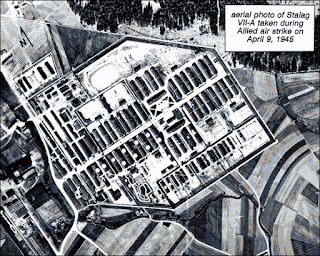
Their march brought them to an overcrowded POW camp in Moosburg. It contained thousands of prisoners, many having to sleep outside. One afternoon a rumor began to circulate that Patton and his men were just across a small ravine and would come to get them the next morning. Sure enough, Pittman woke to the sound of a gun. Being outside, he quickly saw that the front gate had been pushed in by a big tank and drove right up to the barbed wired compound he was in, and General Patton jumped out of it. A few days later, the war ended.

General Patton on liberation day at Camp Stalag VII A, 29 Apr 1945
Before returning to the states, the men were brought to Camp Lucky Strike in France, where they were disinfected, bathed, given haircuts and clean clothes. For some, this was their first bath since being captured. Pittman fondly remembers being allowed to bathe in the Danube during their march to camp Moosburg—his first bath since arriving in Germany. From there, the liberated prisoners were either placed on a ship or plane to return home.

View of Camp Lucky Strike - Saint-Valery, France. 1945.
Source: State Archives of Florida, Florida Memory.
<https://www.floridamemory.com/items/show/136556>.

Pittman tells his audience that "during our captivity—it was the roughest part of my life! The combat was bad, the flying combat was very nerve-wracking, everybody was tense, and you were literally scared! But to me, staying there in that prison camp and being tortured with hunger, I think, was probably the worst experience I had. We were threatened several times with our lives, but that didn't bother us too much. It was just the dream of food, and it was wanting food and not being able to get it that was a nightmare! You would go to sleep, and you'd dream about food. When you'd wake up, and you were talking, all you would talk about was food!"

Pittman lost 50 pounds during his imprisonment, but other survivors who had been there longer being reduced to skin and bones. Some would consider being shot down on the 13th mission bad luck, but Pittman felt it was good luck because he lived to tell about it.

To read the full transcript of Pittman's story and the discussion that followed after his talk, visit the Bossier Parish Libraries History Center at 2206 Beckett Street, Bossier City. Donations are a large part of our collection and are vital in helping us preserve Bossier Parish's history. Visit, call, or email the Bossier Parish Library History Center for help with your research. We are at 2206 Beckett Street, Bossier City, 318-746-7717, history-center@bossierlibrary.org.

By: Amy Robertson

Wednesday, September 15, 2021

Bossier Native Survives WWII Prison Camp, Part 1

This Friday is National POW/MIA Recognition Day, first established in 1979 through a proclamation signed by President Jimmy Carter. Since then, each subsequent president has issued an annual proclamation commemorating the third Friday in September as National POW/MIA Recognition Day. Today, more than 81,600 Americans remain missing from WWII, the Korean War, the Vietnam War, the Cold War, and the Gulf Wars/other conflicts. Approximately 72,000 missing Americans are from WWII alone, 976 of which are Louisianans.

Among those unaccounted for include those buried with honors as unknowns, officially buried at sea, and missing in action, including prisoners of war. Not all POWs became unaccounted for; many were liberated and came home. This week we remember Robert Milton Pittman, Sr., a Plain Dealing native who survived being a POW in Germany during WWII.

Pittman graduated from Plain Dealing High School in 1940 as a track runner and football player. His skill on the gridiron won him a scholarship to Tulane University, where he continued his education. At the end of 1941, the United States entered World War II after Japan staged a surprise attack on American military installations in the Pacific with the most devastating strike at Pearl Harbor. Pittman registered for the draft in 1942 and was accepted, along with 45 other Bossierites, by the Bossier City Draft Board No. 1 in May of 1943 for Army Air Force Services.

Robert Milton Pittman
After going through basic training and several technical schools, he reported to Omaha, Nebraska, for assignment to a combat crew. But once they saw that he played football for Tulane, they signed him up to play football for the Second Air Force that fall. Pittman did not want to stay and play football for the base team; he wanted to join a combat crew. He put in a request for assignment on a combat crew, and it was granted. His assignment was to a B-24 Liberator Bomber crew of the 712th Squadron of the 448th Bomb Group.

On Apr. 5, 1945, The "Bossier Tribune" announced, "Plain Dealing Man German POW."

"S/Sgt. R. Milton Pittman, radioman-gunner on a B-24, reported missing in action over Germany since Jan. 16, is a prisoner of the German government, his parents, Mr. and Mrs. S.D. Pittman of Plain Dealing, have been advised by the war department.

"In a card received a few days after the report from the war department, Sergeant Pittman told his parents he is in perfect health and is grateful for the Red Cross clothing distributed in the camp.

"The young flier, who has been overseas since August, 1944, has a brother, Sgt. Perry Pittman, stationed in Thomasville, Ga. His brother-in-law, S/Sgt. Cecil R. Roberts, is a marine stationed in the Pacific area."

Then, on June 7, 1945, "The Bossier Banner-Progress" announced, "Sgt. Milton Pittman Is Reported at Home Now" [Miller's Bluff Correspondent].

"Sgt. Milton Pittman arrived home Monday morning from overseas. He had been a war prisoner of the Germans since the 16th of last January. He was liberated on the 29th of April by our armed forces, and arrived in the States last Tuesday, May 29th.

"Milton was a radio man-gunner on one of the planes that bombed Berlin so often last winter. We're all quite glad he is back home and in good health. All are rejoicing with his parents, Mr. and Mrs. S.D. Pittman, of the Wardview community."

Another interesting report appeared in "The Shreveport Journal" on June 28, 1945.

"Lieut. John J. Doles, Jr., is with the 14th armored division that liberated the big prisoner of war camp at Moosburg, Germany. He did not know that his school mate, Milton Pittman, whom he had liberated many times in football games, was one of the prisoners. Lieutenant Doles has what it takes to make a good soldier. In his last letter to his parents, Mr. and Mrs. J.J. Doles, he asked them not to worry about him, that he is all right and is in no danger now. We are all proud of you, Lieutenant Doles."

These reports in the local papers let us know that he was captured by the enemy, held prisoner and that he wanted his folks to know that he was in good health. We also know that he was liberated and came home. These articles are all his community saw and learned about his ordeal until he shared his story.

Often, survivors of war don't like talking about their experiences; it's something that most want to and try to forget. Those who share their stories allow the listeners to understand better what it was like for them and others serving in the military during wartime. Pittman shared his story with the Plain Dealing Phi Delta Club in 1980. The Bossier Parish Libraries History Center is grateful to have been donated the transcript of that talk and the discussion afterward. Come back next week to read a summary of his account of what it was like to be a POW in Germany during WWII.

By: Amy Robertson

Wednesday, December 9, 2020

"Hollywood Commandos" Film at Barksdale

During World War II, it was common for celebrities to make the ultimate sacrifice and join the United States military to support the war efforts, which brought Hollywood actors, writers, photographers, and models to Barksdale Field as soldiers during that time. Many of which worked for the First Motion Picture Unit of the Army Air Forces.

First Motion Picture Unit insignia, public domain, Wikimedia Commons

The Army bought the Hal Roach Studio in Culver City, Ca, where the unit was headquartered. The men nicknamed the headquarters "Fort Roach," and this unit of the Army was nicknamed "The Culver City Commandos," "Celluloid Commandos," and "Hollywood Commandos." Their motto was, "We kill 'em with fil'm." It was the first military unit made up entirely of professionals from the film industry. They were tasked with making propaganda and training films, some of which were nominated for and won Academy Awards.

In December of 1942, some of these Hollywood celebrities, now soldiers, came to Barksdale, where they combined their talents to entertain the locals and train the enlisted. The entertainment came in the form of a radio program on KWKH called "Bomber Squadron." "The first in a new series of dramatized programs to be written, portrayed and produced by soldiers at Barksdale Field," aired on Christmas Eve.

Sgt. Richard R. Raleigh wrote the program. Before the war, he worked as a John Power's model, stage actor, short story and radio writer. The program featured Cpl. Oliver Wendell Holmes, an actor whose career included radio, television, Broadway, and film work. He was known for his roles in Zorro (1957), The Twilight Zone (1959), and Leave It to Beaver (1957), to name a few. Holmes and other Barksdale personnel portrayed the American soldier of that time "through the medium of a soldier's letter to his wife."

Martin B-26 Marauder. US Air Force picture,
public domain., Wikimedia Commons
The training came in the medium of a film produced by the First Motion Picture Unit. The working title was "Flying Characteristics of the B-26," and it was the unit's third training film. The production crew shot all but one scene at Barksdale Field. The B-26 had difficult flying characteristics and other issues which lead to many accidents, earning it nicknames, such as "widow-maker," "Martin murderer," and "Flying Coffin." This training film provided training on how to handle these problematic flying characteristics to prevent unnecessary accidents and deaths.

Capt. Robert Carson wrote and directed the film under the guidance of Col. Millard Lewis, who was closely connected with the modification of the B-26. Carson was a film and television screenwriter, novelist, and short-story writer. He won an Oscar for best writing, original story, at the 1938 Academy Awards for his 1937 screenplay "A Star is Born." which was also nominated that year for best writing, screenplay. Capt. Charles H. Seawell was the assistant technical advisor, as well as, set coordinator and advisor.

Sgt. Don Porter played the role of Capt. Dick Blake, the B-26 flight instructor. In Hollywood, he was a film and television actor. One of the parts he is known for is that of Russell Lawrence, the widowed father of 15-year-old Frances "Gidget" Lawrence, played by Sally Field in the 1963 film "Gidget Goes to Rome" and the 1965 sitcom "Gidget." While in the military, he also served as a combat photographer during the war.

Pvt. Gail Shackles, whose screen name was Craig Stevens, played the role of co-pilot Lt. Jim Anthony. Shackles was a film and television actor, best known for his starring role as private detective Peter Gunn from 1958 –1961. Some sci-fi fans also know him for his leading role as Col. Joe Parkman in the cult-classic "The Deadly Mantis" (1957). He also appeared in other propaganda and training films while serving in the Army Air Corps.

Capt. Ullman J. Carruth of the 335th Bomb Group played a minor role in the film, and he served as the coordinator of supplies for the Motion Picture unit during the making of this film. Staff Sgt. Richard R. Raliegh mentioned earlier, also had a short role in the film. During his time in the military, he served in the Public Relations Department of the 335th Bomb Group and the 1143rd Engineering Combat Group.

First Motion Picture Unit credit screen c.1943

The training film was completed in about six weeks and is titled "How to Fly the B-26 Airplane." If you enjoy watching old movies or if you want to check out the one made at Barksdale, a quick search online will provide options for watching this and other films by the First Motion Picture Unit.

By: Amy Robertson

Wednesday, November 27, 2019

Morgan S. Freeman: A Man of Courage and Honor - Part 2

Very interesting closeup view of Martin B-26C Marauder.
==Source== http://www.maxwell.af.mil/au/afhra/photo_galleries/merhar/Photos/01097628_035.jpg

Staff Sgt. Morgan S. Freeman in his WWII uniform c. 1943
Morgan Earl Freeman Collection: 2019.061.001
Ten days after the mission, The Shreveport Times printed the news that Freeman was missing in action. Then, on June 4, 1943, The Shreveport Times announced that two Bossier City soldiers were officially listed as prisoners of war by the War Department. The report listed Staff Sgt. Freeman as a POW of the German government and that he was “slightly wounded.”

By mid-July Freeman's, “parents received 18 cards and three letters from shortwave radio listeners in 8 states. These messages have all told of SERGEANT FREEMAN speaking from Europe and telling that he was safe, well and receiving good treatment. He told that he would soon be assigned to a German prison camp and would be allowed to correspond with his relatives,” according to The Shreveport Times, July 16, 1943.

That same month, Freeman sent a card to his parents, which did not make it to them until December. According to the Dec. 19, 1943 issue of The Shreveport Times, Freemans card stated, “that he had been out of bed a week at that date and asked that his family keep in touch with the Red Cross. He said that he was getting along well and was taking exercises. It is presumed that he meant he was taking exercise after being a hospital patient from May to July.”

Five months went by without any word on Freeman’s condition. Was he still in the POW camp, and how was he doing? Finally, his parents received a telegram from Staff Sgt. Frank Batterson stating, “Just arrived back in this country from prisoner of war camp where your son is held by Germans. His health is good and he sends his love to all.” Right after the telegram came, the Freeman’s received a letter from their son reassuring them “he was fine and had received their letters, packages and pictures.”

The Shreveport Times later revealed that in Freeman’s letter to his parents, dated May 24, 1944, he told them that Staff Sgt. Frank Scorsune of Bossier City had just arrived at the camp a few days earlier and caught Freeman up on the latest news of friends and family back home in Bossier City.

On April 26, 1945, The Shreveport Times announced, “Three Bossier City boys, MILTON J. DEVILLE, MORGAN FREEMAN AND FRANK SCORSUNE, were held prisoner in a German camp, Stalag 17B, which was among those listed yesterday by the war department as liberated by Allied armies.” This news was confirmed a month later when Freeman’s parents were informed directly by Freeman in a letter that “he had been freed from Stalag 17-B, German prison camp, and that he would be home ‘just as soon as I can make it.’ He wrote that he was in good health.”

Although the letters and the reports to the newspapers painted a nice picture of POW camp, the reality is that prisoners often did not receive the best treatment, and food was scarce. When Freeman enlisted in the U.S. Air Corps, he weighed 148 lbs., but after two years in the German POW camp, Stalag Luft 17B, he weighed only 80 lbs.

Freeman received an honorable discharge from his military service on Oct. 18, 1945, and returned home to Bossier City. George Dement introduced Freeman to Georgia McMillan, who he married in 1947. In 1948 their first and only child, Morgan Earl Freeman, was born.

Thanks to Freeman’s son, Morgan, we know that Freeman did not remember the crash,
and as a result of it, he suffered a leg injury losing some of his hamstring on one leg, and he
sustained burns. We also learned that he did not talk about his time overseas with just anyone;
most of what Morgan learned about his father’s time in the war was told to him by his mother.
Despite his injuries, Freeman never walked with a limp, and he worked as a self-employed
contractor installing flooring and countertops, a trade he learned from his father-in-law.

To learn more about Bossier Parish during wartime or to research Bossier Parish veterans
in your family, visit the Bossier Parish Libraries History Center at 2206 Beckett St., Bossier
City.

By: Amy Robertson

Wednesday, November 20, 2019

Morgan S. Freeman: A Man of Courage and Honor - Part 1

Morgan Samuel Freeman was born on Jun. 11, 1915, in Ruston, La. to James and Elizabeth Freeman. He had two brothers and four sisters. In the early 1920s, the Freeman’s moved to Bossier City, where Freeman lived the rest of his life, which ended suddenly on “a beautiful, sunny January day,” according to Freeman’s son Morgan Earl Freeman. He died on Jan. 6, 1972, of a brain aneurysm while at the VA medical center when he was picking up a prescription.

Bossier High School 1932 graduating class.
Morgan S. Freeman is on the second row on the right.
Gaye Englad Colelction: 2018.034.005
Freeman graduated from Bossier High School in 1932, where fellow students voted him as the "wittiest boy" of his senior class. He was a member of the Bossier City Athletic Club, where he learned to box, training under Babe Kennedy. By the time he started college at LSU in Baton Rouge, his boxing skills were already well known in north Louisiana.

As a freshman at LSU, he earned the title as the champion of the featherweight fighters of the LSU freshman team and was declared “the best prospect” that Captain Brink, coach of the team, had ever had to that point. He completed three years at LSU, where he continued his boxing career and for at least the next few years afterward. After college, he worked in the oilfield in Rodessa, LA.

Staff Sgt. Morgan S. Freeman in his WWII uniform c. 1943
Morgan Earl Freeman Collection: 2019.061.001
On Jan. 22, 1942, Freeman enlisted in the U.S. Air Corps. After gunnery school, Freeman was offered a position as an instructor, but he declined this opportunity. Instead, he served on the 452nd Bomb Squadron, and in March of 1943, he was sent overseas to Rougham, Bury St. Edmunds, England, where he was an engineer/gunner for the 322nd Bomb Group commanded by Lt. Col. Robert M. Stillman.

Freeman was on the B-26 Marauder 41-17982 that was shot down on a low-level mission on May 17, 1943. The goal of the mission was to raid a Velsen power station in IJmuiden, Holland. The Marauder plane was hit by German flak and crashed into dunes west of Rozenburg, Holland killing three of the six crewmembers. The surviving crew members were Lt. Col. Robert Stillman, pilot; Sgt. Clyde D. Willis, radio operator/gunner tech.; and Staff Sgt. Morgan S. Freeman, engineer/gunner were pulled from the wreckage by Germans and placed in a prisoner of war camp.

In light of it being aviation history month, I feel it necessary to explain in greater detail what happened on May 17, 1943, as it served as a pivotal point in the history of the B-26 Marauder.
The B-26 Marauder that Freeman was on that day was only one of the 11 Marauders that went on this mission. All but one of these 11 Marauders were shot down by flak on that mission. The only plane not shot down that day experienced mechanical problems and turned back to base. There was a total of sixty airmen shot down in enemy territory, 22 survived as prisoners of war.

As a result of this ill-fated mission, tactics of how the military implemented the B-26 changed. The 322nd Bomb Group was stood down, and the B-26 Marauder program was put on
hold temporarily. Flying the B-26 at low-level was deemed suicidal and was only used at
medium levels from then on.

Be sure to pick up the Bossier Press-Tribune next week to read the second part of
Freeman’s ordeal. Remember, if you are researching veterans in your family tree that are from
Bossier Parish, be sure to visit the Bossier Parish Libraries History Center at 2206 Becket St.,
Bossier City.

By: Amy Robertson

Wednesday, November 13, 2019

Wednesday, May 1, 2019

Barksdale Field’s Role During WWII

Barksdale Field, 1934; Eunice DeField Collection: 2002.027.003
Before the United States Air Force was formed on September 18, 1947, Barksdale was known as Barksdale Field and was a part of the United States Air Corps a division of the U.S. Army. Barksdale Field was the largest military airfield in the world, dedicated on February 2, 1933.

In 1939 war broke out in Europe, and Washington called for an immediate expansion of its military capabilities. Along with the rest of the U.S. military branches, Barksdale started to prepare for war. As a result of the war raging in Europe, the personnel strength doubled at Barksdale Field by the end of that year.

In 1940 Barksdale Field was converted into an Air Corps Flying School, playing an essential role in World War II. In which there were four specialized flying schools established under the Southeast Air Corps Training Center. These flying schools were the Advanced Flying School two-engine (TE) pilots; Advanced Flying School TE Bombardier; Advanced Flying School TE Navigation; and Advanced Flying School single engine pilots.

After Barksdale Field was placed on war status in December of 1941, they transitioned from a training base to an operational base. In February of 1942, the Third Air Force assumed jurisdiction over Barksdale with a mission to train bombardment groups for combat service. Later that year the mission at Barksdale changed again, this time from operational training to replacement training. The Second Air Support Command Headquarters made Barksdale Field it's home in March 1943. Within a year, the remaining 335th Medium Bombardment Group was operating 95 airplanes and furnishing 65 crews per month for the combat theaters.

In the summer of 1943, the first Women’s Army Auxiliary Corps (WAAC) arrived at Barksdale, who along with the nurses provided vital services toward making Barksdale an exceptional airfield.

Just months after the attack on Pearl Harbor, the 44th Bombardment Group was established at Barksdale Field. This unit created and trained America’s most famous B-24 organizations, including itself.

Unfortunately, accidents happened but when they did, they provided training on how to respond. On July 7, 1942, two accidents took place one involving a B-24D the other, separate accident, was of a B-26 Marauder, both planes experienced collapsed nose gear. These and other similar occurrences during the War brought about the slogan “Two a day, the Barksdale way.”

Beginning in 1944, Barksdale Field also served as a training center for the Army Air Corps Military Police during World War II, which included airfield defense. The vastness of Barksdale Field provided military police in training with a realistic experience when they simulated scenarios for both European and Pacific theater operations.

Barksdale Field also served as a training base for the Free French Air Force, where several hundred French airmen trained. The French Air Force received combat crew training in the Martin B-26. Every Friday Barksdale would fly the French tri-color flag while the French airmen trained.

In 1943 soldiers built and tended what was known as the largest Army Victory Garden; towards the end of the war German POW’s were brought from Camp Ruston to Barksdale to maintain the garden. German POWs could also on occasion be seen tending to the roads and maintaining the grounds.

On August 9, 1945, one of the bombardiers trained at the U. S. Air Corps Bombardier School at Barksdale Field, Kermit Beahan, dropped the lethal atomic payload on Nagasaki, Japan. The War was finally ended on September 2, 1945. After the war ended, Barksdale Field became a peacetime training center becoming the home of the Air Training Command from 1946-1949.

If you enjoy learning about history, you won’t want to miss Reverend Siegfried Kunz’s talk, “World War II and its Aftermath Through the Eyes of a German Boy.” Where Rev. Kunz will tell his riveting and heartbreaking story as a child refugee with his family, ethnic German minorities in Eastern Europe during and just after World War II. Monday, May 6, 2019, at 6:00 pm at the Bossier Parish Libraries History Center, 2206 Beckett Street, Bossier City.

By: Amy Robertson

Tuesday, April 16, 2019

World War II and its Aftermath Through the Eyes of a German Boy

Reverend Siegfried Kunz will tell his riveting and heartbreaking story as a child refugee with his family, ethnic German minorities in Eastern Europe during and just after World War II.
Refugees and carts walking behind a train.


Monday, May 6, 2019
6:00 pm
Bossier Parish Libraries
History Center

Refugee women and children leaving the train.

Refugee barracks
German refugee children.
Refugees moving westward.


Rev. Kunz retired in May 2016 after 53 years in the ministry, 48 of them as a pastor of immanuel Lutheran Church in Bossier City, La. Since the late 1980's he has conducted mission trips to Ukraine, his birthplace.

Wednesday, March 27, 2019

Bossier Parish Conserves to Help Feed Starving Nations

Public Domain
World War II left famine in its’ wake with dozens of nations and millions of people on the brink of starvation. These nations turned to the United States of America for help.  President Harry S. Truman assembled a Famine Emergency Committee and appointed former President Herbert Hoover as the honorary chairman.  

The committee did not waste any time in setting out to do what they could to help bring relief to these starving nations.  In the committees’ first meeting on March 1, 1946, Hoover asserted, “Mr. President, the inevitable aftermath of war is famine, and with famine civilization itself is jeopardized. The last great reservoir from which starvation can be halted is in the United States.” 

As advised by Hoover, Clinton P. Anderson, Secretary of Agriculture of the U.S. Department of Agriculture secured cooperation on the State and local levels. 

In response the Bossier Parish Home Demonstration Agent, Lettie Van Landingham worked with school officials to get school children and their parents involved in saving food. She went to Benton and Plain Dealing where they collected and weighed the food waste. They gathered the students and teachers, and Van Landingham demonstrated how the bread in these meals could be saved. Administrators and others, including ex-servicemen, spoke on the need for food in foreign countries and the need to conserve so that American’s can help give to those in desperate need of food. 

A few days later they weighed the food waste again to find that Benton students and teachers reduced their food waste from 14.5 to 9 pounds and Plain Dealing reduced theirs from 22 to 12 pounds. Van Landingham then shared their efforts in the Plain Dealing Progress on April 12, 1946, where she urged other schools in the Parish to do the same and to report their results to T. A. Tidwell, Chairman of the Bossier Parish Agricultural Conservation Committee.  

On May 10, 1946, in the Plain Dealing Progress, the following article appeared with the headline “Local Plan For Saving Food Is Here Commended: State Worker Writes In Praise of Program Inaugurated In Parish. 

“Under date of April 26th, L. A. Mullin, of Baton Rouge, state director of the Field Service Branch of the Production and Marketing Administration, has directed the following letter to Mr. T. A. Tidwell, of Vanceville, chairman of the Bossier Parish ACC: 

“’Dear Mr. Tidwell: Under date of April 15th Mr. Coleman submitted to this office a newspaper clipping outlining the food conservation program being carried on in Benton and Plain Dealing. I am referring to the program under which the waste food was weighed before the children’s attention was called to the necessity of conserving food in order that it may be diverted to the starving people abroad. It is noted from this article that the food waste was reduced in Plain Dealing from 22 to 12 pounds.’” 

“’I think this is a very unique idea and is a good example of what can be done when an effort is made. We have taken the liberty of submitting this idea to our Washington office as being one of the most outstanding articles that developed in connection with this program.’” 

“’Please extend my sincere appreciation to the person responsible for this particular program as I believe it is a very effective way of having school children realize what can be done.’” 

To learn more about the history of Bossier Parish during and after World War II visit the Bossier Parish Libraries History Center at 2206 Beckett Street, Bossier City.

By: Amy Robertson