Showing posts with label Marisa Richardson newspaper article. Show all posts

Wednesday, September 4, 2024

Bossier Biography: Lettie van Landingham

Have you ever had questions about gardening, landscaping, pressure cooking, furniture refinishing, public health, floral design, nutrition, infant care, historic preservation, city cleanup, sewing, personal hygiene, or food preservation? Would you believe that for 30 years Bossier Parish had one woman who could provide you with answers to questions on this wide variety of subjects? That woman was Lettie van Landingham. She described her work as “doing everything you can’t get the other fellow to do.”


Lettie was born in Claiborne Parish on August 21, 1893. She graduated from Louisiana Industrial Institute in Ruston, which is now called Louisiana Tech. Miss van Landingham began her teaching profession in 1914, teaching home economics in De Ridder, Lake Charles, Minden, and Belcher. She accepted the position as the first Bossier Parish Home Demonstration Agent on August 1, 1929. She held this post with the LSU Cooperative Extension Service until her retirement in 1960; completing 31 years of service.


Home demonstration agents taught local women vital homemaking techniques through organized clubs. These clubs were in even the smallest of Bossier Parish communities. Representatives of the clubs formed a larger Parish Home Demonstration council. These Home Demonstration clubs were popular in from the 1930s through the 1950s, a time when our parish was segregated. Bossier did have an active home demonstration program for African American women. Lettie worked with community leaders, including supervisory teacher Charlotte Mitchell, to assist all clubs in the parish. In 1931, Bossier’s African American clubs filled 6,000 tin cans at canning centers located within 4 of the local Black schools, with many of the cans going to the American Red Cross to distribute to the hungry.


Lettie pioneered the food preservation program in Bossier. She taught rural girls in 4-H classes and women in home economic skills, particularly food production and preservation. These skills were especially important during the Great Depression of the 1930s and during World War II, when food preservation was a necessity. The price of canned goods was prohibitive for many rural Bossier Parish residents, so Lettie took orders throughout the parish. She then placed one large bulk order and had an entire truckload of canned goods delivered. This bulk price allowed families to purchase the cans they needed at a reasonable price.


She also wanted to help make cooking both easier and safer. Pressure cookers were considered dangerous by some housewives. The Bossier Banner ran an article in 1932 titled, “Caution needed; Cooker Explodes During Past Week” when Mr. A.E. Robinson, the agricultural instructor at Haughton High School, was burned by steam in an accident with a pressure cooker. Miss Van submitted a list of 5 rules for safe pressure cooker use and also demonstrated how to can corn in a pressure cooker over an improvised brick furnace.


The beloved “Miss Van”, as she was affectionately called, set up 23 canning centers, a community frozen food plant, and helped bring electricity to rural Bossier Parish residents. She was also one of the founders of the Bossier Restoration Foundation, an organization dedicated to preserving Bossier Parish’s historic sites. She received a certificate for outstanding work from the National Home Demonstration Association. She conducted health clinics with the assistance of local doctors and the Webster Parish Public Health Unit, and was instrumental in the establishment of the Bossier Public Health Department in 1937. During this time, she worked with a relief agency and, with the help of W.P.A. labor, built approximately 85 sanitary toilets. Several rural communities in Bossier Parish did not have running water or indoor toilets at this time.


She firmly believed in beautifying her community. She initiated the Plain Dealing Clean-Up Campaign in 1930, which was awarded a national certificate. One of her pet projects was the Keep Bossier Beautiful Club. She fought to rid the highways of litter and spearheaded a campaign to obtain the Cleanest City Award for Bossier City in 1966.


In a 1921 letter from the state superintendent, the value of a Home Demonstration Agent is discussed. “When the right agent is selected, she is always worth many times her salary to the parish. She goes into homemaking clubs of various kinds, which results in the girls having a deeper appreciation of a good home and in their knowledge and skill in making it such. If the agent is a woman of tact and wisdom (and she usually is) she gets into the homes of the people throughout the parish, especially the country homes, makes the acquaintance of the housewives and the girls who are beyond school age, and establishes among them better ideals of homemaking. She shows them what a good home is and how to provide the elements that result in good homes.”


In 1968, on her 75th birthday, Mayor George Nattin proclaimed Wednesday, August 21 as Lettie Van Landingham Day in Bossier City. This honor was in tribune to the people of Bossier City and for the example she set in friendship and devotion to her work. Sadly, Lettie was killed in a traffic accident 8 years after her retirement, on October 24, 1968. “Miss Van gained the respect with all whom she has served and with whom she has worked.”


* To see an illustrated video (5.36 minutes) of this biography, with additional images of Lettie van Landingham and of home demonstration work, check out the Bossier Parish Libraries YouTube channel. Go to www.youtube.com then search “Bossier Parish Libraries” and choose the History Center’s “Playlist.” or use the link below. 

https://www.youtube.com/watch?v=Ba8ERyDuKFI&list=PLHkR-8TzYOEZcND1t3EpBk6FZBFStx3tX&index=2

To visit us in person, the History Center is now within the new Bossier Parish Libraries Central Complex at 850 City Hall Drive, Bossier City, LA (across Beckett Street from the original History Center and “old” Central Library). We are open M-Th 9-8, Fri 9-6, and Sat 9-5. Our phone number is (318) 746-7717 and our email is history-center@bossierlibrary.org


For other fun facts, photos, and videos, be sure to follow us @BPLHistoryCenter on FB, @bplhistorycenter on TikTok, and check out our blog http://bpl-hc.blogspot.com/.


Images: 

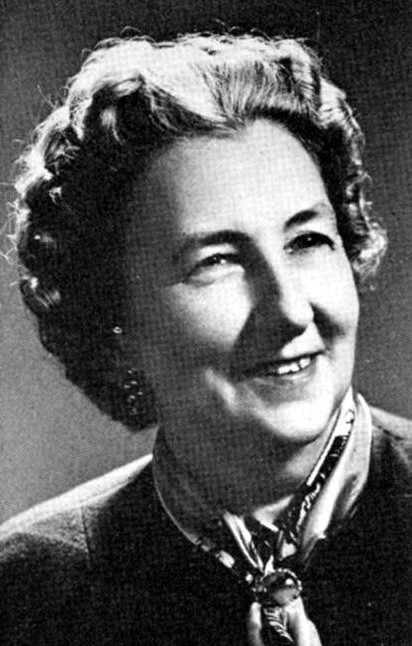
Lettie van Landingham, portrait.

Bossier City wins Fourth District Cleanest City competition. (L-R) Mayor Geoge Nattin, Lettie van Landingham, Mrs. L.H. Taylor, Mrs. W.E. Piper, and George Adams. May, 1966. Photo from the Marie Wissman Collection, BPL History Center.

Cover of the Bossier Parish Home Demonstration Council Yearbook for 1953 – 1954, showing locations of Home Demonstration Clubs throughout the parish.


Article by: Marisa Richardson

Wednesday, July 17, 2024

A Bossier Biography – Lambert W. Baker

Here is a story of a resilient Bossier Parish man that takes place during the Reconstruction era, 1865-1877. His story shows that Reconstruction was a time of strident national political division. It was a time when to vote Republican in the South, which had been the party of Abraham Lincoln, was to risk ostracism or even serious physical harm or death.


Lambert William Baker was born in North Carolina in 1818. In 1844, he married Martha “Mattie” Allen in Walker County, Alabama. Their first daughter, Theodocia, and only son, Percy, were both born in Jasper, AL. By 1849, the family had moved to Minden, LA, where they had four more daughters: Josephine, Alza Dora, Elizena, and Martha Cassandra. Their last child, Maniza Louisa, was born in Bossier Parish in 1860. Lambert, a republican, was elected as Bossier Parish judge in 1868 with 945 votes. He was re-elected in both 1870 and 1872. Richard Welcome Turner defeated Baker in the district judge election of 1876.


As a republican in Reconstruction-era Louisiana, Baker was known as a “scalawag” by the democratic majority of Bossier Parish. The term was mainly used in a derogatory fashion to refer to white republican Southerners who sided with Reconstructionist policies after the Civil War. Baker writes to Governor Warmoth in July of 1868, “I have not been molested, but hear threats of assassination in every direction and it seems to aggravate them that I treat such talk as a joke. My son [Percy] was assaulted on the 26th instant by a squad of cut-throats, with whom he was unacquainted, in the presence of Mr. Hill, sheriff of the parish, but he did not intercede to protect the life of a republican (of course not).”


At the time of these threats, Baker’s seven children still lived with him at home. Maniza, the youngest, would have been about 8 years old. Sheriff Hill, who would go on to become US Marshal of Louisiana, wrote a letter to The Bossier Banner editor, William Scanland, proclaiming the account a falsehood. The Congressional review into the Presidential Election Investigation of 1878-79 mentions that Hill was one of the leaders during the Bossier Riots of 1868.


Baker’s political career came at a tumultuous and dangerous time in Bossier Parish. In 1868, an event known by several names (Shady Grove Riot, Bossier Riot, Bossier Massacre, and Gibson’s War) occurred in the parish. While the exact number of victims is not known, it is thought that around 300 black citizens of Bossier Parish were murdered and possibly another 100 wounded. Baker’s accounts of this time are recorded in the Session of the 44th Congress, known as “Use of the Army in Certain Southern States”.


“Bossier, This parish...has had enacted within its borders during the last six years some of the most atrocious murders ever put upon record by the historian's pen. As no language of mine can add to the extracts taken from official records and personal experiences hereinafter set forth, I shall simply give the statistics as I have been able to collect them, with the remark that, in my opinion, the "Bossier negro-hunt" or massacre, during the month of September, 1868, was, without exception, the most thoroughly wanton, unjustifiable, and in every respect uncalled-for slaughter of innocent and unoffending people, solely on account of their color and political sentiments, that ever occurred among civilized people.


"I have often conversed with men who took an active part in what is known as the Bossier Riot of 1868, and who participated at different places, and they place the number killed at from two to three hundred. Some say more than three hundred. Of that number two were white men and the balance were negroes. No prosecutions were had for that riot.”


Baker and his son Percy both went to the polls with their shot-guns in their hands, as they cast the only two votes for the Louisiana Constitution of 1868 in Bossier Parish. The Bossier Banner newspaper published an article noting that “only two white men in Bossier parish voted for the mongrel Constitution!...Who are the men of nerve among you?...Who are the two greatest skunks in Bossier!” At the time, Percy was a state representative from the parish, but this position offered him no protection. Both father and son report that election fraud was rampant in the 1872 election, and “wholesale intimidation was practiced throughout the parish. Terrible threats were made to revive the fearful election massacre of four years ago [a reference to the event known as the Bossier Riots or Massacre], at which several hundred colored men were killed…A body of Ku-Klux, commissioned as constables, did the work.” Lambert writes to republican politician Stephen B. Packard that armed guards in Bossier Parish are well-known as members of the KKK, and claim not to be White-Leaguers, preferring to call themselves ‘Governor McEnery’s militia’.


In September of 1874, Baker wrote to Packard again and described a threat leveled against him by a White League committee. Baker was told to cease to act as parish judge and United States commissioner and ordered not to make any report of this threat under any circumstances. He was told that disobedience would result in his inability to leave the state and that he “could not live here twenty-four hours.” Baker told Packard that armed White Leaguers held the courthouse and had all elected officials under surveillance. The scope of the situation is not readily available as “outrages are daily committed but not reported by the papers. Anarchy prevails.” The newspaper that fails to report these outrages must be The Bossier Banner.


There is evidence that Baker’s political ideals made even small matters difficult within the parish. In 1875, he applied with the Police Jury to change the Bellevue and Fillmore road in front of his residence. The jurors rejected his application on the grounds that it would lengthen the road. Sheriff W.H. Hill, the same man who failed to intervene during the attack on Percy, submitted the report and reason for rejection.


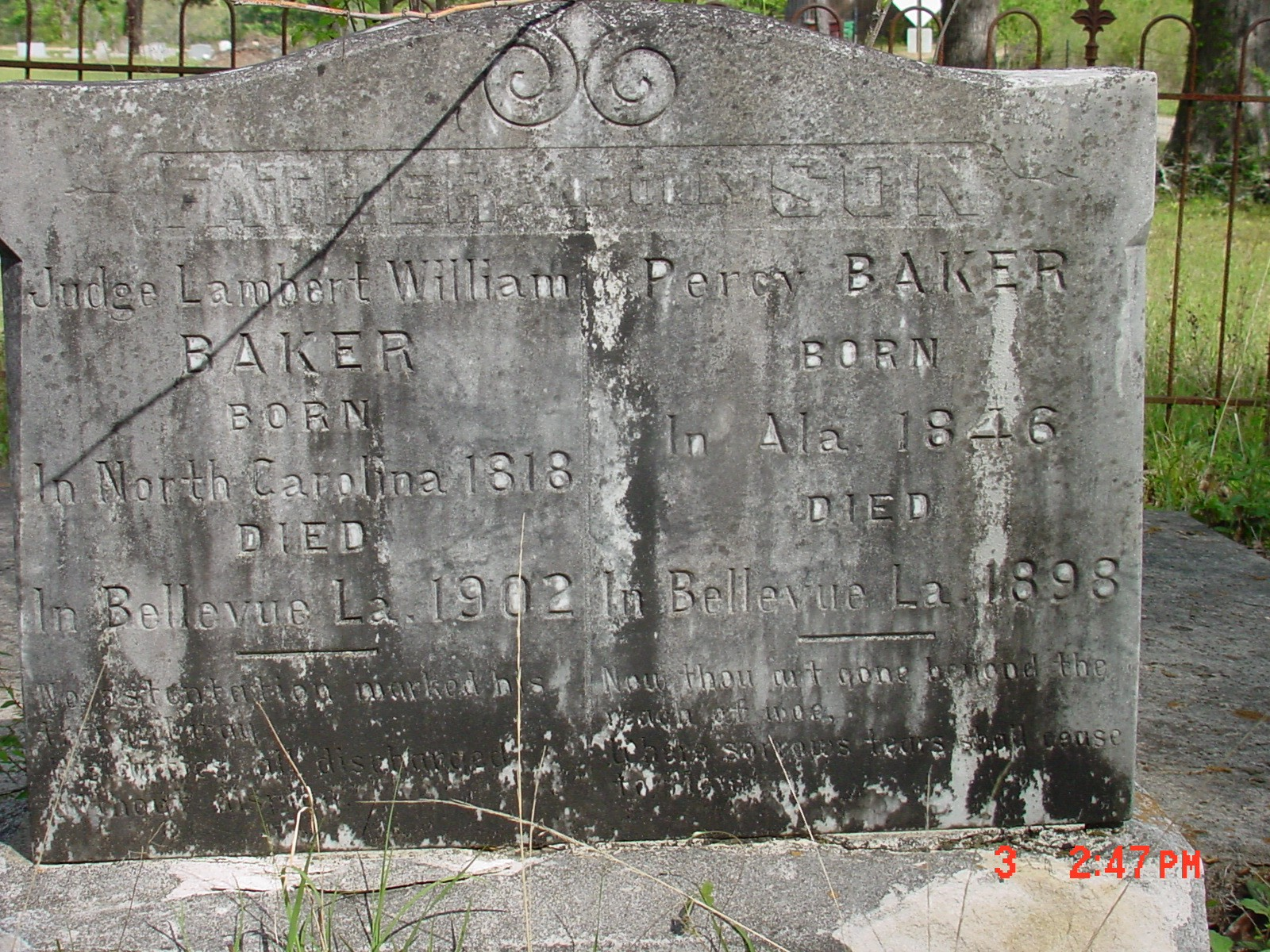
Baker and his family continued to live in Bossier Parish. Lambert Baker died in 1902 and is buried in the Bellevue Cemetery.


To learn more about life in early Bossier Parish, come visit us in the History Center, which is now within the new Bossier Parish Libraries Central Complex at 850 City Hall Drive, Bossier City, LA (across Beckett Street from the original History Center and “old” Central Library). We are open M-Th 9-8, Fri 9-6, and Sat 9-5. Our phone number is (318) 746-7717 and our email is history-center@bossierlibrary.org


For other fast facts, photos, and videos, be sure to follow us @BPLHistoryCenter on FB, @bplhistorycenter on TikTok,


Images: 

  • Lambert William Baker, c. 1860. Photo from the Pete Long collection, Bossier Parish Libraries History Center
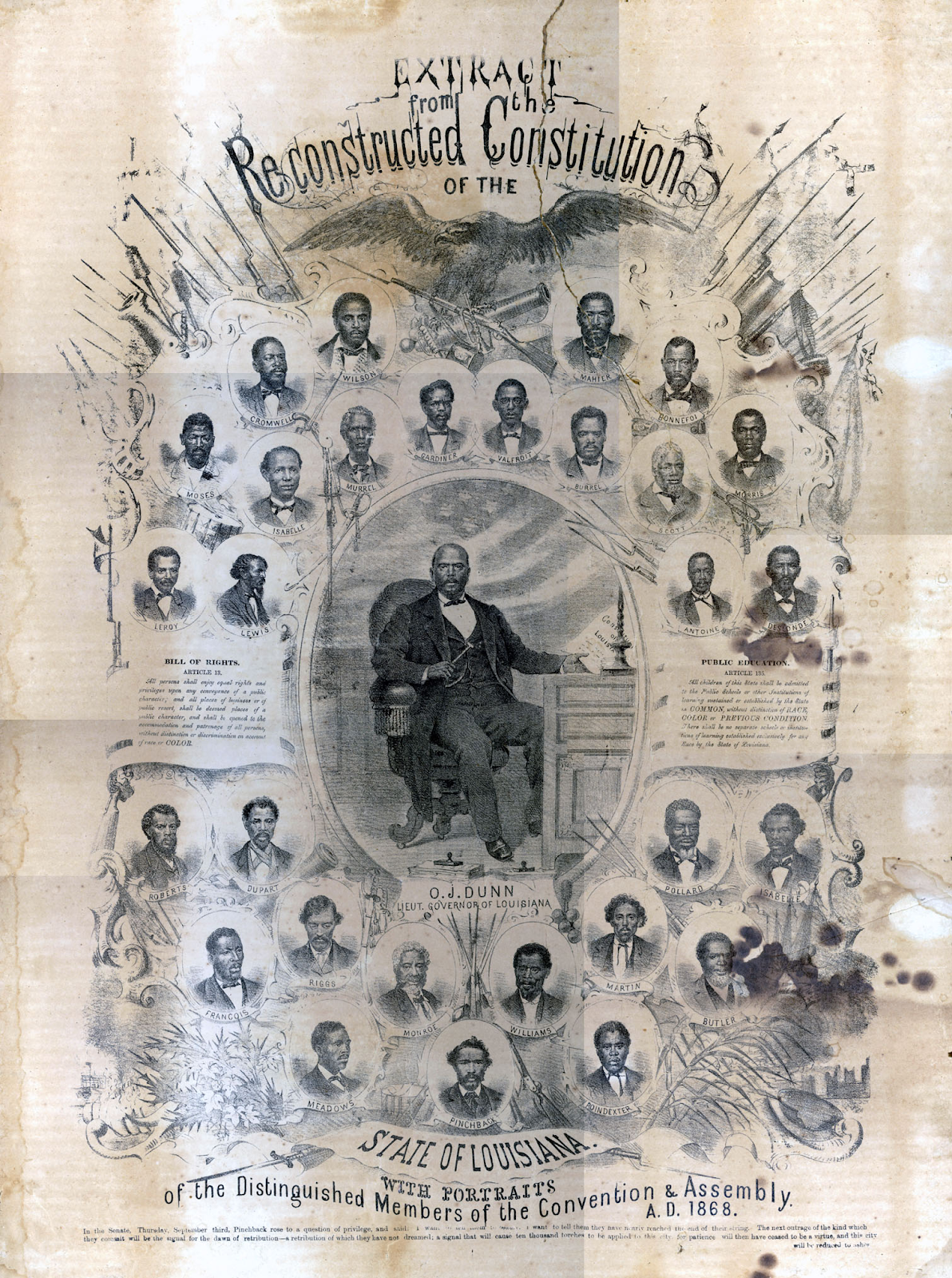
  • Lithographed broadside, “Extract from the Reconstructed Constitution of the State of Louisiana with Portraits of the Distinguished Members of the Convention and Assembly A.D. 1868."   Contains illustrations of prominent African Americans in office.  An equal number of Black and white Republicans met in convention to write the Louisiana Constitution of 1868. Broadside from the collection of the Bossier Parish Libraries History Center, courtesy of John F. Geary
  • Headstone of Judge Lambert William Baker, 1818-1902 and his son, Percy Baker 1846 – 1898, in Bellevue Cemetery, Haughton, Louisiana. Photo from the Pete Long collection, Bossier Parish Libraries History Center
Article by: Marisa Richardson

Wednesday, July 10, 2024

Dear Mr. President, 1942

Two weeks ago, we featured kids, the fifth graders of Mrs. Bonvillion’s class at Bossier Grammar School, who were making a difference during World War II. They collected the waste fats and tin cans that were needed to make munitions for the armed services. The children posed for a photo in 1944, a copy of which is in our History Center collections, showing them holding a banner that said, “We Brought the GREASE to Write the PEACE.” Here’s another story from our collections of a Bossier City youngster doing her part, and making her voice known, for the war effort.


Ten years ago, we received a donation of some newspaper clippings from Billie Jackson Lynn of Bedford, Texas. Ms. Lynn lived in Bossier City as a girl, graduating from Bossier High School in 1950. Her mother saved two clippings about a letter Billie wrote to President Franklin Roosevelt in 1942. Billie had four uncles and a cousin serving their country during World War II, all but one in the Army Air Forces. Two were prisoners of war, captured after the Philippine fighting. Worried about them, Billy decided to appeal to President Roosevelt to do his best to get them back safe and sound to their homes in Shreveport. He referred her letter to the War Department, which, in turn, referred it to General Ulio, adjutant general.


Here is his reply: "Dear Billy, Your letter of September 12, 1942, addressed to the President, concerning your loved ones who are now serving their country, has been transmitted to the War Department for reply. Your comments have been noted with interest and you may be assured that the War Department is always glad to receive the opinions of our young women and future citizens. Very truly yours, J.A. Ulio, Major General, The Adjutant General."


The newspaper noted the status of the soldiers in Billie’s family: “Billy's [sic] uncles are: Staff Sergeant H.F. Leeman, now a prisoner of war in Japan, formerly with the Army Air Forces; Private Charles H. Haynes, in the Air Forces in England; Private Homer W. Haynes, last heard from in Fort Lewis, Wash., with the Air Forces; and Corporal Clyde A. Jackson, in San Diego, with an anti-aircraft unit of the coast artillery. Her cousin: Private First Class James H. Markham, of the Air Forces, a prisoner of war [in Japan].


All are from Shreveport, and Billy hopes they all get back safely, after the job is finished. If she, the President, and General Ulio can affect it, they will. Meanwhile, she is an earnest collector of scrap metals, which will free her uncles and cousin.”


Both SSgt. Leeman and PFC Markham had been stationed at Barksdale Field and were reassigned to Savannah Army Air Base in Georgia in early 1941. They then went on to the Philippines where they were captured by the Japanese and taken prisoner. The men survived the Bataan Death March and were held in separate prison camps in Japan. They were finally released after the war and returned to the US.


Her newspaper photo shows Billie holding the letter she received along with a bomb, which her uncle had been fashioning into an ashtray before he was called into service. Billie donated the bomb to a scrap metal campaign. Ms. Lynn remembers that “in those days, we were all patriotic.”

Newspaper clippings are commonly saved and passed down as family mementos, but newspaper is acidic by nature. This acid causes the paper to turn yellow and break – things you don’t want to happen to your family keepsakes! Since the information in the clipping is the real treasure and not the newspaper itself, be sure to make copies of fragile clippings. Use an acid-free, lignin-free paper for the copies. Much of the standard copy paper today is acid-free and can be purchased at any office supply store. By making copies, you ensure all of the important information is preserved for future generations. We made photocopies and scans of Billie’s articles so that we can easily preserve and share the story of her presidential correspondence.


To learn more about life during World War II, join us for World War Tuesdays on the second Tuesday of the month from 10:30 – noon. The next meeting is August 13, 2024 – in our new location! The History Center is now within the new Bossier Parish Libraries Central Complex Library at 850 City Hall Drive, Bossier City, LA (across Beckett Street from the original History Center and the “old” Central Library). We are open M-Th 9-8, Fri 9-6, and Sat 9-5. Our phone number is (318) 746-7717 and our email is history-center@bossierlibrary.org


For other fun facts, photos, and videos, be sure to follow us @BPLHistoryCenter on FB, @bplhistorycenter on TikTok, and check out our blog http://bpl-hc.blogspot.com/.


Images: 

  • Billie Jackson (Lynn) in 1942, holding a letter she received from General Ulio, US Adjutant General, and a bomb that had been fashioned into an ash tray, which she was donating to a scrap metal campaign.
  • Brigadier General J.A. Ulio, 1940. Photo by Harris & Ewing, courtesy of the Library of Congress
Article by: Marisa Richardson