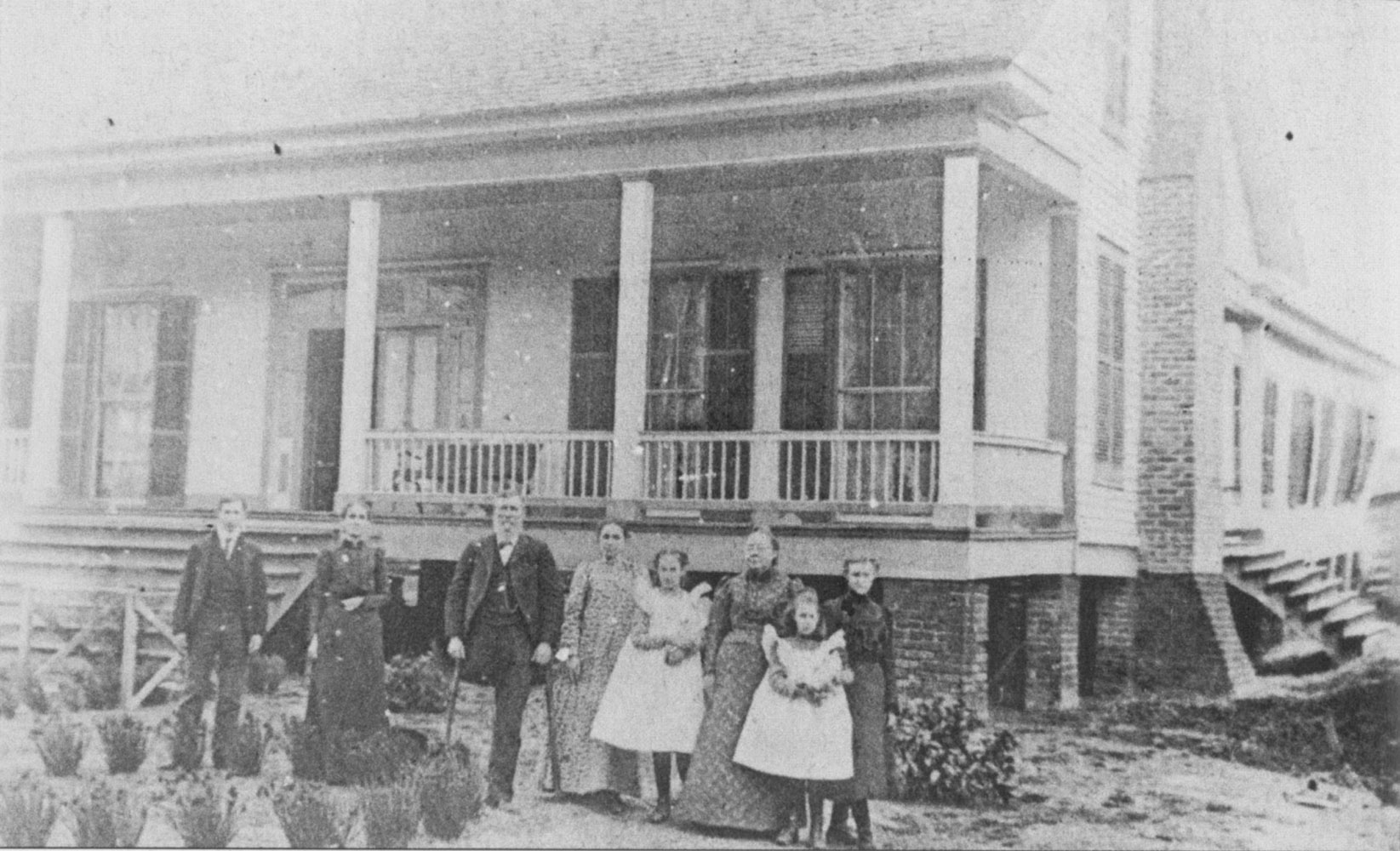
Showing posts with label Haughton. Show all posts

Wednesday, June 16, 2021

Haughton's Early Days

The Village of Haughton
This unique picture of Haughton, Louisiana, was taken in 1910, from atop the church bell tower. A wagon loaded with a bale of cotton proceeds to the railroad depot. the three-story building in the center is the Crume Hotel. At the far left is the store of T.H. Lawrence, which was the last surviving building, until 1997, when it was dismantled. the white house on the right would burn in the 1950s. Behind it is the Edwards' home, which would burn in the 1990s. Fire has been a strong enemy of Bossier Parish's early homes and towns. Emma Patillo Collection: 0000.003.033-2

When William Purvis Haughton moved his family to Bossier Parish, he had no idea that the land he pioneered along with the Lawrence family would one day be named after him and would continue to grow as it has. Haughton's beginning goes back roughly forty years before it was officially designated as such on Sept. 1, 1884, when the VS&P railroad changed the community known as Lawrenceville to Haughton.

The name change was because when the railroad came through Lawrenceville, the train station was named Lawrence Station, but there was already a Lawrence Station in Mississippi. Dr. Paul Andrew Lawrence, the son of pioneer David Lawrence and son-in-law of William Haughton, chose to change Lawrence Station of Lawrenceville to Haughton Station. And the community from that point forward has been known as Haughton.

Being chosen as a location for a railroad station set into motion a significant growth spurt for Haughton. During the summer of 1884, the railroad was built through the community. The Bossier Banner reported on July 10, 1884, "Lawrenceville, situated ten miles south of Bellevue, on the Vicksburg, Shreveport and Pacific Railroad, is having quite a boom in business and improvements. There is life and bustle everywhere, and our new railroad town evidently has a bright future before it, in which well directed industry and liberal investments will surely be well rewarded. Success to the new town and its progressive citizens."

A few days later, the first U.S. Post Office opened with Luther E. McDade as postmaster. Of course, the post office name changed from Lawrenceville to Haughton a little over a month after the community's name was changed. The second postmaster was Milus W. Haughton, son of William.

The community continued to grow, and when talks of moving the Parish seat from Bellevue started, the citizens of Haughton wrote a letter to the editor of the Bossier Banner with their bid to be chosen for the new location. The letter was dated May 7, 1885, and was published a week later. It reads as follows:

"As there is a great deal of talk about the Parish site removal, and some little bidding for the Court House, the citizens of Haughton and vicinity desire to be heard. We will give ($3,000) three thousand dollars and one lot of ground for the parish site. Our land ranges in value from $125 to $1000 per lot; and we will give a suitable lot worth at least $500. If parties do not believe that we are in earnest, let us be awarded the parish site and the cash will be forthcoming. In the early days of Rome the crown was put up to the highest bidder, and the money this derived was given to the people. — In this, we propose to assist the people of Bossier in building a new Court House and jail. If any other community offers this amount we may raise our bid, but think that those who get the advantage of the parish site, should pay for that advantage. We are willing to do so."

The letter continues with boastings of the fruitfulness of the land, its commercial advantages, and schools. The amount of cotton they shipped out in 1884 was 3,000 bales, and the fact that they paid more for cotton than any other place. Pointing out that "everything argues in favor of Haughton. We have six business houses, boarding houses, livery stables, saw mills, and everything that constitutes a first-class village, with the ambition of a town — Within the present year Dr. Lawrence, Messrs. McClanahan, Davis, Grounds, Bullock and Odom, have built residences, and Messrs. Bryan, Radcliff, Bodenheimer, McKinney and J.F. Edwards are constructing residences. If any town, or neighborhood in the parish can beat this showing of a town less than a year old, we would like to hear from them, especially if they will offer more for the Court House."

That same year a Baptist church house and Methodist church house were erected. P.B. Holt became the editor and proprietor of the first newspaper, the “Haughton Democrat.” The village held its first election that fall, where the people elected Henry Bodenheimer as their first Mayor and for Trustees, Dr. Paul Lawrence, J.F. Edwards, J.W. Elston, D.H. Cale, D.E. Griffin, and J.G. Grounds. Come Christmas time; the people put up a community Christmas tree in the schoolhouse where they gathered on Christmas Eve. The first telephone was installed in June of 1889.

The village of Haughton continued to grow. With a population of over 1,000 inhabitants, Governor Edwin Edwards, through proclamation, reclassified the Village of Haughton to the Town of Haughton in Sept. 1975. Currently the largest town in Bossier Parish, and once it reaches a population of 5,000, it will be eligible for reclassification as a city.

To learn more about Haughton, visit the Bossier Parish Libraries History Center at 2206 Beckett Street, Bossier City. Be sure to follow us @BPLHistoryCenter on FB, @bplhistorycenter on Tiktok, and check out our blog, http://bpl-hc.blogspot.com/.

By: Amy Robertson

Wednesday, March 17, 2021

Plain Dealing High School's Forest

Future Farmers of America with Oren S. McFatter, vocational instructor.
Plain Dealing High School Collection: 2004.013.020

In 1946, Plain Dealing High School Principal Felix G. Phillips called a meeting to discuss the organization of a forestry program for the school. Phillips explained to his audience that "he had been thinking of and was interested in forestry and the improvement of agriculture in general for many years; and for the past five years had been planning a forestry program for the Plain Dealing High School and had now reached that point where he could put those plans into effect.

"He explained that his idea was to develop a forest project on the land belonging to the school and use it to enable boys and girls to become familiar with forest development and management. In doing this it will also influence farmers in this section as well as other schools to become interested. The school is fortunate in having for its site about 25 acres.

"Mr. Phillips further stated that Bossier Parish is especially suited for the production of forest and forest products and he wanted to do all he could to get the citizenry interested. He believes this can be done by working through the children."

The meeting included members of the State Forestry Commission, Soil Conservation Service, Bossier Parish School Board, fire prevention, Louisiana State Forestry Commission, farmers, and the Southern Craft Paper Mill, an International Paper division. Those in attendance favored the idea and formed committees to see the project through to completion. By the end of 1946, Phillips' vision for a school forestry program became a reality after a 10-acre plot was dedicated to the program.

The District Forester, D.Y. Smith, brought 2,500 saplings for the occasion. That year's freshman class planted the first 500. Students in the Future Farmers of America club lead by Oren S. McFatter, Plain Dealing High School's vocational agricultural teacher; 4-H clubbers lead by Enoch T. Nix and other interested high school students planted the remaining 2,000 saplings. Over the next two years, an additional 4,000 saplings were planted in the school's forest.

Principal Phillips with sign O.S. McFatter presented
to him dedicating the forest plot in his honor, 1948.
In 1948, O.S. McFatter presented a plaque with a dedicatory inscription naming the forest plot in honor of Principal Felix G. Phillips.

Nine years after the program started, John Webb, a representative from the Louisiana Forestry Commission, visited the Phillips Forestry Project to inspect Louisiana high schools' first forestry project. Tommy Kohara, the official photographer of the Louisiana Forestry Commission, took pictures. Six months later, in celebration of the forest's 10th anniversary, a three full-page article appeared in "Forests and People," the Louisiana Forestry Commissions magazine.

According to Webb's article, "Since the dedication, small landowners in the environs of the town have planted many plots to pine. Oren McFatter, vocational agricultural teacher at Plain Dealing High School, is teaching forestry to agricultural classes each year, using the demonstration plot to teach planting and management. He and Glenn H. Crawford, present principal of the high school, plan on expanding the forestry project when and if more land can be obtained."

(L to R) C.O. Holland, James A. Gayle, B.L. Snyder, T.L. Rhodes
Dedication of Haughton High School Forest, 1961. Source: Bossier Press
Three years later, the school dedicated an additional 40-acres just north of the Arkansas-Louisiana line. In 1961, the second Bossier Parish High School forest was dedicated at Haughton High School. A 40-acre tract located just north of Fillmore, where vocational agriculture students studied under Frank Staten. Profits from selling forest products produced by both schools were used to buy equipment for vocational agriculture.

By: Amy Robertson


Wednesday, October 21, 2020

Blind Man Hunts Again

Walter Hill was a Benton resident and avid outdoor sportsman who probably planned to spend his retirement hunting and fishing at the Sailes Hunting Club in Bienville Parish. On May 13, 1975, a valve on a storage tank filled with anhydrous ammonia malfunctioned while working, causing severe damage requiring 27 surgeries and four transplants. In the end, the Doctors were unable to restore Hill’s sight. Now, legally blind, he was forced into early retirement and feared that his disability would prevent the retirement he always imagined.

Walter Hill and "Junior" Williams
Shreveport Times Photo by Reeves Feild
Hill learned that there’s not much one can’t do, where there is passion, will, and good friends. It was not long, maybe about a year or so after the accident, he began fishing again with the help of a friend, part-time fishing guide, Vardaman “Junior” Williams of Williams and Son Plant Farm in Keithville.

Ten years later, he learned that his neighbor, Margaret Stewart, loved to hunt and fish, so he made her a deal, “if you get me there, I will pay all of the expenses.” From that point forward, Hill and Stewart began “hunting” and fishing together. Though he could not hunt, he enjoyed being in the woods and sitting in the deer stand.

Over the years, Hill lost his wife, Dorothy, and eventually, he and Margaret married on Valentine’s Day 2006. As a mother of a legally blind son and an avid hunter herself, she started making phone calls when she heard of a blind person in Texas hunting using a laser sight and partner. Margaret called the Louisiana Wildlife and Fisheries to learn that, in Louisiana, this would be illegal. Next, she called Louisiana State Representative Henry Burns, a long-time friend, and resident of Haughton. 

Burns went on to sponsor a bill (HB 39) through the Louisiana legislature, which was signed into law by Governor Bobby Jindal, just in time for hunting season. “The new law authorizes the use of laser scopes by visually impaired hunters while hunting with a sighted individual.” Louisiana is the 17th state to pass such a bill allowing the blind to hunt with the assistance of technology and a sighted partner.

The last time Hill shot a gun for hunting purposes was on New Year’s Day in 1975, just five and a half months before losing his sight. Finally, with the new law in place and family and friends’ help, Hill could do more than sit in the tree stand. It was the winter of 2010 when, once again, Hill experienced the thrill of hunting when he shot his first deer since becoming blind 35-years earlier.


The most important message that Hill would want readers to take from this is “not to be afraid of doing things with people who are handicapped.” He did not take lightly the challenge and effort it took for his friends and family to help him fish and hunt. Hill stated, “You don’t realize how much it meant. When I caught that first bass, I almost cried. Margaret and Junior helped give me my life back.” 

Learn more about the local history by visiting the Bossier Parish Libraries History Center, your leading source for local history. We are located adjacent to the Central Library branch at 2206 Beckett Street, Bossier City.

Whether you want to learn about local history or research your family history, we are here to help in person or online, www.bossierlibrary.org/research/history-genealogy. Be sure to follow us @BPLHistoryCenter on FB and check out our blog, http://bpl-hc.blogspot.com/. 318-746-7717, history-center@bossierlibrary.org

By: Amy Robertson

Wednesday, July 1, 2020

U.S. Postal Service and Bossier Parish

First US Postage Stamps, George Washington and Benjamin Franklin, issue of 1847, 5c and 10c
Did you know that Benjamin Franklin greatly influenced how the postal service operates today in the United States? His work in postal services began in 1737 when the British Crown appointed him as the postmaster of Philidelphia. Franklin was dismissed as postmaster in 1774 because the British Crown felt he was too sympathetic to the colonies as he vocalized support for their independence.

On Jul. 26, 1775, the Second Continental Congress appointed Benjamin Franklin as the first postmaster general of the United Colonies. The Declaration of Independence created the United States in July 1776, making Franklin the first postmaster general of the United States.

The Articles of Confederation and the Constitution were both written to ensure the vital services were preserved. In 1792, President George Washington signed into law the Postal Service Act, which established the United States Post Office Department as a permanent part of the Federal government.

General Jean Pierre Baptiste Bossier
Charcoal drawing by John J. Audubon, Nelson
Museum, Kansas City.
Patrick D. McAnany Collection: 2001.044.001

Louisiana’s first post office was established in New Orleans in 1804. It wasn’t until 1843 that Bossier Parish was carved out of Claiborne Parish, and that same year General Pierre Bossier began his term as a congressman for Louisiana’s fourth district. According to the official Bossier Parish historian, “One of the first actions taken in 1843 by the newly elected General Bossier in the U.S. Congress was to obtain postal service for his namesake, Bossier Parish.”

General Bossier introduced a bill to authorize a survey for a postal route from Shreveport to Bellevue by way of Willow Chute and on up to Conway, Ark. Unfortunately, General Bossier died of tuberculosis just 13 months into his term, before his efforts for a postal route were realized.

The first post office in Bossier Parish was established at Red Land on Nov. 20, 1846, with Jerome Bonaparte Mading serving as the first postmaster. After nearly 63 years in service, the post office in Red Land was discontinued on Apr. 15, 1909.

This year, the Benton post office celebrates its 150th anniversary as the oldest post office in Bossier Parish; it was established in March 1870 with Elias O’Neill serving as the postmaster. Through the implementation of the Rural Free Delivery, postal mail was delivered to Benton residents, beginning in 1907 before this time residents had to travel to the post office to retrieve their mail or pay a private delivery service.
Unidentified postal carriers for the RFD (rural free delivery) in Plain Dealing C. 1910
Buelah Findley Collection: 1997.054.054

Another fascinating part of postal history in Bossier Parish can be discovered in the Apr. 17, 1913 issue of The Bossier Banner, where the following article appeared.

“Our fellow townsmen Mr. Edwin W. Doran has been granted a patent on a mail box indicator. The device accurately indicates the last hour the box was ‘robbed’ by the postman, thus serving as a convenient guide to the public when wishing to post letters. It is particularly intended for use in cities, but would be practical anywhere. Mr. Doran has received encouraging communications from the postmaster general and others regarding his patent and he will no doubt later reap considerable pecuniary gain from it.”

Bossier Parish currently has seven post offices located in Benton, established 1870; Bossier City, established 1891; Elm Grove, established 1902; Haughton, established 1884; Plain Dealing, established 1888, and Princeton, established 1910.

The History Center is excited to announce that our branch of the Bossier Parish Library System will be re-opening our doors to the public this Monday, July 6. Until then, we are here to answer your calls and emails. What do you want to know about Bossier Parish History? Email history-center@bossierlibrary.org or call us at 318-746-7717.

By: Amy Robertson

Wednesday, June 17, 2020

Dr. Paul Lawrence: Man of Many Hats

Dr. Paul Lawrence C. 1890
Emma Pattillo Collection: 0000.003.040

Dr. Paul Lawrence is remembered as the one-legged, horseback doctor of Haughton. Though he served this rural community for fifty years as a doctor, it is not how he made his living. That is because during the 19th Century, doctors, especially frontier doctors in rural areas, were rarely paid in cash. Instead, they were often paid in-kind with whatever produce, services or goods were available to the patient. Because of this, he was a man of many hats.

Lawrence first came to Bossier Parish in 1851, when he was only twelve-years-old, moving here from Mississippi with his family. He obtained his education from Fillmore Academy. Then, in the fall of 1860, Lawrence began his medical studies in New Orleans at the University of Louisiana, known today as Tulane University.

With tensions rising between the states, he came home in Dec. 1861 and enlisted in the Robin Greys, a Bossier Parish company of the 19th Louisiana Infantry, Company B, The Army of Tennessee. The Army of Tennessee was the principal Confederate army operating between the Appalachian Mountains and the Mississippi River.

During the Civil War, Lawrence sustained two injuries, one to the shoulder in 1863. After a six-month recovery, he rejoined his company, and two months later, he suffered an injury that required the amputation of his right leg. After convalescing in Mississippi with relatives until he was well and able to travel, he returned to Louisiana, wasting no time in resuming his medical studies in the summer of 1865.

Mary "Mollie" Jane Haughton C. 1890
Emma Pattillo Collection: 0000.003.040-2

In 1867, Lawrence returned to Bossier Parish and began his medical practice. He married Mary (Mollie) Jane Haughton, daughter of Harriet (Hassell) Haughton and William Purvis Haughton, whom the town is named after. When the railroad first came through the area, it was initially called Lawrenceville, after Dr. Paul Lawrence as the train depot, often referred to as Lawrence Station, was located on land that was formerly owned by him. On Sep. 1, 1884, Lawrenceville officially became Haughton.

As mentioned earlier, Lawrence was a man of many hats. Besides always being on call as the town’s physician, he was also a third-generation cotton planter, as well as a merchant, owning and running a general mercantile and cotton brokerage business, Lawrence & Son. After his death, his youngest son, Thomas Humphrey Lawrence, who partnered with him at the store, changed the name to Lawrence & Company, and it remained open until his retirement in the 1950s.

Even after retirement, Lawrence continued to superintend his farm until his death. As a retired physician, he would still provide medical services when called on, whether filling in when a doctor was not available and assisting in surgeries when requested. He was a prominent member of the community, and he gladly served it in various ways, from serving as a voting commissioner to being a member of the Bossier Parish School Board, and later as a member of the Board of Trustees for Haughton white 
schools.

Lawrence was appointed by the Bossier Parish Police Jury as a Health Officer for the Fillmore area in 1878 in response to the threat of dangerous and contagious diseases, such as smallpox and yellow fever. In 1885, he was on the building committee for the Methodist Church in Haughton, which has been in the same location on E. McKinley Ave for 120 years.

He was nominated to represent Bossier Parish as a delegate for the Democratic State Convention. And, he was a delegate for the Louisiana State Division, United Confederate Veterans in 1914. When he died in Nov. 1934; he was the last Robin Grey soldier to die.

When driving down Hwy. 157, about a half-mile south of the red light in Haughton, sits Dr. Paul Lawrence’s old house, which is now a historic site.
C. 1900. Dr. Paul Lawrence is shown standing with his family in front of his south Haughton home. From left to right are T. Humphrey Lawrence, Mary Lawrence (sister to Paul), Dr. Paul Lawrence, Eva Lawrence, Myrtis Lawrence, Mary Haughton Lawrence (wife of Paul), Sudye Lawrence(youngest of nine children), and Lucille Lawrence. (Clifton Cardin Collection: 1999.089.003)

Wednesday, June 3, 2020

Bossier Parish's First Woman Mayor

Elizabeth O. Sherwin was not born in Bossier Parish, but that did not stop her from faithfully serving the Haughton community from the time she moved there and until she departed from this earth. Sherwin and her husband moved to Haughton after World War II, in 1945 from Marshall, Texas. They purchased land and built a house where they could raise kids away from the city, calling Haughton home from then on.

When Sherwin first arrived in Haughton, it was just a small town with unnamed dirt roads. As she watched her kids grow, she also attended the town grow. She got involved in the community by joining committees, clubs, and programs. She organized the Haughton P.T.A. in 1947, and she organized the candy striper program at Bossier General Hospital in 1965.

She began serving Haughton politically as the first woman to serve on the town council for Haughton in 1970. In 1972, she was the first alderwoman elected to the Haughton Town Council. After six years as an alderwoman, Sherwin ran for mayor. In an interview with Shanda Thomas, for The Shreveport Journal, Sherwin stated, “She was urged to seek the top position by her husband because she ‘put in as many hours as an alderman as she would as mayor.”

In 1976 Sherwin became the first female mayor of Haughton, the first female mayor in Bossier Parish, and the first female Republican mayor elected in Louisiana. Taking her first oath of office on July 1, 1976, after beating her opponent Sylvester E. Carson. Eager to continue the many projects she had begun and happy to continue serving the community, she ran for re-election; this time, she was unopposed. After her first term as mayor, she ran unopposed for re-election and joyfully continued serving the great town of Haughton.

During her stay in office as the Mayor of Haughton, Sherwin helped Haughton to become recognized
as an official Bicentennial Community, making the town eligible for a variety of grants. Including grant funds for the construction of a new water treatment plant; to connect all houses within Haughton town limits to the sewerage system; to add fluoridation to the water system to prevent dental disease, and to implement an ongoing drainage program for flood-prone areas. She also obtained funding to build a new firehouse, a new library, and to expand the city hall.

Sherwin took her responsibility to keep the citizens of Haughton safe during an emergency and organized a mock evacuation drill to access the town’s ability to respond effectively to a public emergency in coordination with the various agencies. She evaluated the railroad tracks for disrepair and saw to it that the railway company made necessary repairs. Also, she was successful in imposing a 10-mph speed limit on trains passing through the town.

She always looked for ways to help others and could rally people together to help make a difference in the lives of others. In 1983, after the tragic loss of Haughton’s very own Joe Delaney, she established a memorial scholarship in his name to serve the athletically inclined graduates of Haughton High School.

While the BPL History Center is closed during the pandemic, our staff members are still available to answer any research questions you may have. What do you want to know about Bossier Parish History? Email history-center@bossierlibrary.org or call us at 318-746-7717.

By: Amy Robertson

Wednesday, March 4, 2020

History in the Name: Bossier Parish Cities and Towns

The Parish of Bossier is a medley of communities that includes two cities, three towns, two census-designated places, as well as several unincorporated communities. Names for these communities were inspired by the area’s physical features, given in memory of an early settler, or after an individual that made significant contributions to the development of that area.
Bossier City is the highest populated municipality in the parish, and like many other communities, it has had more than one name. The first European settlers of the Bossier City area were James and Mary Cane, who had a plantation called Elysian Grove, which was about 600 acres in size. The plantation’s port or ferry landing was known as Canes Landing, and sometime after the Cane’s opened a store near the landing, the area became known as Cane City.

Near the end of the nineteenth century, a small village was laid out by Mary Cane’s granddaughter and her husband, changing the name to Bossier City. Bossier was later incorporated as a village in 1907 by Gov. Blanchard. Bossier City was named in memory of Pierre Evariste John Baptiste Bossier, the same U.S. Congressman that Bossier Parish was named after. In 1843, he was elected to represent Louisiana’s 4th District in the Twenty-Eighth Congress, the same year that Bossier Parish was created.
General Pierre Evariste Jean Baptiste Bossier C. 1820-30.
Clifton Cardin collection:1997.065.001
Shreveport is the second city that resides in Bossier Parish, but only small portions of it. It is easy to assume that the Red River perfectly divides Caddo and Bossier Parishes, and at one time, this was true. However, over time through natural and artificial causes, the course of the river has changed. The boundaries of the two parishes were designated based on how the “Old River” ran; however, the river has moved east over the years. Making it so that areas of Shreveport seem to be in Bossier and areas of Bossier seem to be in Shreveport.

The Shreveport downtown airport, Wright Island, Shreveport Aquarium, El Dorado Casino, and the Charles and Marie Hamel Memorial Park are all in Shreveport, Bossier Parish, Louisiana. Boomtown Casino is in Bossier City, Caddo Parish, as well as most of Cane’s Landing, and a portion of the eastern bank of the river south of Jimmie Davis Bridge. Therefore, parts of Shreveport are in Bossier Parish, making Shreveport the other city within the parish.

Shreveport was named in honor of Captain Henry Miller Shreve, who not only made the Red River navigable in 1838, but he also made contributions to the settlement of the region. Shreveport was first called Shreve Town after the real estate brokerage firm, Shreve Town Company, in which Captain Shreve was an owner.
Captain Henry Miller Shreve by artist George
D'Almaine Source: https://commons.wikimedia.org
There are two accounts of how the town of Benton received its name. In one account, it is said that it was initially called Ben’s Town after a merchant by the name of Benjamin Looney, who was reported as being the first merchant in the area. The other account is that the town of Benton was named in honor of Thomas Hart Benton, a United States Senator from Missouri. He played a critical role in developing the west by building roads west of the Mississippi, including the road from Arkansas into Shreveport, which passed through Lewisville, Plain Dealing, and Benton operating as a stagecoach line for many years.
Daguerreotype of United States Senator Thomas Hart Benton, C. 1850.
Image courtesy of the Harvard University Library.
Source: 
Harvard University Library, Weissman Preservation Center
found on  https://commons.wikimedia.org
The town of Haughton, which is expected to qualify to become a city after the 2020 U.S.
Census, started as Lawrenceville. When the VS&P railroad came through in 1884, the name was changed to Haughton on Sept. 1 of that year—named after one of the original settlers, William Haughton. The Lawrence’s and Haughton’s once owned all of the lands that make up Haughton today.
William Purvis Haughton
Source: http://bebossier.com/2018/03/history-of-haughton/
Before the Civil War, there was the Plain Dealing Plantation that was operated by George Gilmer. When the Shreveport and Arkansas Railroad, commonly known as the Cotton Belt Railroad, was announced to be coming through the area in 1888, S.J. Zeigler a businessman and the husband of a Gilmer descendant that owned the Plain Dealing property, selected the property to establish a village. It was briefly known as Guernshein after a prominent railroad company stockholder, but it was soon renamed to Plain Dealing after the plantation. It was chartered in 1890 and became incorporated as a town in 1928.

George Oglethorpe Gilmer owner
of Plain Dealing Plantation
Source: ancestry.com
To learn more about these and other communities in Bossier Parish, visit the Bossier Parish Libraries History Center at 2206 Beckett Street, Bossier City.

By: Amy Robertson

Wednesday, February 5, 2020

Local Educator Fulfills Need for Adult Education

Minnie B. Walker and her father Jim Walker
High School Graduation Day 1935, McDade, LA.
Minnie B. Walker Payne was born in 1926 in the south Bossier Parish farming community of McDade, La on Tinsley McDade’s Plantation, where her father, Jim Walker, was a tenant farmer with five families that worked under him. The information shared in this article comes from an oral history interview of Payne conducted by Bossier Parish Library History Center’s archivist at that time, Nita Cole, in the summer of 2000. During the interview, Payne recalls picking cotton with her siblings growing up there, stating, “I used to pick 380 [pounds] a day.”

According to Payne, McDade, La was named for Tinsley “Tin” McDade. She describes McDade as a small crossroads community during the 1920s. It had the L.R. & N. railroad, which “it would switch at McDade, and he [Tin McDade] would send the wagon there to pick up the food to stock his commissary.” McDade also had a post-office, a store, and a gas station.

Minnie B. Walker age 4, and her mother
Louisa Hall Walker 1917, McDade, La.
When asked if education was important in her family, she replied, “Oh yes, ma’am. Mama saw that all of her children got an education.” In response to the question about her parent’s level of education, Payne stated, “Well at that time see, Mother married Daddy Sept. 8, 1888. It wasn’t too much education that people got other than what they would give themselves, you know. Now she could read and write. And then, when we were walking to New Zion School, she went right along with us every day, and the teacher taught her. She got as high as the seventh grade.”

After finishing the seventh grade, Payne went to C.H. Irion in Benton, where she lived in a dormitory while school was in session. During her time at C.H. Irion, R.V. Kerr was the superintendent, and Mrs. Hessie Player was the dean. Through observation, Mr. Kerr saw that Payne was “a real lady” and obeyed the rules, so he advised the board that she should be assigned as the Assistant Dean. One task assigned to her as the Assistant Dean was to keep the girls from hopping out of the windows at night to meet boys, reminding that they needed to finish their education. She was also in charge of taking the girls to church.

Upon graduation from C.H. Irion in 1935, Payne went to Grambling State University. Due to a shortage of teachers, “Mr. Kerr fixed it so we could go to summer school and get a third-grade certificate, and he would let us teach. And we would go to college on a Saturday or either at night.” “And when school closed, then we would go to summer school.” Payne started her teaching career “in Allentown, where the shell plant is now,” where she was the only teacher for grades 1-7 and made $26 per month. She also taught fifth grade at Butler Elementary School from 1953 until she retired in 1971.

Payne also taught adult education in the evenings, first at an adult education school for veterans only, located on “the Doyline Road” under the supervision of Frank Hughes. On Oct. 3, 1968, Payne purchased the old Redmond Spikes three-room, wood-frame schoolhouse from the Bossier Parish School Board for $273. She paid to have the building moved onto her father’s property in Haughton and to have electricity run to it.

She and her sister, Lula Walker Hardman, established the Jim Walker Adult Education School in honor of their father. The two sisters and Adeline Williams were the teachers in the beginning, and the school was open to any adult in the community that wished to earn their high school diploma. Payne recalls, “I had forty-nine old folk to get their high school diploma under me through Dr. Miles at Centenary College.”

When asked about paying for the building and moving it out to the family property to teach adults, Payne replied, “Yes. They wanted to...the old folks wanted a school to go to.” Payne recognized this need and how important it was for these adults to achieve the simple dream of finishing high school, something that is often taken for granted these days. Later, the adult education school was relocated to Saint James Lodge in Elm Grove.

Oral histories of Bossier Parish residents are one of the many sources that the Bossier Parish Libraries History Center offers. Oral histories provide a window into the past of not only the person interviewed but also into the community that they lived and worked. Often, times providing insights that cannot be found through any other source.

Another fascinating fact that I learned while reading the transcript of Payne’s oral history interview is that her father was the first African American man to vote in Bossier Parish sometime before 1920. To explore the history of Bossier Parish through our oral history collection, visit the Bossier Parish Libraries History Center at 2206 Beckett St., Bossier City.

If you did not make it to Monday night’s R & R with history, it is not too late to register and join in the discussion. This reading and discussion series will focus on Jason Fagone's book, The Woman Who Smashed Codes: A True Story of Love Spies, and the Unlikely Heroine Who Outwitted America's Enemies. Facilitating this R & R series is Mr. Rusty Beckham, a history teacher at Benton High School. Back by popular demand, Rusty has an M.A. in History from Villanova University. Call the History Center to register and reserve a book, (318) 746-7717. Monday nights, Feb. 3 through Mar. 2, 2020, from 6 – 7:30 p.m. at the History Center meeting
room.

By: Amy Robertson

Wednesday, June 27, 2018

"HILL CREST MEMORIAL A VALUABLE ASSET"

Hill Crest Memorial Park receiving the Bossier Chamber of Commerce monthly Commercial Beautification Award in 1981.
Bossier Chamber of Commerce Collection; 1998.047.249
In its July 27, 1956 issue The Bossier Press praised Hill Crest Memorial Park for its value to Bossier Parish.

“The Hill Crest Memorial Park has proven to be a valuable institutional asset to all of Ward 2 and Ward 6.”

“The cemetery, located on a beautiful rolling hill tract, has been accepted by scores of Bossier families as their choice of a final resting place. Many families which did not have burial plots in Shreveport cemeteries have reserved plots in the Hill Crest Park, and some who had previously made arrangements elsewhere have sold their lots in order to reserve burial space in the local institution.”

“Interest in Hill Crest has been especially high at Haughton, Red Chute and Fillmore, where residents feel that its perpetual care features offer distinct advantages.”

“There is no cemetery located in the city limits of Bossier City, and Hill Crest was established to fill this need. Most of the residents of Bossier City are from families who formerly lived in the hill lands. To them, a cemetery or burial park must be situated on high ground and should be in beautiful rolling hills. Hill Crest Memorial Park meets all of these requirements.”

“Gracing the tract are large handsome pine trees, well planned drives and beautiful landscaping.”

“President of the corporation which established the park to serve this area is W. A. Gandy of Bossier City, a civic church and financial leader. Mr. Gandy and other leaders in the movement decided in the beginning that Hill Crest Memorial Park should be second to none in beauty and in planning.”

“The park maintains a business office on East Texas Street in Bossier City, where families may make plans at any time instead of waiting until a death occurs in the family, when emotional pressures may prevent wise decisions.”

Hill Crest Memorial Cemetery was founded in 1954 and has offered funeral and cremation
services since 1985. To learn more contact the Bossier Parish Library Historical Center.

By: Ann Middleton

Tuesday, March 9, 2010

Homicide in Haughton

In its Feb. 14, 1887 issue, The Shreveport Times recounted the particulars of a deplorable altercation that had a fatal ending. William M. Mercer was killed by Haughton mayor Henry Bodenheimer.

Both men were described as well known through North Louisiana. Friendly and cordial feelings existed between them and they had even been in a prosperous business together. Bodenheimer was described as a married gentleman possessing a quiet and genial disposition. Mercer was "a kind-hearted man, aged about 37 years, and was married. His death was regretted by all who knew him."

The newspaper account relates that William Mercer came to Haughton heavily intoxicated and threatening to kill someone. He had two pistols with him and threatened the life of Bodenheimer several times during the day. One of Mercer's pistols was taken from him by a friend. On the evening of the shooting, Mercer called Bodenheimer to Griffin's Saloon where he grabbed Bodenheimer by the collar and, using abusive language, demanded the return of the pistol that had been taken from him.

The unfolding of the shooting is further described 4 days later when the preliminary trial took place. The trial was originally to be held in Bellevue, the parish seat at the time, but was changed to Haughton for the convenience of the witnesses and parties interested in the trial. Of the ten or twelve witnesses present, only L.E. McDade was called to testify. Mr. McDade was employed as barkeeper in Griffin's Saloon where the killing took place. He testified that Mr. Mercer insisted that Mr. Bodenheimer come in to the saloon and have a drink with him. Mr. Bodenheimer attempted to dissuade Mr. Mercer form drinking any more, advising him to go home and go to bed. Mercer became angry and broke a glass on the bar. Mercer told the bartender to take one of his pistols. McDade took the pistol and handed it to a Dr. Moody. Mercer then asked the doctor to give him the pistol. When the doctor refused, Mercer reportedly drew a knife and threatened to cut Dr. Moody's throat. When Mercer was given his pistol, he pulled off his coat, stating that he wanted to fight. After being assisted in putting his coat back on, Mercer continued to make a commotion, waving his pistol about. He then grabbed Bodenheimer and threated to throw Bodenheimer down and stomp him to death. As Mercer reached for the pistol he had put in the hip pocket of his pants, Bodenheimer pulled out his own pistol and fired four shots, all four shots taking effect and killing Mercer. (The February 17, 1887 issue of the Bossier Banner reported that only two took effect.) Accounts differ here as to how long Mercer may have lived after being shot, but he died shortly after in the saloon. According to McDade's testimony, Bodenheimer was not drinking and had several times tried to kindly persuade Mercer to go home.

Based on McDade's testimony, the verdict was that "Under the circumstances there is not a particle of doubt as to the nature of the homicide. It was one of those regrettable occurrences which could not be avoided and it was done in self-defense." Nonetheless, because of a dispute in town over the fact that it was "the first time a Jew had ever killed anybody in those parts," a lynch mob was organized. When the mob approached Bodenheimer's store, a boyhood friend of his, Ford Edwards, came to the door and announced to the mob that if they got Henry they would have to get him also, and the first man that stepped on the gallery would be fired upon. The mob dissolved and the next day Edwards rode with Henry Bodenheimer to Bellevue for the hearing.

Henry Bodenheimer and his wife moved to Shreveport in 1889 where Henry had several different businesses, the most successful of which was an insurance company. Today the Bodenheimer family still has interests in the insurance and security fields in both Shreveport and New Orleans.